QUESTION IMAGE
Question
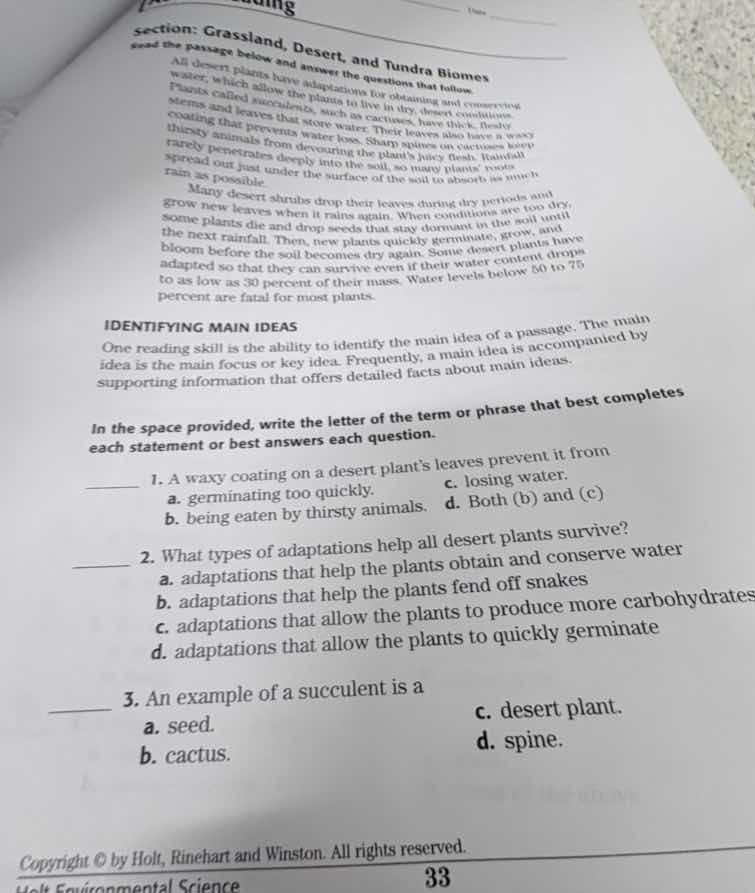
section: grassland, desert, and tundra biomes
read the passage below and answer the questions that follow.
all desert plants have adaptations for obtaining and conserving water, which allow the plants to live in dry, desert conditions. plants called succulents, such as cacti, have thick, fleshy stems and leaves that store water. their leaves also have a waxy coating that prevents water loss. sharp spines on cacti keep thirsty animals from devouring the plants juicy flesh. rainfall rarely penetrates deeply into the soil, so many plants roots spread out just under the surface of the soil to absorb as much rain as possible.
many desert shrubs drop their leaves during dry periods and grow new leaves when it rains again. when conditions are too dry, some plants die and drop seeds that stay dormant in the soil until the next rainfall. then, new plants quickly germinate, grow, and bloom before the soil becomes dry again. some desert plants have adapted so that they can survive even if their water content drops to as low as 30 percent of their mass. water levels below 50 to 75 percent are fatal for most plants.
identifying main ideas
one reading skill is the ability to identify the main idea of a passage. the main idea is the main focus or key idea. frequently, a main idea is accompanied by supporting information that offers detailed facts about main ideas.
in the space provided, write the letter of the term or phrase that best completes each statement or best answers each question.
- a waxy coating on a desert plants leaves prevent it from
a. germinating too quickly.
b. being eaten by thirsty animals.
c. losing water.
d. both (b) and (c)
- what types of adaptations help all desert plants survive?
a. adaptations that help the plants obtain and conserve water
b. adaptations that help the plants fend off snakes
c. adaptations that allow the plants to produce more carbohydrates
d. adaptations that allow the plants to quickly germinate
- an example of a succulent is a
a. seed.
b. cactus.
c. desert plant.
d. spine.
Analyze Question 1
The passage states: "Their leaves also have a waxy coating that prevents water loss." It also mentions: "Sharp spines on cactuses keep thirsty animals from devouring the plant's juicy flesh." Therefore, the waxy coating specifically prevents water loss, which corresponds to option (c).
Analyze Question 2
The passage states: "All desert plants have adaptations for obtaining and conserving water, which allow the plants to live in dry, desert conditions." This directly matches option (a).
Analyze Question 3
The passage states: "Plants called succulents, such as cactuses, have thick, fleshy stems and leaves that store water." This identifies a cactus as an example of a succulent, which corresponds to option (b).

Snap & solve any problem in the app
Get step-by-step solutions on Sovi AI
Photo-based solutions with guided steps
Explore more problems and detailed explanations
Question 1
- a. germinating too quickly.
- b. being eaten by thirsty animals.
- c. losing water. (Correct answer)
- d. Both (b) and (c)
Question 2
- a. adaptations that help the plants obtain and conserve water (Correct answer)
- b. adaptations that help the plants fend off snakes
- c. adaptations that allow the plants to produce more carbohydrates
- d. adaptations that allow the plants to quickly germinate
Question 3
- a. seed.
- b. cactus. (Correct answer)
- c. desert plant.
- d. spine.