QUESTION IMAGE
Question
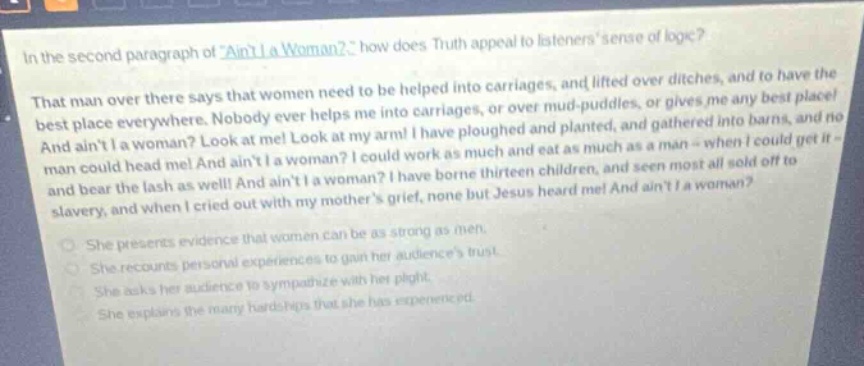
in the second paragraph of \aint i a woman?\, how does truth appeal to listeners sense of logic?
that man over there says that women need to be helped into carriages, and lifted over ditches, and to have the best place everywhere. nobody ever helps me into carriages, or over mud-puddles, or gives me any best place! and aint i a woman? look at me! look at my arm! i have ploughed and planted, and gathered into barns, and no man could head me! and aint i a woman? i could work as much and eat as much as a man - when i could get it - and bear the lash as well! and aint i a woman? i have borne thirteen children, and seen most all sold off to slavery, and when i cried out with my mothers grief, none but jesus heard me! and aint i a woman?
- she presents evidence that women can be as strong as men.
- she recounts personal experiences to gain her audiences trust.
- she asks her audience to sympathize with her plight.
- she explains the many hardships that she has experienced.
🆕 New Concept Discovered: Rhetorical Appeals (Logos, Pathos, Ethos)
Using logic and evidence to persuade an audience.
Step 1: Understand the Question
The question asks how Sojourner Truth appeals to the listeners' sense of logic (also known as logos) in the second paragraph of her speech, "Ain't I a Woman?".
An appeal to logic relies on rational arguments, evidence, and counterarguments to prove a point.
Step 2: Analyze the Text
Let's look at the structure of Truth's argument in this paragraph:
- The Opposing Claim: She starts by pointing out what men claim about women: "That man over there says that women need to be helped into carriages, and lifted over ditches, and to have the best place everywhere."
- The Counter-Evidence: She provides direct, physical evidence from her own life to disprove this claim: "Look at me! Look at my arm! I have ploughed and planted, and gathered into barns, and no man could head me!" and "I could work as much and eat as much as a man..."
- The Logical Conclusion: By showing that she (a woman) can perform the same physical labor as any man, she logically refutes the premise that women are inherently weaker and need special, delicate treatment.
Therefore, she appeals to logic by presenting concrete evidence that women can be as strong as men.
Step 3: Evaluate the Options
- Option 1: "She presents evidence that women can be as strong as men."
- Why it's correct: This directly addresses the logical appeal (logos). She uses her own physical capabilities as empirical proof to dismantle the argument that women are too weak to have equal rights.
- Option 2: "She recounts personal experiences to gain her audience's trust."
- Why it's incorrect: Gaining trust is an appeal to credibility (ethos), not primarily an appeal to logic.
- Option 3: "She asks her audience to sympathize with her plight."
- Why it's incorrect: Appealing to sympathy and emotion is an appeal to emotion (pathos), not logic.
- Option 4: "She explains the many hardships that she has experienced."
- Why it's incorrect: While she mentions hardships (like slavery and losing her children), describing hardships on its own is meant to evoke sadness and empathy (pathos), rather than serving as a direct logical proof of equality in physical capability.

Snap & solve any problem in the app
Get step-by-step solutions on Sovi AI
Photo-based solutions with guided steps
Explore more problems and detailed explanations
She presents evidence that women can be as strong as men.