QUESTION IMAGE
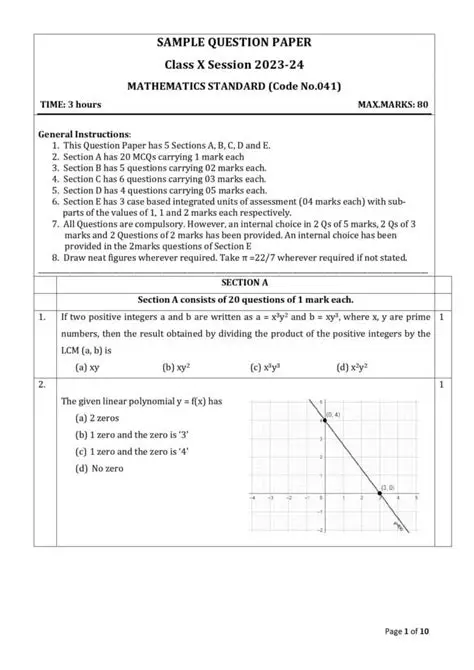
Question
sample question paper
class x session 2023-24
mathematics standard (code no.041)
time: 3 hours
max.marks: 80
general instructions:
- this question paper has 5 sections a, b, c, d and e.
- section a has 20 mcqs carrying 1 mark each
- section b has 5 questions carrying 02 marks each.
- section c has 6 questions carrying 03 marks each.
- section d has 4 questions carrying 05 marks each.
- section e has 3 case based integrated units of assessment (04 marks each) with sub-parts of the values of 1, 1 and 2 marks each respectively.
- all questions are compulsory. however, an internal choice in 2 qs of 5 marks, 2 qs of 3 marks and 2 questions of 2 marks has been provided. an internal choice has been provided in the 2marks questions of section e
- draw neat figures wherever required. take \pi = 22/7 wherever required if not stated.
section a
section a consists of 20 questions of 1 mark each.
- if two positive integers a and b are written as \\(a = x^3y^2\\) and \\(b = xy^3\\), where x, y are prime numbers, then the result obtained by dividing the product of the positive integers by the \\(\text{lcm}(a, b)\\) is
(a) \\(xy\\)
(b) \\(xy^2\\)
(c) \\(x^3y^3\\)
(d) \\(x^2y^2\\)
- the given linear polynomial \\(y = f(x)\\) has
(a) 2 zeros
(b) 1 zero and the zero is 3
(c) 1 zero and the zero is 4
(d) no zero
🆕 New Concept Discovered: Fundamental Property of LCM and HCF
Finding LCM and HCF using prime factorization
Step 1: Identify the given values
We are given two positive integers \(a\) and \(b\) expressed in terms of their prime factors \(x\) and \(y\):
We need to find the result of dividing the product of these two integers, \(a \cdot b\), by their Least Common Multiple, \(\text{LCM}(a, b)\).
Step 2: Find the LCM of \(a\) and \(b\)
To find the \(\text{LCM}\) of two numbers expressed as products of prime factors, we take the highest power of each prime factor present in the expressions:
- For the prime factor \(x\), the powers are \(x^3\) and \(x^1\). The highest power is \(x^3\).
- For the prime factor \(y\), the powers are \(y^2\) and \(y^3\). The highest power is \(y^3\).
Therefore:
Step 3: Calculate the product of \(a\) and \(b\)
Multiply the two expressions together:
Step 4: Divide the product by the LCM
Now, divide the product \(a \cdot b\) by \(\text{LCM}(a, b)\):
Using the laws of exponents, subtract the powers of like bases:
(Note: Alternatively, using the fundamental property \(\text{HCF}(a, b) \cdot \text{LCM}(a, b) = a \cdot b\), we know that \(\frac{a \cdot b}{\text{LCM}(a, b)} = \text{HCF}(a, b)\). The \(\text{HCF}\) is found by taking the lowest power of each common prime factor, which gives \(x^1 y^2 = xy^2\).)

Snap & solve any problem in the app
Get step-by-step solutions on Sovi AI
Photo-based solutions with guided steps
Explore more problems and detailed explanations
(b) \(xy^2\)