QUESTION IMAGE
Question
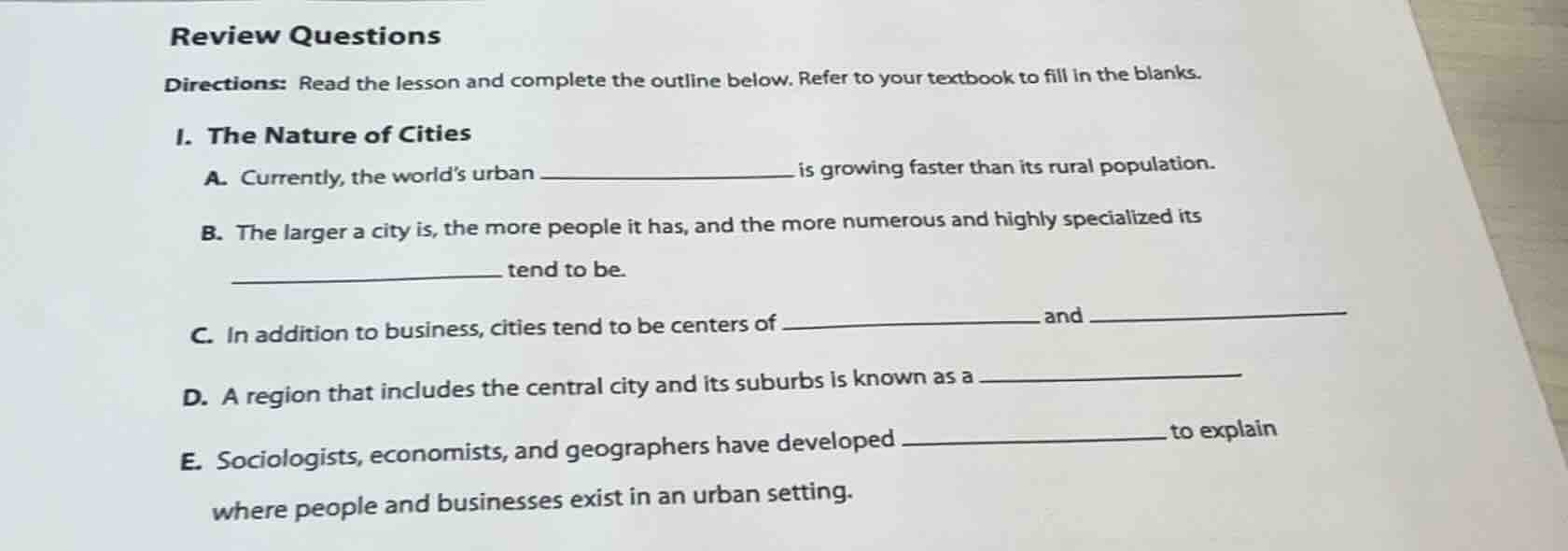
review questions
directions: read the lesson and complete the outline below. refer to your textbook to fill in the blanks.
i. the nature of cities
a. currently, the worlds urban ____________________ is growing faster than its rural population.
b. the larger a city is, the more people it has, and the more numerous and highly specialized its ____________________ tend to be.
c. in addition to business, cities tend to be centers of __________________ and __________________.
d. a region that includes the central city and its suburbs is known as a ____________________.
e. sociologists, economists, and geographers have developed ____________________ to explain where people and businesses exist in an urban setting.
Analyze urban population growth
The first statement compares the growth of the world's urban population to its rural population. In Human Geography, the process of global population shifting from rural to urban areas is a core trend. The term that completes "world's urban ________ is growing faster" is "population".
Identify urban specialization
The second statement describes how larger cities function. As cities grow in size and population, their economic activities, services, and functions become more diverse and specialized. The term that completes "highly specialized its ________ tend to be" is "functions" (or "services").
Determine urban cultural and political roles
The third statement looks at the non-business roles of cities. Historically and structurally, cities serve as major hubs for social, cultural, and political activities. The blanks "centers of ______ and ______" are completed by "culture" and "politics" (or "government").
Define metropolitan regions
The fourth statement defines the functional region consisting of a central city and its surrounding suburbs. In urban geography, this integrated economic and social region is known as a "metropolitan area".
Identify spatial organization theories
The fifth statement refers to the conceptual frameworks developed by social scientists to explain the spatial layout of cities (such as the concentric zone, sector, and multiple nuclei models). These frameworks are called "models" (or "urban models").

Snap & solve any problem in the app
Get step-by-step solutions on Sovi AI
Photo-based solutions with guided steps
Explore more problems and detailed explanations
Question 1
A. Currently, the world's urban <blank>population</blank> is growing faster than its rural population.
Question 2
B. The larger a city is, the more people it has, and the more numerous and highly specialized its <blank>functions</blank> tend to be.
Question 3
C. In addition to business, cities tend to be centers of <blank>culture</blank> and <blank>politics</blank>.
Question 4
D. A region that includes the central city and its suburbs is known as a <blank>metropolitan area</blank>.
Question 5
E. Sociologists, economists, and geographers have developed <blank>models</blank> to explain where people and businesses exist in an urban setting.