QUESTION IMAGE
Question
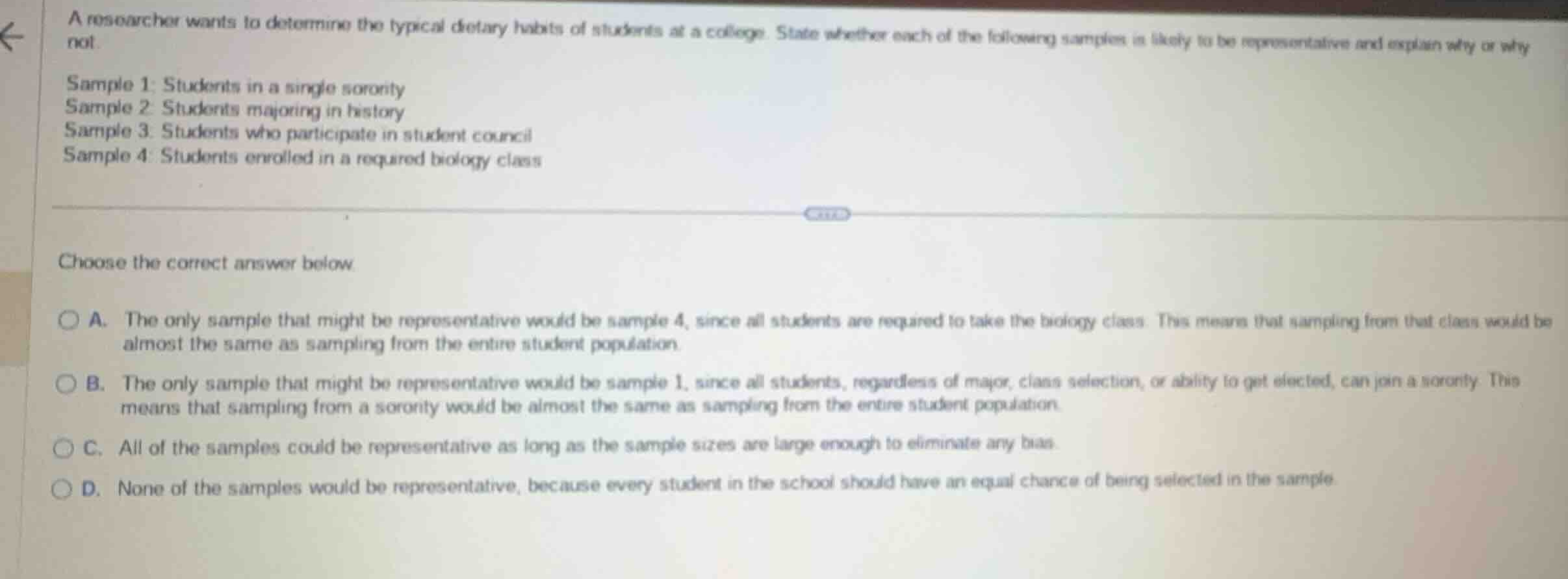
a researcher wants to determine the typical dietary habits of students at a college. state whether each of the following samples is likely to be representative and explain why or why not.
sample 1: students in a single sorority
sample 2: students majoring in history
sample 3: students who participate in student council
sample 4: students enrolled in a required biology class
choose the correct answer below.
a. the only sample that might be representative would be sample 4, since all students are required to take the biology class. this means that sampling from that class would be almost the same as sampling from the entire student population.
b. the only sample that might be representative would be sample 1, since all students, regardless of major, class selection, or ability to get elected, can join a sorority. this means that sampling from a sorority would be almost the same as sampling from the entire student population.
c. all of the samples could be representative as long as the sample sizes are large enough to eliminate any bias.
d. none of the samples would be representative, because every student in the school should have an equal chance of being selected in the sample.
Analyze the target population and samples
Target population: All students at a college.
- Sample 1 (sorority): Biased toward a specific social group (mostly female, shared living/eating habits).
- Sample 2 (history majors): Biased toward a specific academic interest.
- Sample 3 (student council): Biased toward highly active, leadership-oriented students.
- Sample 4 (required biology class): Since it is a required class for all students, it contains a diverse cross-section of the entire student body, making it the most representative.
Evaluate the given options
- Option A: Correctly identifies Sample 4 as representative because it is a required class, making it highly similar to sampling from the entire student population.
- Option B: Incorrectly claims anyone can join a sorority and that Sample 1 is representative.
- Option C: Incorrectly claims large sample size alone eliminates selection bias.
- Option D: Incorrectly claims none are representative.

Snap & solve any problem in the app
Get step-by-step solutions on Sovi AI
Photo-based solutions with guided steps
Explore more problems and detailed explanations
- (A) The only sample that might be representative would be sample 4, since all students are required to take the biology class. This means that sampling from that class would be almost the same as sampling from the entire student population. (Correct answer)
- (B) The only sample that might be representative would be sample 1, since all students, regardless of major, class selection, or ability to get elected, can join a sorority. This means that sampling from a sorority would be almost the same as sampling from the entire student population.
- (C) All of the samples could be representative as long as the sample sizes are large enough to eliminate any bias.
- (D) None of the samples would be representative, because every student in the school should have an equal chance of being selected in the sample.