QUESTION IMAGE
Question
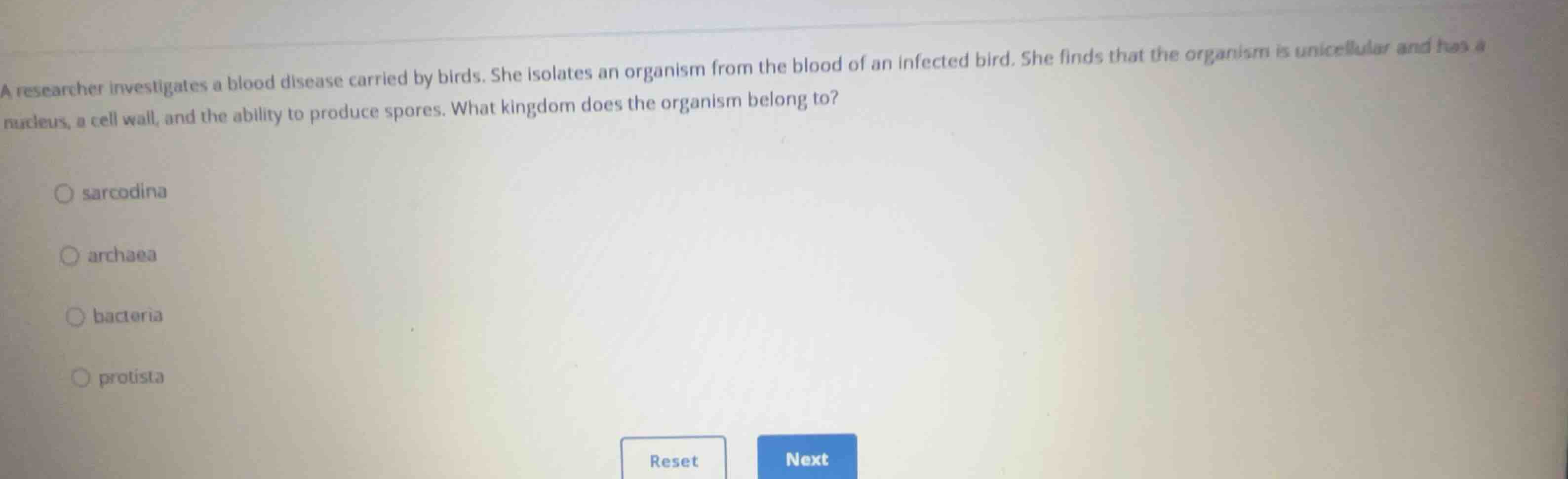
a researcher investigates a blood disease carried by birds. she isolates an organism from the blood of an infected bird. she finds that the organism is unicellular and has a nucleus, a cell wall, and the ability to produce spores. what kingdom does the organism belong to?
sarcodina
archaea
bacteria
protista
Analyze the organism's characteristics
The problem describes an organism isolated from the blood of an infected bird with the following characteristics:
- Unicellular (single-celled)
- Has a nucleus (eukaryotic)
- Has a cell wall
- Has the ability to produce spores
Evaluate the taxonomic domains and kingdoms
Let's evaluate the given options based on these biological characteristics:
- archaea: These are prokaryotic organisms, meaning they lack a membrane-bound nucleus. This contradicts the finding of a nucleus.
- bacteria: These are also prokaryotic organisms and lack a nucleus. This contradicts the finding of a nucleus.
- sarcodina: This is a subphylum/group of amoeboid protists (within the kingdom Protista) that typically lack a rigid cell wall and do not typically form spores in this context.
- protista: This kingdom includes unicellular eukaryotic organisms. Many unicellular eukaryotes with cell walls and spore-producing capabilities (such as certain unicellular algae, slime molds, or parasitic protozoans/sporozoans) are classified under the kingdom Protista.
Determine the correct kingdom
Since the organism is unicellular and eukaryotic (has a nucleus), it cannot belong to the prokaryotic domains/kingdoms (Bacteria or Archaea). Among the eukaryotic options, "protista" is the correct kingdom classification for a unicellular eukaryote with these features.

Snap & solve any problem in the app
Get step-by-step solutions on Sovi AI
Photo-based solutions with guided steps
Explore more problems and detailed explanations
- sarcodina
- archaea
- bacteria
- protista (Correct answer)