QUESTION IMAGE
Question
remarks on the signing of the civil rights act
by lyndon b. johnson
on july 2, 1964, president lyndon b. johnson signed into law the civil rights act of 1964. in his speech, johnson pointed to the nations founding principles in the declaration of independence and the constitution as inspiration for his remarks and the new laws significance.
(1) my fellow americans, i am about to sign into law the civil rights act of 1964.
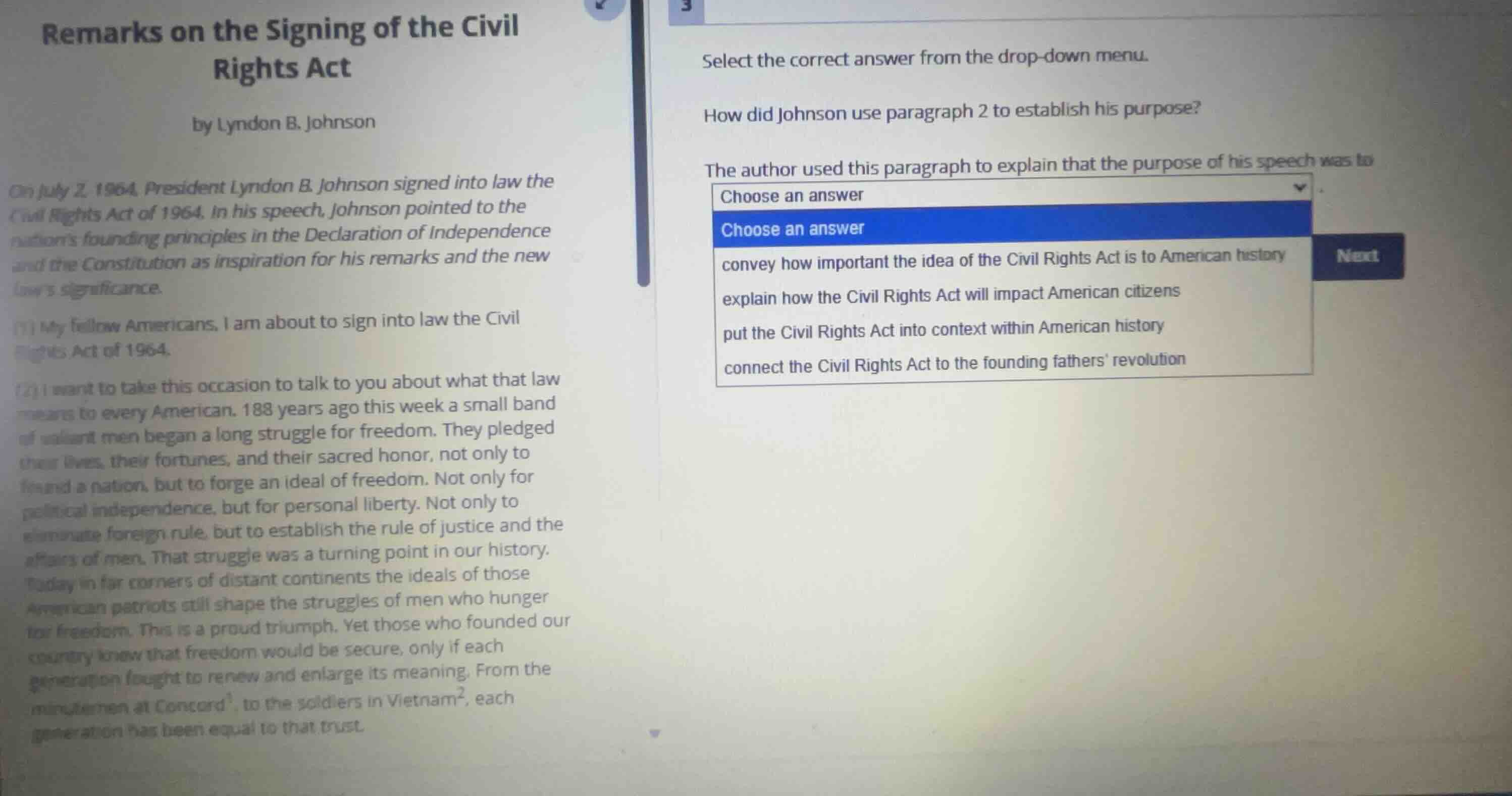
(2) i want to take this occasion to talk to you about what that law means to every american. 188 years ago this week a small band of valiant men began a long struggle for freedom. they pledged their lives, their fortunes, and their sacred honor, not only to found a nation, but to forge an ideal of freedom. not only for political independence, but for personal liberty. not only to eliminate foreign rule, but to establish the rule of justice and the affairs of men. that struggle was a turning point in our history. today in far corners of distant continents the ideals of those american patriots still shape the struggles of men who hunger for freedom. this is a proud triumph. yet those who founded our country knew that freedom would be secure, only if each generation fought to renew and enlarge its meaning. from the minutemen at concord, to the soldiers in vietnam, each generation has been equal to that trust.
select the correct answer from the drop-down menu.
how did johnson use paragraph 2 to establish his purpose?
the author used this paragraph to explain that the purpose of his speech was to
choose an answer
- convey how important the idea of the civil rights act is to american history
- explain how the civil rights act will impact american citizens
- put the civil rights act into context within american history
- connect the civil rights act to the founding fathers revolution
Analyze the prompt and paragraph 2
Using the Rhetorical Purpose Analysis knowledge point
The question asks how President Lyndon B. Johnson uses paragraph 2 to establish his purpose. Paragraph 2 begins by referencing "188 years ago this week" when "a small band of valiant men began a long struggle for freedom." It traces this struggle from the founding of the nation, through various generations, up to "the minutemen at Concord" and "the soldiers in Vietnam," stating that "each generation has been equal to that trust."
Evaluate the options based on textual evidence
Using the Textual Evidence Analysis knowledge point
- Option 1 ("convey how important the idea of the Civil Rights Act is to American history"): While the speech relates the Act to history, the specific rhetorical function of paragraph 2 is to place the current struggle and the Act within the continuous historical timeline of American struggles for freedom.
- Option 2 ("explain how the Civil Rights Act will impact American citizens"): Paragraph 2 does not detail the specific legal or social impacts of the Act on individual citizens.
- Option 3 ("put the Civil Rights Act into context within American history"): This matches perfectly. By starting 188 years ago and tracing the struggle for freedom through the founding fathers, Concord, and Vietnam, Johnson frames the Civil Rights Act as the latest step in a long, continuous historical journey toward securing liberty.
- Option 4 ("connect the Civil Rights Act to the founding fathers' revolution"): While it mentions the founders, the paragraph goes far beyond them to include multiple generations up to Vietnam, making "context within American history" the more accurate and comprehensive description.

Snap & solve any problem in the app
Get step-by-step solutions on Sovi AI
Photo-based solutions with guided steps
Explore more problems and detailed explanations
- convey how important the idea of the Civil Rights Act is to American history
- explain how the Civil Rights Act will impact American citizens
- put the Civil Rights Act into context within American history (Correct answer)
- connect the Civil Rights Act to the founding fathers' revolution