QUESTION IMAGE
Question
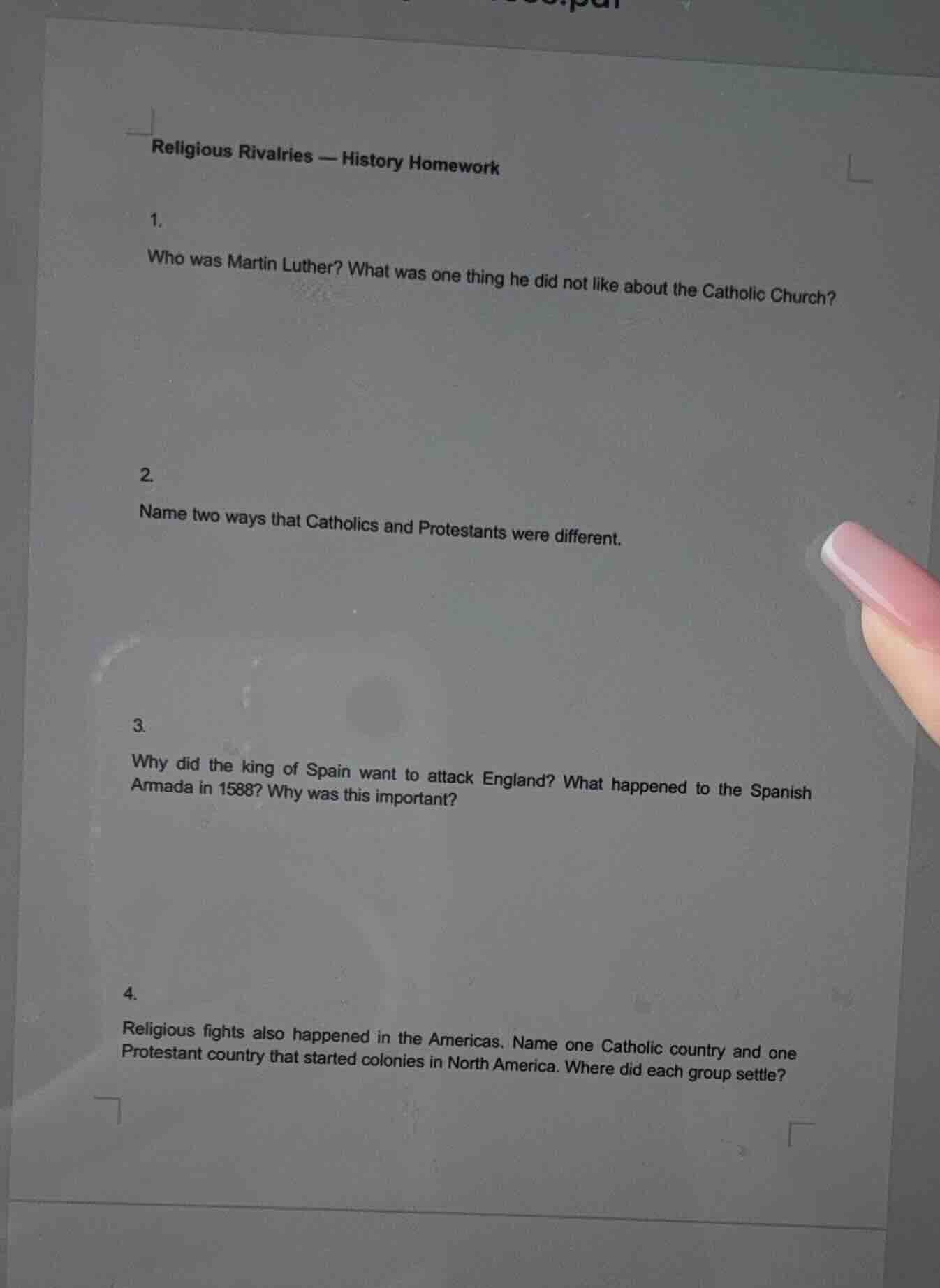
religious rivalries - history homework
- who was martin luther? what was one thing he did not like about the catholic church?
- name two ways that catholics and protestants were different.
- why did the king of spain want to attack england? what happened to the spanish armada in 1588? why was this important?
- religious fights also happened in the americas. name one catholic country and one protestant country that started colonies in north america. where did each group settle?
Identify Martin Luther and his criticisms
Martin Luther was a German monk and theology professor who initiated the Protestant Reformation in 1517 by publishing his Ninety-Five Theses. One major practice he strongly opposed was the sale of indulgences, which were certificates sold by the Catholic Church that promised to reduce a soul's punishment in purgatory for sins.
Compare Catholics and Protestants
During the Reformation, key theological and structural differences emerged between the two groups:
- Authority: Catholics believe the Pope is the supreme head of the Church on Earth, whereas Protestants reject papal authority and believe the Bible is the sole source of religious truth.
- Salvation: Catholicism teaches that salvation is achieved through faith combined with good works and participation in the sacraments, while Protestantism teaches that salvation is achieved through faith alone (sola fide).
Analyze the Spanish Armada conflict
- Reason for attack: King Philip II of Spain, a devout Catholic, wanted to overthrow the Protestant Queen Elizabeth I of England, restore Catholicism to England, and stop English privateers from raiding Spanish treasure ships.
- What happened: In 1588, the Spanish Armada sailed to invade England but was defeated by the faster, more maneuverable English ships and devastated by severe storms (the "Protestant Wind") in the North Sea.
- Importance: The defeat of the Armada marked the decline of Spain's naval supremacy and established England as a major global naval power, securing Protestantism in England.
Examine religious colonization in the Americas
- Catholic Country: France (or Spain). France established colonies in North America, settling primarily in New France (modern-day Canada, along the St. Lawrence River, and the Great Lakes/Mississippi River valley).
- Protestant Country: England. England established colonies along the Atlantic coast of North America (such as Jamestown in Virginia and the Plymouth/Massachusetts Bay colonies in New England).

Snap & solve any problem in the app
Get step-by-step solutions on Sovi AI
Photo-based solutions with guided steps
Explore more problems and detailed explanations
Question 1
Martin Luther was a German monk and theologian who started the Protestant Reformation in the early 16th century. One major thing he did not like about the Catholic Church was the sale of indulgences, which were certificates sold to forgive sins and reduce time in purgatory.
Question 2
Two ways that Catholics and Protestants were different are:
- Authority: Catholics recognize the Pope as the supreme leader of the Church, while Protestants reject the Pope's authority and believe the Bible is the ultimate authority on faith.
- Salvation: Catholics believe salvation is achieved through faith and good works, whereas Protestants believe salvation is achieved through faith alone.
Question 3
- Why Spain wanted to attack: King Philip II of Spain wanted to overthrow the Protestant Queen Elizabeth I, restore Catholicism to England, and stop English ships from raiding Spanish treasure fleets.
- What happened: In 1588, the Spanish Armada was defeated by the smaller, faster English navy and further destroyed by powerful storms as they attempted to retreat.
- Why it was important: It weakened Spain's dominance as a global superpower, established England as a major naval power, and ensured that England remained Protestant.
Question 4
- Catholic Country: France started colonies in North America and settled primarily in eastern Canada (along the St. Lawrence River) and the Mississippi River valley.
- Protestant Country: England started colonies in North America and settled along the eastern Atlantic coast (such as Virginia and New England).