QUESTION IMAGE
Question
related questions: lesson 5: inequalities
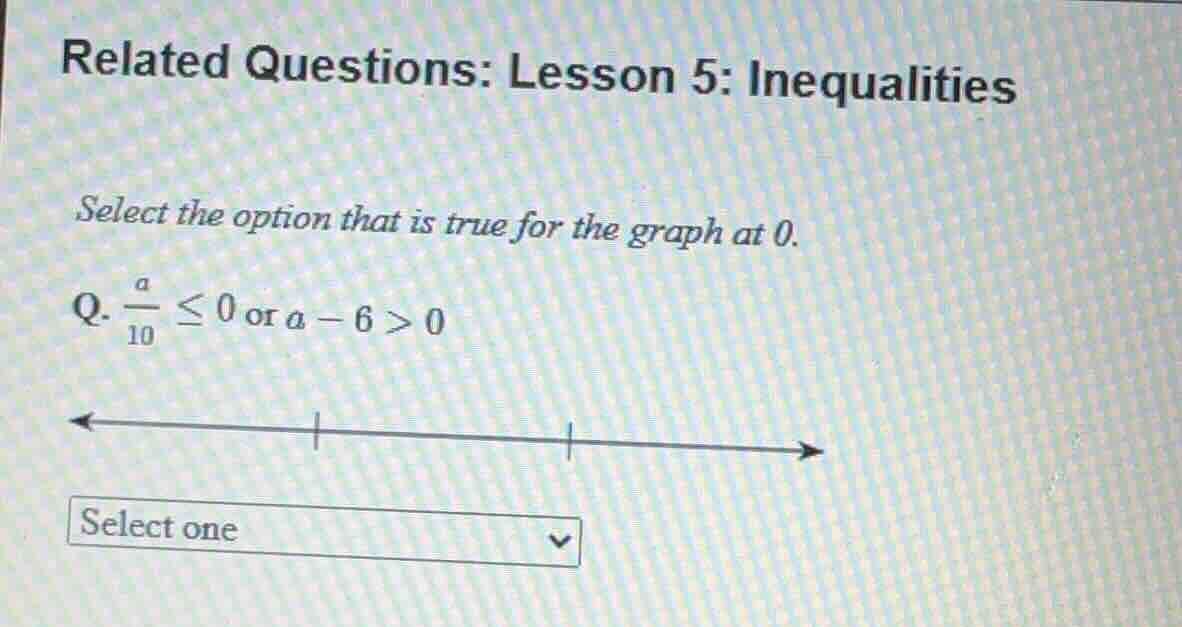
select the option that is true for the graph at 0.
q. \\(\frac{a}{10} \le 0\\) or \\(a - 6 > 0\\)
Solve the individual inequalities
We solve each part of the compound inequality separately.
First inequality:
Multiply both sides by \(10\):
Second inequality:
Add \(6\) to both sides:
Combine using the "or" logical operator
Using the Compound Inequalities knowledge point, the word "or" represents the union of the two solution sets.
The combined solution set is:
Analyze the graph at 0
Using the Graphing Compound Inequalities knowledge point, we determine the behavior of the graph at \(a = 0\).
The inequality \(a \le 0\) includes the value \(0\) because of the "less than or equal to" symbol (\(\le\)).
Therefore, at \(a = 0\), there should be a solid (closed) circle, and the line should be shaded to the left (towards negative infinity).
Determine the true statement
Since \(a = 0\) is a solution to the inequality \(a \le 0\), the statement "the graph has a closed circle at 0" or "the graph is shaded at 0" is true.
Specifically, for the boundary point \(0\):
- It uses a solid/closed circle because of the \(\le\) sign.
- The shading goes to the left of \(0\).

Snap & solve any problem in the app
Get step-by-step solutions on Sovi AI
Photo-based solutions with guided steps
Explore more problems and detailed explanations
The inequality simplifies to \(a \le 0\) or \(a > 6\).
For the graph at \(0\):
- There is a closed (solid) circle at \(0\).
- The number line is shaded to the left of \(0\).