QUESTION IMAGE
Question
3 - reinforcement and behavioral change
learning objective: apply the four strategies to use for behavioral change.
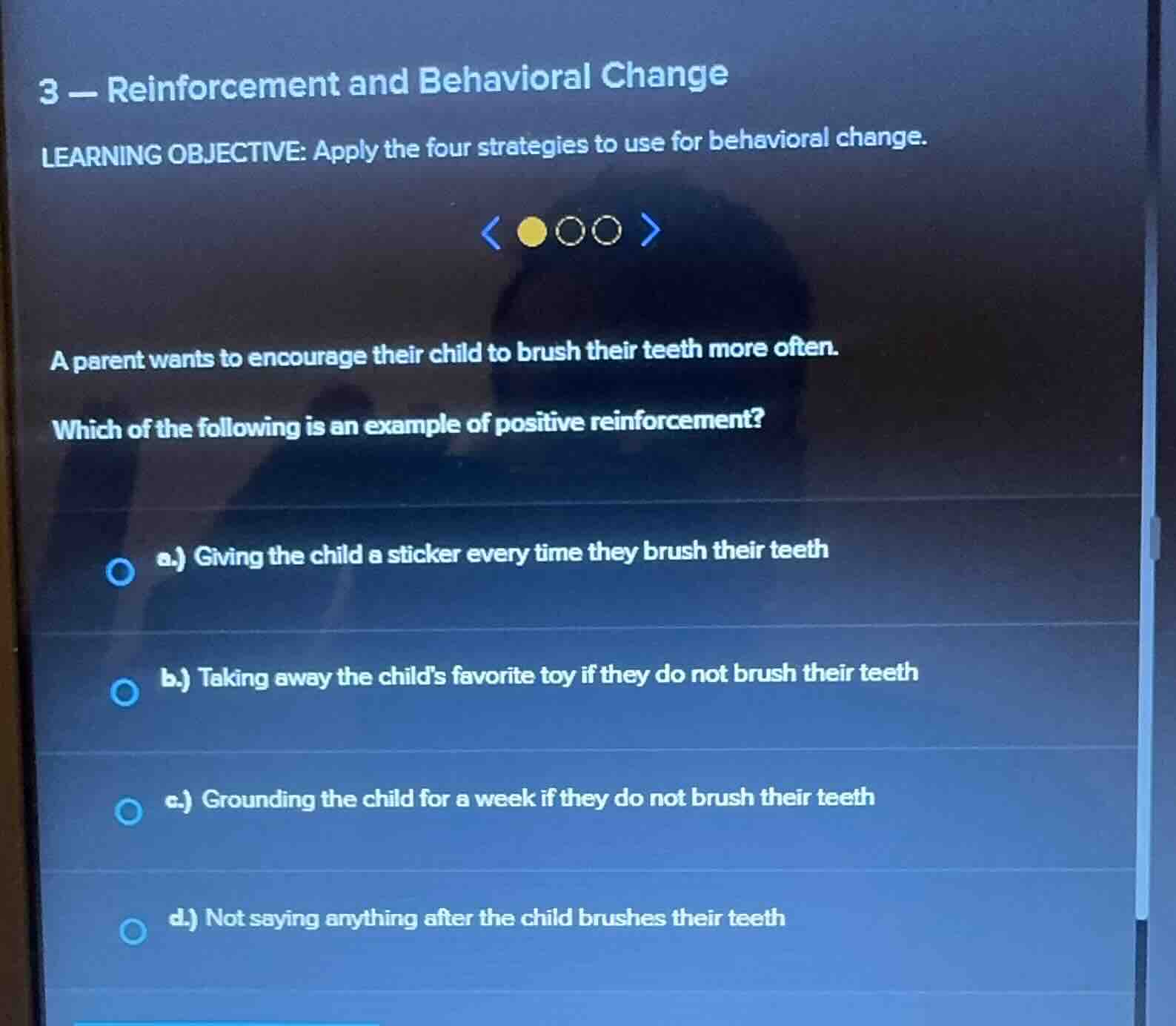
a parent wants to encourage their child to brush their teeth more often.
which of the following is an example of positive reinforcement?
a.) giving the child a sticker every time they brush their teeth
b.) taking away the childs favorite toy if they do not brush their teeth
c.) grounding the child for a week if they do not brush their teeth
d.) not saying anything after the child brushes their teeth
Define positive reinforcement
Using the Operant Conditioning knowledge point, positive reinforcement involves adding a desirable stimulus immediately following a target behavior to increase the likelihood that the behavior will be repeated in the future.
Analyze the given scenario
The parent's goal is to increase the frequency of the target behavior: brushing teeth more often. To use positive reinforcement, the parent must introduce a pleasant or rewarding stimulus (a positive reinforcer) whenever the child performs this behavior.
Evaluate the answer choices
- Option a: Giving a sticker (adding a desirable stimulus) when the child brushes their teeth (target behavior) directly fits the definition of positive reinforcement.
- Option b: Taking away a favorite toy (removing a desirable stimulus) is a form of negative punishment designed to decrease an undesired behavior (not brushing).
- Option c: Grounding the child (adding an undesirable stimulus) is a form of positive punishment designed to decrease an undesired behavior.
- Option d: Not saying anything represents extinction, which does not actively reinforce the behavior.

Snap & solve any problem in the app
Get step-by-step solutions on Sovi AI
Photo-based solutions with guided steps
Explore more problems and detailed explanations
- a.) Giving the child a sticker every time they brush their teeth (Correct answer)
- b.) Taking away the child's favorite toy if they do not brush their teeth
- c.) Grounding the child for a week if they do not brush their teeth
- d.) Not saying anything after the child brushes their teeth