QUESTION IMAGE
Question
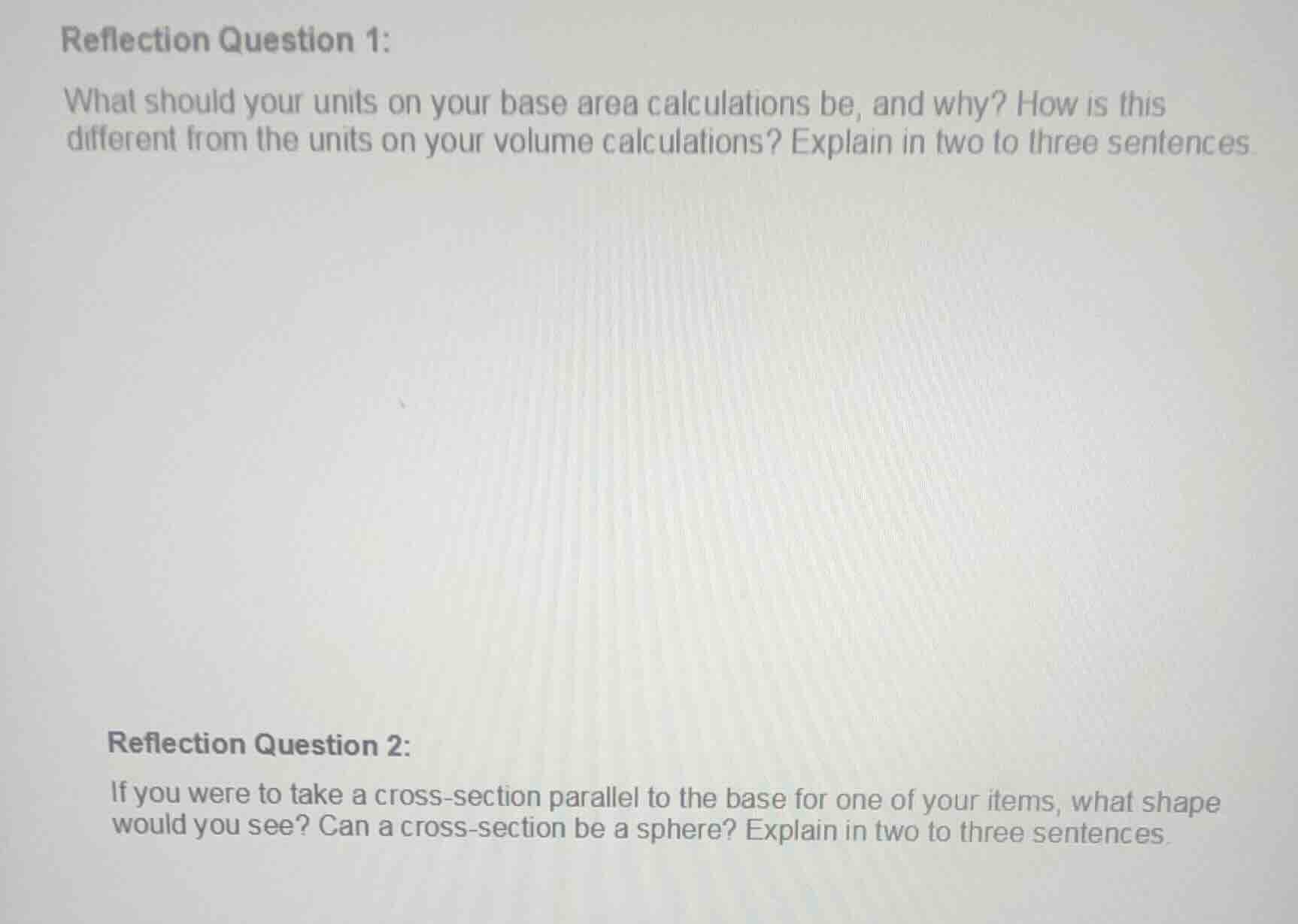
reflection question 1:
what should your units on your base area calculations be, and why? how is this different from the units on your volume calculations? explain in two to three sentences.
reflection question 2:
if you were to take a cross-section parallel to the base for one of your items, what shape would you see? can a cross-section be a sphere? explain in two to three sentences.
Analyze units for area and volume
The first question asks about the units for base area calculations versus volume calculations. Area measures a two-dimensional region, which is calculated by multiplying two linear dimensions, resulting in square units (e.g., \(\text{cm}^2\) or \(\text{in}^2\)). In contrast, volume measures three-dimensional space, which is calculated by multiplying three linear dimensions, resulting in cubic units (e.g., \(\text{cm}^3\) or \(\text{in}^3\)).
Analyze cross-sections of 3D solids
The second question asks about the shape of a cross-section parallel to the base of a 3D item, and whether a cross-section itself can be a sphere.
- For standard geometric items like cylinders, cones, or prisms, a cross-section parallel to the base yields a 2D shape identical or similar to the base (such as a circle or polygon).
- A cross-section is a intersection of a plane with a solid, which is always a two-dimensional flat shape. Therefore, a cross-section can never be a sphere, because a sphere is a three-dimensional solid.

Snap & solve any problem in the app
Get step-by-step solutions on Sovi AI
Photo-based solutions with guided steps
Explore more problems and detailed explanations
Question 1
Your base area calculations should be in square units (such as \(\text{cm}^2\) or \(\text{in}^2\)) because area measures a two-dimensional surface. This is different from volume calculations, which must be in cubic units (such as \(\text{cm}^3\) or \(\text{in}^3\)) because volume measures three-dimensional space.
Question 2
If you take a cross-section parallel to the base of a cylinder or cone, you would see a circle (or a polygon if the item is a prism). A cross-section can never be a sphere because a cross-section is a flat, two-dimensional shape, whereas a sphere is a three-dimensional solid.