QUESTION IMAGE
Question
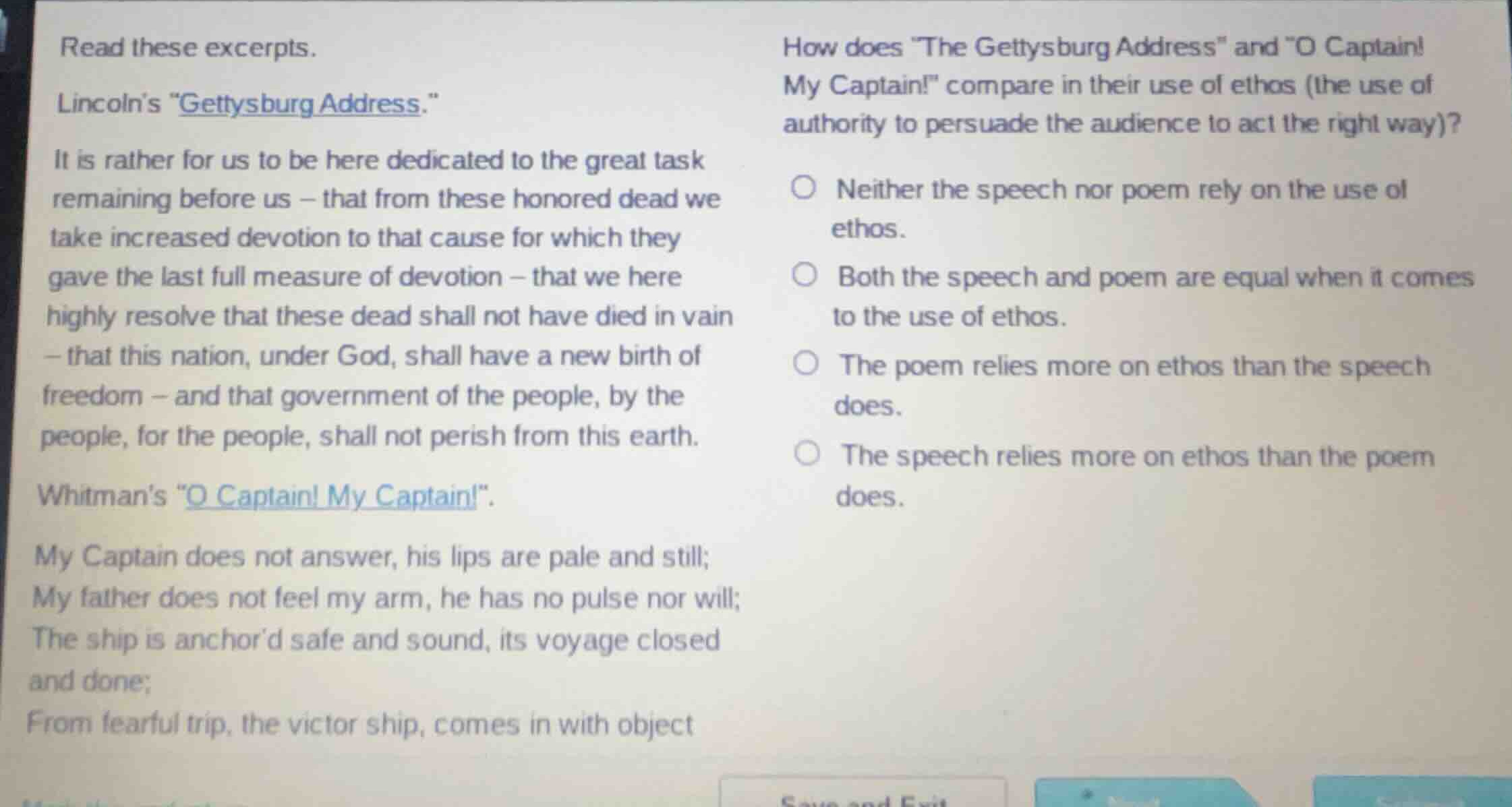
read these excerpts.
lincolns \gettysburg address.\
it is rather for us to be here dedicated to the great task remaining before us - that from these honored dead we take increased devotion to that cause for which they gave the last full measure of devotion - that we here highly resolve that these dead shall not have died in vain - that this nation, under god, shall have a new birth of freedom - and that government of the people, by the people, for the people, shall not perish from this earth.
whitmans \o captain! my captain!\.
my captain does not answer, his lips are pale and still;
my father does not feel my arm, he has no pulse nor will;
the ship is anchord safe and sound, its voyage closed and done;
from fearful trip, the victor ship, comes in with object
how does \the gettysburg address\ and \o captain! my captain!\ compare in their use of ethos (the use of authority to persuade the audience to act the right way)?
neither the speech nor poem rely on the use of ethos.
both the speech and poem are equal when it comes to the use of ethos.
the poem relies more on ethos than the speech does.
the speech relies more on ethos than the poem does.
Analyze the rhetorical purpose of the Gettysburg Address excerpt
The excerpt from Lincoln's "Gettysburg Address" is a formal speech designed to persuade the nation to continue fighting for a unified, free country. It relies heavily on ethos (the moral authority of the "honored dead" and the shared democratic values of "government of the people, by the people, for the people") to call the audience to action.
Analyze the rhetorical purpose of the "O Captain! My Captain!" excerpt
Walt Whitman's poem is an elegiac tribute mourning the death of Abraham Lincoln. It focuses on personal grief, emotional imagery ("lips are pale and still", "no pulse nor will"), and the sorrow of losing a leader. It relies primarily on pathos (emotional appeal) rather than ethos to persuade or call an audience to action.
Compare the use of ethos in both texts
Because the speech is a public address calling for collective moral dedication and political action, it relies much more heavily on ethos than the deeply personal, mourning-focused poem.

Snap & solve any problem in the app
Get step-by-step solutions on Sovi AI
Photo-based solutions with guided steps
Explore more problems and detailed explanations
- Neither the speech nor poem rely on the use of ethos.
- Both the speech and poem are equal when it comes to the use of ethos.
- The poem relies more on ethos than the speech does.
- The speech relies more on ethos than the poem does. (Correct answer)