QUESTION IMAGE
Question
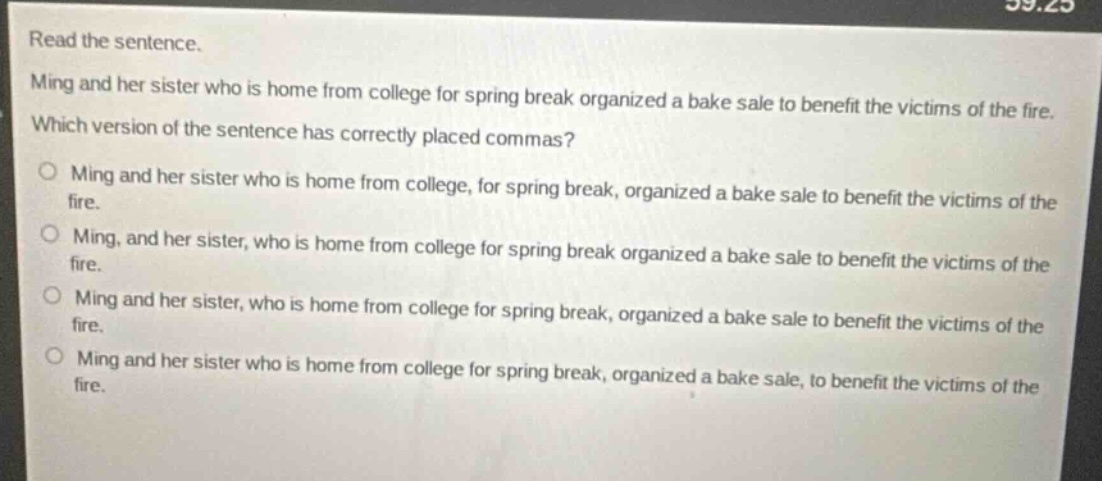
read the sentence.
ming and her sister who is home from college for spring break organized a bake sale to benefit the victims of the fire.
which version of the sentence has correctly placed commas?
ming and her sister who is home from college, for spring break, organized a bake sale to benefit the victims of the fire.
ming, and her sister, who is home from college for spring break organized a bake sale to benefit the victims of the fire.
ming and her sister, who is home from college for spring break, organized a bake sale to benefit the victims of the fire.
ming and her sister who is home from college for spring break, organized a bake sale, to benefit the victims of the fire.
🆕 New Concept Discovered: Nonrestrictive and Restrictive Clauses
Extra information gets set off by commas.
Step 1: Identify the core sentence and the extra information
The core message of the sentence is:
"Ming and her sister organized a bake sale to benefit the victims of the fire."
The phrase "who is home from college for spring break" provides extra, non-essential information about the sister. It is a nonrestrictive relative clause because removing it does not change the core meaning or identity of who organized the bake sale.
Step 2: Apply the rule for nonrestrictive clauses
Nonrestrictive clauses must be set off from the rest of the sentence using commas at both the beginning and the end of the clause:
- A comma must be placed right before the clause starts: after "sister".
- A comma must be placed right after the clause ends: after "break".
This gives us:
"Ming and her sister, who is home from college for spring break, organized a bake sale to benefit the victims of the fire."
Step 3: Evaluate the given options
- Option 1: Places commas around "for spring break", which incorrectly splits the relative clause.
- Option 2: Places a comma after "Ming" and fails to close the clause after "break".
- Option 3: Correctly places commas before "who" and after "break" to set off the entire nonrestrictive clause.
- Option 4: Fails to open the clause with a comma and incorrectly places a comma before "to benefit".

Snap & solve any problem in the app
Get step-by-step solutions on Sovi AI
Photo-based solutions with guided steps
Explore more problems and detailed explanations
Ming and her sister, who is home from college for spring break, organized a bake sale to benefit the victims of the fire.