QUESTION IMAGE
Question
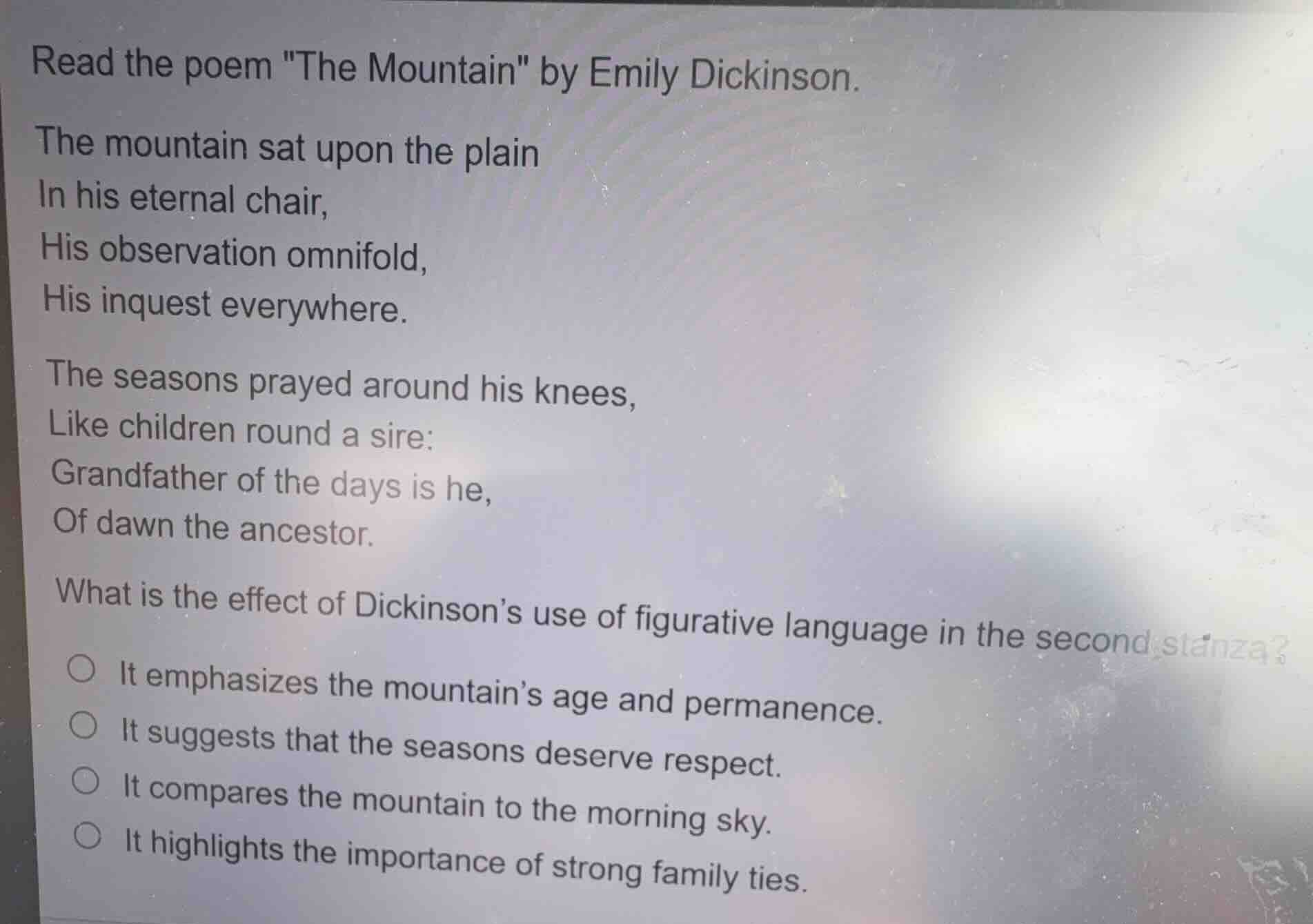
read the poem \the mountain\ by emily dickinson.
the mountain sat upon the plain
in his eternal chair,
his observation omnifold,
his inquest everywhere.
the seasons prayed around his knees,
like children round a sire:
grandfather of the days is he,
of dawn the ancestor.
what is the effect of dickinsons use of figurative language in the second stanza?
it emphasizes the mountains age and permanence.
it suggests that the seasons deserve respect.
it compares the mountain to the morning sky.
it highlights the importance of strong family ties.
Analyze the figurative language in the second stanza
The second stanza uses personification and simile: "The seasons prayed around his knees, / Like children round a sire: / Grandfather of the days is he, / Of dawn the ancestor."
Determine the effect of these literary devices
Describing the mountain as a "sire," "Grandfather of the days," and "Of dawn the ancestor" emphasizes its extreme age, timelessness, and enduring presence relative to the passing seasons.
Evaluate the given options
- Option 1 ("It emphasizes the mountain's age and permanence") directly aligns with terms like "Grandfather" and "ancestor" of time itself.
- Option 2 is incorrect because the focus is on the mountain's status, not the seasons.
- Option 3 is incorrect because the comparison to dawn ("Of dawn the ancestor") highlights age/origin rather than a direct visual comparison to the sky.
- Option 4 is incorrect because the familial terms are metaphorical personifications of nature, not a commentary on human family ties.

Snap & solve any problem in the app
Get step-by-step solutions on Sovi AI
Photo-based solutions with guided steps
Explore more problems and detailed explanations
- (A) It emphasizes the mountain’s age and permanence. (Correct answer)
- (B) It suggests that the seasons deserve respect.
- (C) It compares the mountain to the morning sky.
- (D) It highlights the importance of strong family ties.