QUESTION IMAGE
Question
read this passage.
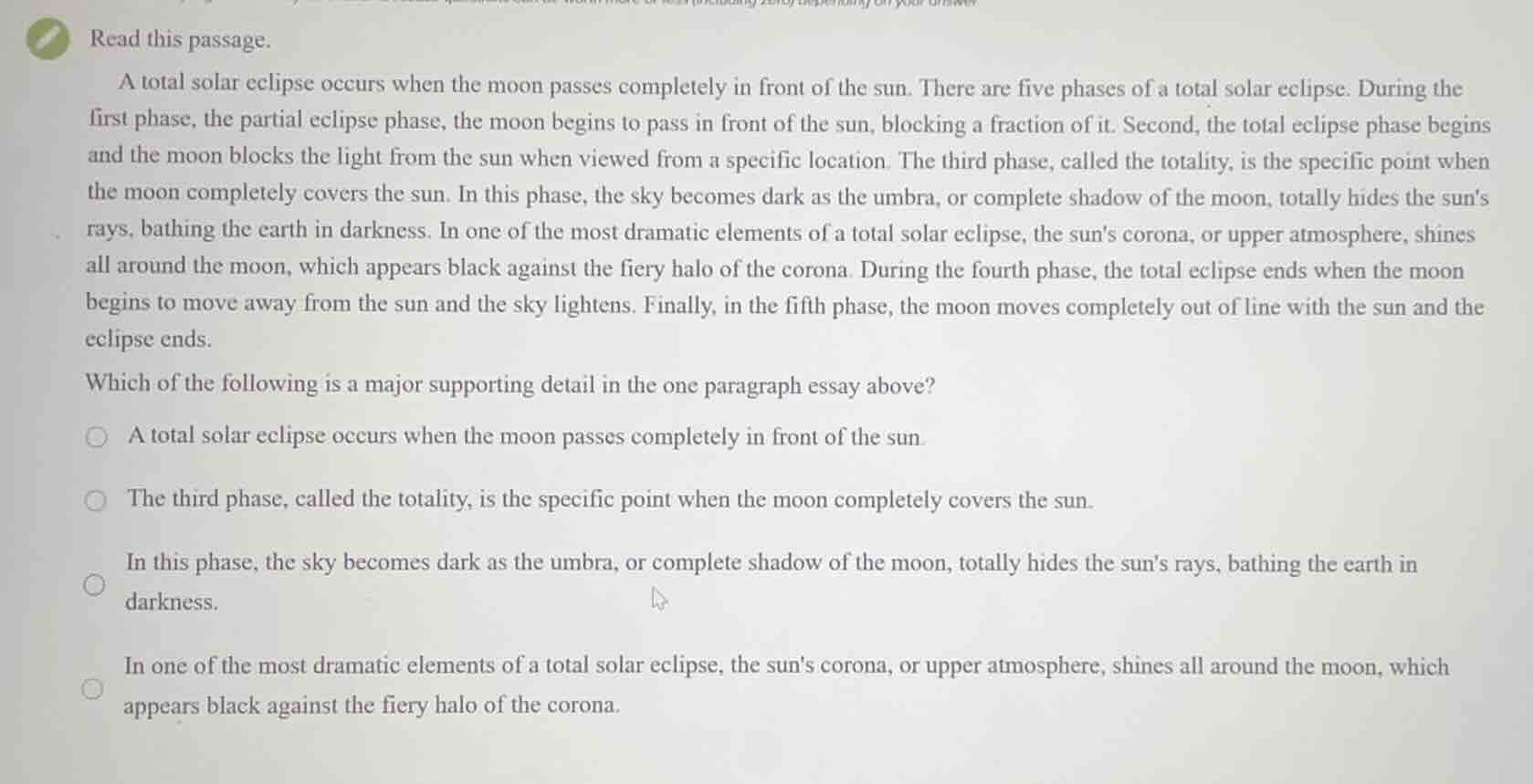
a total solar eclipse occurs when the moon passes completely in front of the sun. there are five phases of a total solar eclipse. during the first phase, the partial eclipse phase, the moon begins to pass in front of the sun, blocking a fraction of it. second, the total eclipse phase begins and the moon blocks the light from the sun when viewed from a specific location. the third phase, called the totality, is the specific point when the moon completely covers the sun. in this phase, the sky becomes dark as the umbra, or complete shadow of the moon, totally hides the suns rays, bathing the earth in darkness. in one of the most dramatic elements of a total solar eclipse, the suns corona, or upper atmosphere, shines all around the moon, which appears black against the fiery halo of the corona. during the fourth phase, the total eclipse ends when the moon begins to move away from the sun and the sky lightens. finally, in the fifth phase, the moon moves completely out of line with the sun and the eclipse ends.
which of the following is a major supporting detail in the one paragraph essay above?
a total solar eclipse occurs when the moon passes completely in front of the sun.
the third phase, called the totality, is the specific point when the moon completely covers the sun.
in this phase, the sky becomes dark as the umbra, or complete shadow of the moon, totally hides the suns rays, bathing the earth in darkness.
in one of the most dramatic elements of a total solar eclipse, the suns corona, or upper atmosphere, shines all around the moon, which appears black against the fiery halo of the corona.
Identify the main idea of the passage
The passage describes the five distinct phases of a total solar eclipse. The main idea is that a total solar eclipse consists of five sequential phases.
Distinguish major supporting details from minor details
Major supporting details directly support the main idea by outlining or defining these five phases. Minor details provide extra descriptions, definitions, or dramatic imagery within those phases (such as describing the umbra, darkness, or the corona).
Evaluate the given options
- Option 1: "A total solar eclipse occurs when the moon passes completely in front of the sun." This is the introductory definition/main idea, not a supporting detail.
- Option 2: "The third phase, called the totality, is the specific point when the moon completely covers the sun." This directly introduces and defines one of the five major phases, making it a major supporting detail.
- Option 3: "In this phase, the sky becomes dark as the umbra..." This is a minor detail describing the visual effects during the third phase.
- Option 4: "In one of the most dramatic elements... the sun's corona..." This is a minor descriptive detail about the appearance of the corona during totality.

Snap & solve any problem in the app
Get step-by-step solutions on Sovi AI
Photo-based solutions with guided steps
Explore more problems and detailed explanations
- (A) A total solar eclipse occurs when the moon passes completely in front of the sun.
- (B) The third phase, called the totality, is the specific point when the moon completely covers the sun. (Correct answer)
- (C) In this phase, the sky becomes dark as the umbra, or complete shadow of the moon, totally hides the sun's rays, bathing the earth in darkness.
- (D) In one of the most dramatic elements of a total solar eclipse, the sun's corona, or upper atmosphere, shines all around the moon, which appears black against the fiery halo of the corona.