QUESTION IMAGE
Question
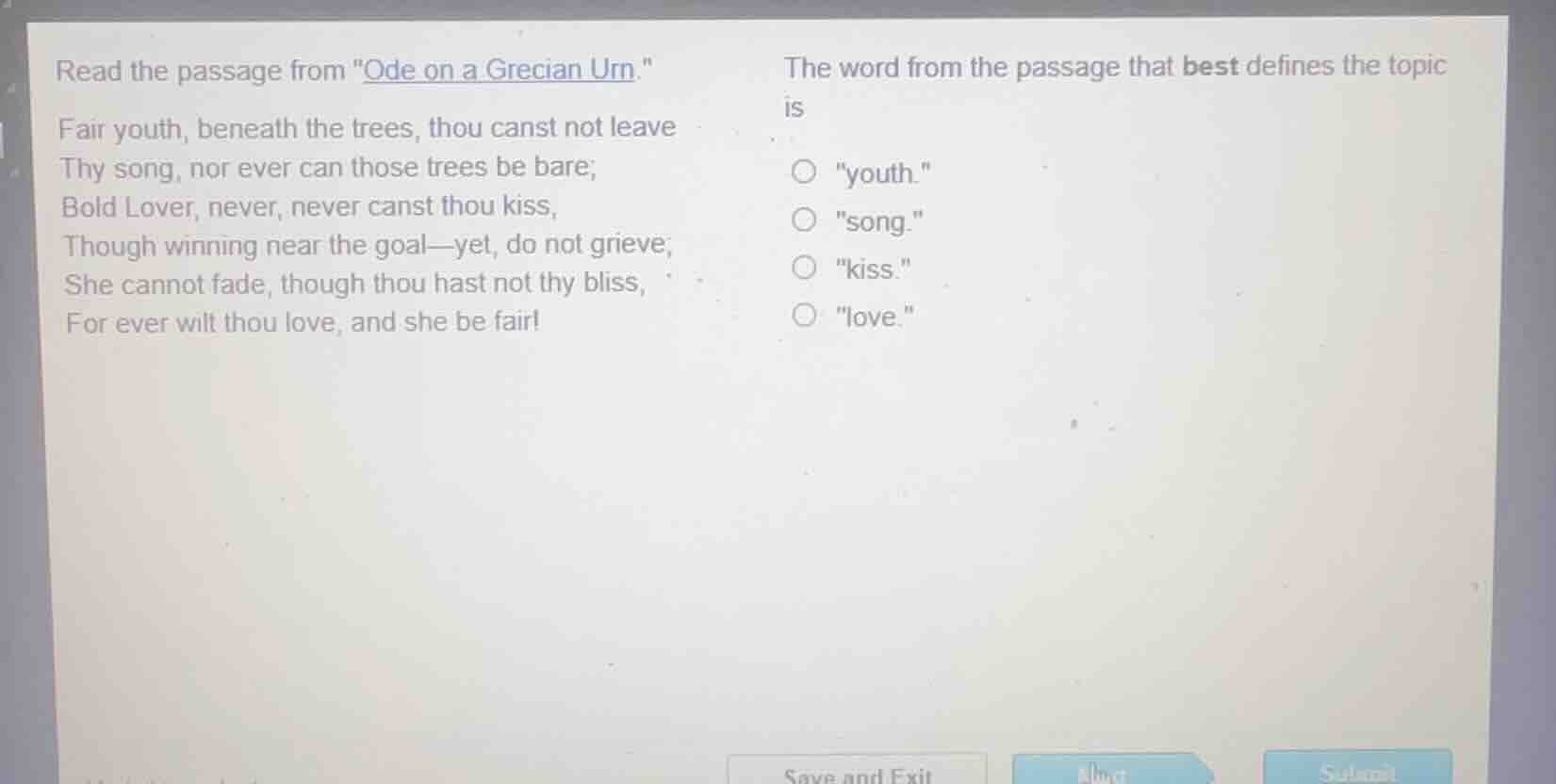
read the passage from \ode on a grecian urn.\
fair youth, beneath the trees, thou canst not leave
thy song, nor ever can those trees be bare;
bold lover, never, never canst thou kiss,
though winning near the goal-yet, do not grieve;
she cannot fade, though thou hast not thy bliss,
for ever wilt thou love, and she be fair!
the word from the passage that best defines the topic is
\youth.\
\song.\
\kiss.\
\love.\
Analyze the passage
Using the Textual Evidence knowledge point
The passage from John Keats's "Ode on a Grecian Urn" describes frozen, eternal moments captured on an ancient urn:
- A youth playing music under trees that will never shed leaves.
- A lover frozen just before a kiss, unable to reach his goal but assured his beloved will never fade.
- The final line concludes: "For ever wilt thou love, and she be fair!"
Identify the central topic
Using the Tone and Mood Analysis knowledge point
The passage emphasizes the timeless nature of the figures' feelings and states. While "youth," "song," and "kiss" are specific images depicted on the urn, the overarching theme and emotional core of this stanza is the eternal nature of their affection. The final line directly highlights that the lover will "love" forever, making "love" the central topic of this passage.
Evaluate the options
- "youth": A descriptive detail of the character, not the central topic.
- "song": A detail representing art/music, but not the main theme of this stanza.
- "kiss": An action that is frozen and cannot happen, serving as a supporting image.
- "love": The ultimate, enduring state that persists forever on the urn, defining the main topic.

Snap & solve any problem in the app
Get step-by-step solutions on Sovi AI
Photo-based solutions with guided steps
Explore more problems and detailed explanations
- "youth."
- "song."
- "kiss."
- "love." (Correct answer)