QUESTION IMAGE
Question
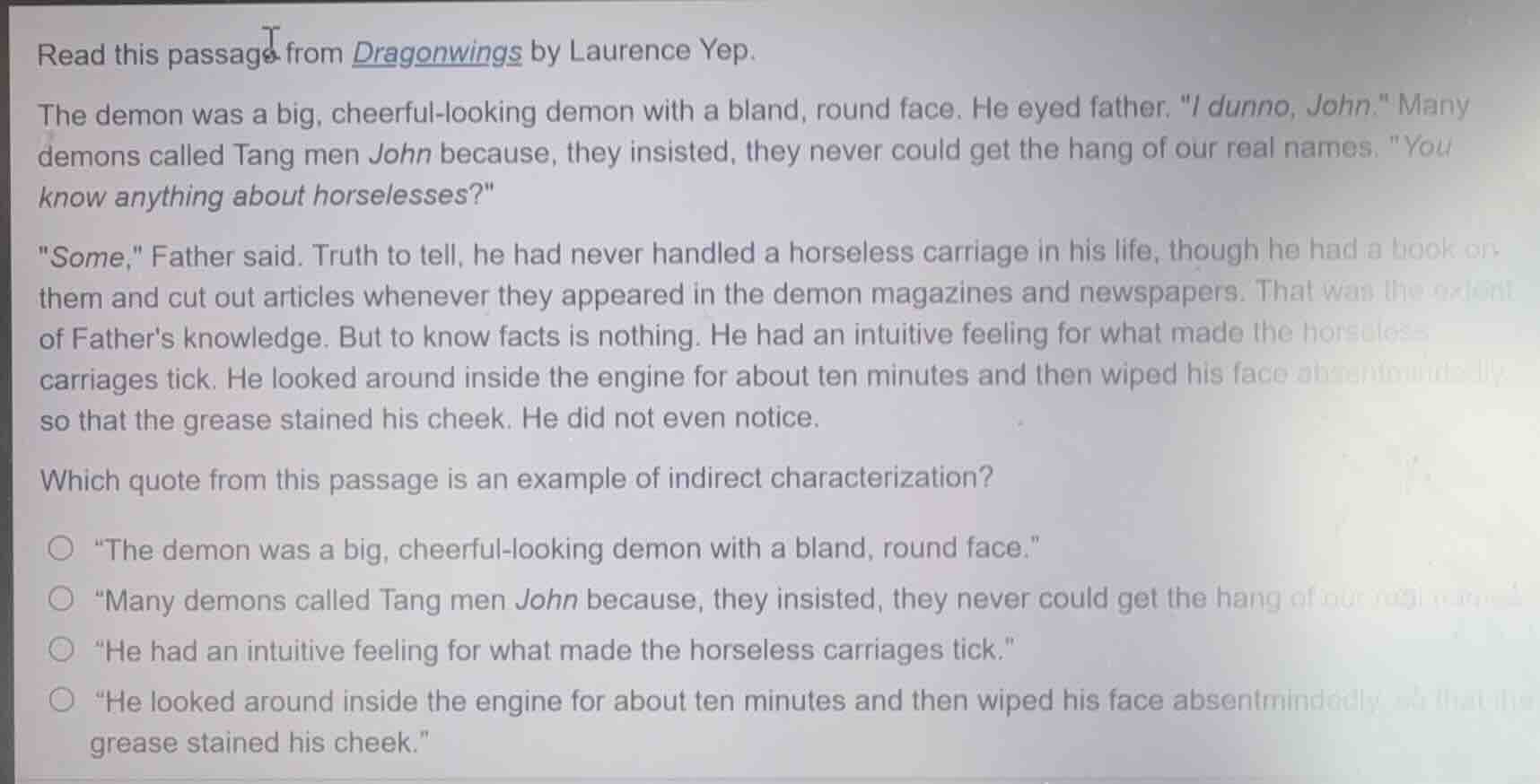
read this passage from dragonwings by laurence yep.
the demon was a big, cheerful-looking demon with a bland, round face. he eyed father. \i dunno, john.\ many demons called tang men john because, they insisted, they never could get the hang of our real names. \you know anything about horselesses?\
\some,\ father said. truth to tell, he had never handled a horseless carriage in his life, though he had a book on them and cut out articles whenever they appeared in the demon magazines and newspapers. that was the extent of fathers knowledge. but to know facts is nothing. he had an intuitive feeling for what made the horseless carriages tick. he looked around inside the engine for about ten minutes and then wiped his face absentmindedly so that the grease stained his cheek. he did not even notice.
which quote from this passage is an example of indirect characterization?
\the demon was a big, cheerful-looking demon with a bland, round face.\
\many demons called tang men john because, they insisted, they never could get the hang of our real names.\
\he had an intuitive feeling for what made the horseless carriages tick.\
\he looked around inside the engine for about ten minutes and then wiped his face absentmindedly so that the grease stained his cheek.\
Define characterization types
Using the Direct Characterization and Indirect Characterization knowledge points
- Direct Characterization explicitly tells the reader what a character is like through direct description.
- Indirect Characterization shows a character's traits through their actions, thoughts, speech, or appearance, requiring the reader to make inferences.
Analyze the first three options
Using the Direct Characterization knowledge point
- Option 1: "The demon was a big, cheerful-looking demon..." directly describes the physical appearance and demeanor.
- Option 2: "Many demons called Tang men John..." directly explains a naming habit and its reason.
- Option 3: "He had an intuitive feeling..." directly states a mental trait of the father.
Analyze the fourth option
Using the Indirect Characterization knowledge point
- Option 4: "He looked around inside the engine... and then wiped his face absentmindedly..." shows his focus and absorption in the task through physical actions.
- We infer his dedication and lack of self-consciousness because he does not notice the grease on his cheek.

Snap & solve any problem in the app
Get step-by-step solutions on Sovi AI
Photo-based solutions with guided steps
Explore more problems and detailed explanations
- (A) "The demon was a big, cheerful-looking demon with a bland, round face."
- (B) "Many demons called Tang men John because, they insisted, they never could get the hang of our real names."
- (C) "He had an intuitive feeling for what made the horseless carriages tick."
- (D) "He looked around inside the engine for about ten minutes and then wiped his face absentmindedly, so that the grease stained his cheek." (Correct answer)