Sovi.AI - AI Math Tutor

Scan to solve math questions

QUESTION IMAGE

read the first stanza of \the tide rises, the tide falls.\ the tide ris…

Question

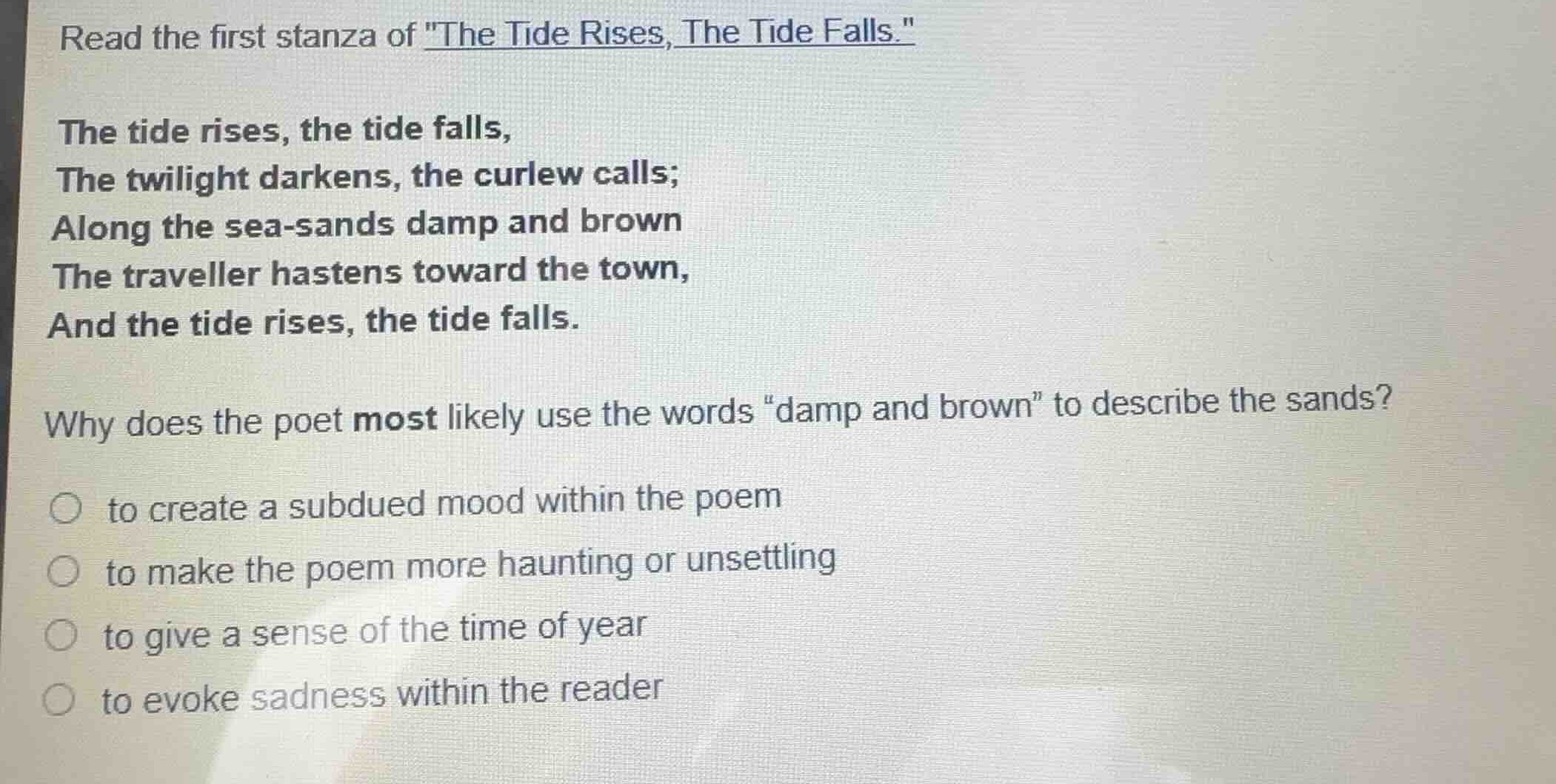
read the first stanza of \the tide rises, the tide falls.\

the tide rises, the tide falls,
the twilight darkens, the curlew calls;
along the sea-sands damp and brown
the traveller hastens toward the town,
and the tide rises, the tide falls.

why does the poet most likely use the words \damp and brown\ to describe the sands?

  • to create a subdued mood within the poem
  • to make the poem more haunting or unsettling
  • to give a sense of the time of year
  • to evoke sadness within the reader

Explanation:

Response

<pre_analysis>
{
"quality": "clear",
"question_count": 1,
"skills_matched": [
"direct_cot",
"multiple_choice_formatter",
"explain_then_answer",
"tutor",
"mastery_adaptive_brevity"
],
"needs_drawing": false,
"concepts_used": [
"Mood and Atmosphere",
"Setting Analysis"
],
"new_concepts": [],
"current_concepts": [
"Mood and Atmosphere",
"Setting Analysis",
"Poetic Devices"
]
}
</pre_analysis>

<reasoning>

Analyze the imagery and setting

Using the Setting Analysis knowledge point
The poet Henry Wadsworth Longfellow describes the "sea-sands" as "damp and brown." This imagery details a coastal setting at twilight, where the wet, dark sand reflects the fading daylight and the incoming tide.

Determine the emotional effect

Using the Mood and Atmosphere knowledge point
The description of "damp and brown" sands, combined with "twilight darkens" and the calling of the "curlew," establishes a quiet, somber, and reflective environment. This imagery is designed to create a subdued, peaceful, yet slightly melancholy mood rather than a frightening, haunting, or deeply sad atmosphere.

Evaluate the multiple-choice options

  • Option 1 ("to create a subdued mood within the poem"): Correct. The sensory details of twilight, damp sand, and bird calls work together to establish a quiet, subdued atmosphere.
  • Option 2 ("to make the poem more haunting or unsettling"): Incorrect. The scene is calm and natural, not eerie or frightening.
  • Option 3 ("to give a sense of the time of year"): Incorrect. "Damp and brown" describes the daily state of tidal sands, not a specific season.
  • Option 4 ("to evoke sadness within the reader"): Incorrect. While reflective, the primary purpose of the imagery is to set a quiet, subdued atmospheric tone rather than to force personal grief or sadness.

</reasoning>

<answer>
<mcq-correct>(A) to create a subdued mood within the poem</mcq-correct>
<mcq-option>(B) to make the poem more haunting or unsettling</mcq-option>
<mcq-option>(C) to give a sense of the time of year</mcq-option>
<mcq-option>(D) to evoke sadness within the reader</mcq-option>
</answer>

<post_analysis>
{
"subject": "Arts",
"question_type": "Multiple Choice",
"knowledge_point": [
"Arts",
"Literature",
"Poetry Analysis"
]
}
</post_analysis>

Answer:

<pre_analysis>
{
"quality": "clear",
"question_count": 1,
"skills_matched": [
"direct_cot",
"multiple_choice_formatter",
"explain_then_answer",
"tutor",
"mastery_adaptive_brevity"
],
"needs_drawing": false,
"concepts_used": [
"Mood and Atmosphere",
"Setting Analysis"
],
"new_concepts": [],
"current_concepts": [
"Mood and Atmosphere",
"Setting Analysis",
"Poetic Devices"
]
}
</pre_analysis>

<reasoning>

Analyze the imagery and setting

Using the Setting Analysis knowledge point
The poet Henry Wadsworth Longfellow describes the "sea-sands" as "damp and brown." This imagery details a coastal setting at twilight, where the wet, dark sand reflects the fading daylight and the incoming tide.

Determine the emotional effect

Using the Mood and Atmosphere knowledge point
The description of "damp and brown" sands, combined with "twilight darkens" and the calling of the "curlew," establishes a quiet, somber, and reflective environment. This imagery is designed to create a subdued, peaceful, yet slightly melancholy mood rather than a frightening, haunting, or deeply sad atmosphere.

Evaluate the multiple-choice options

  • Option 1 ("to create a subdued mood within the poem"): Correct. The sensory details of twilight, damp sand, and bird calls work together to establish a quiet, subdued atmosphere.
  • Option 2 ("to make the poem more haunting or unsettling"): Incorrect. The scene is calm and natural, not eerie or frightening.
  • Option 3 ("to give a sense of the time of year"): Incorrect. "Damp and brown" describes the daily state of tidal sands, not a specific season.
  • Option 4 ("to evoke sadness within the reader"): Incorrect. While reflective, the primary purpose of the imagery is to set a quiet, subdued atmospheric tone rather than to force personal grief or sadness.

</reasoning>

<answer>
<mcq-correct>(A) to create a subdued mood within the poem</mcq-correct>
<mcq-option>(B) to make the poem more haunting or unsettling</mcq-option>
<mcq-option>(C) to give a sense of the time of year</mcq-option>
<mcq-option>(D) to evoke sadness within the reader</mcq-option>
</answer>

<post_analysis>
{
"subject": "Arts",
"question_type": "Multiple Choice",
"knowledge_point": [
"Arts",
"Literature",
"Poetry Analysis"
]
}
</post_analysis>