QUESTION IMAGE
Question
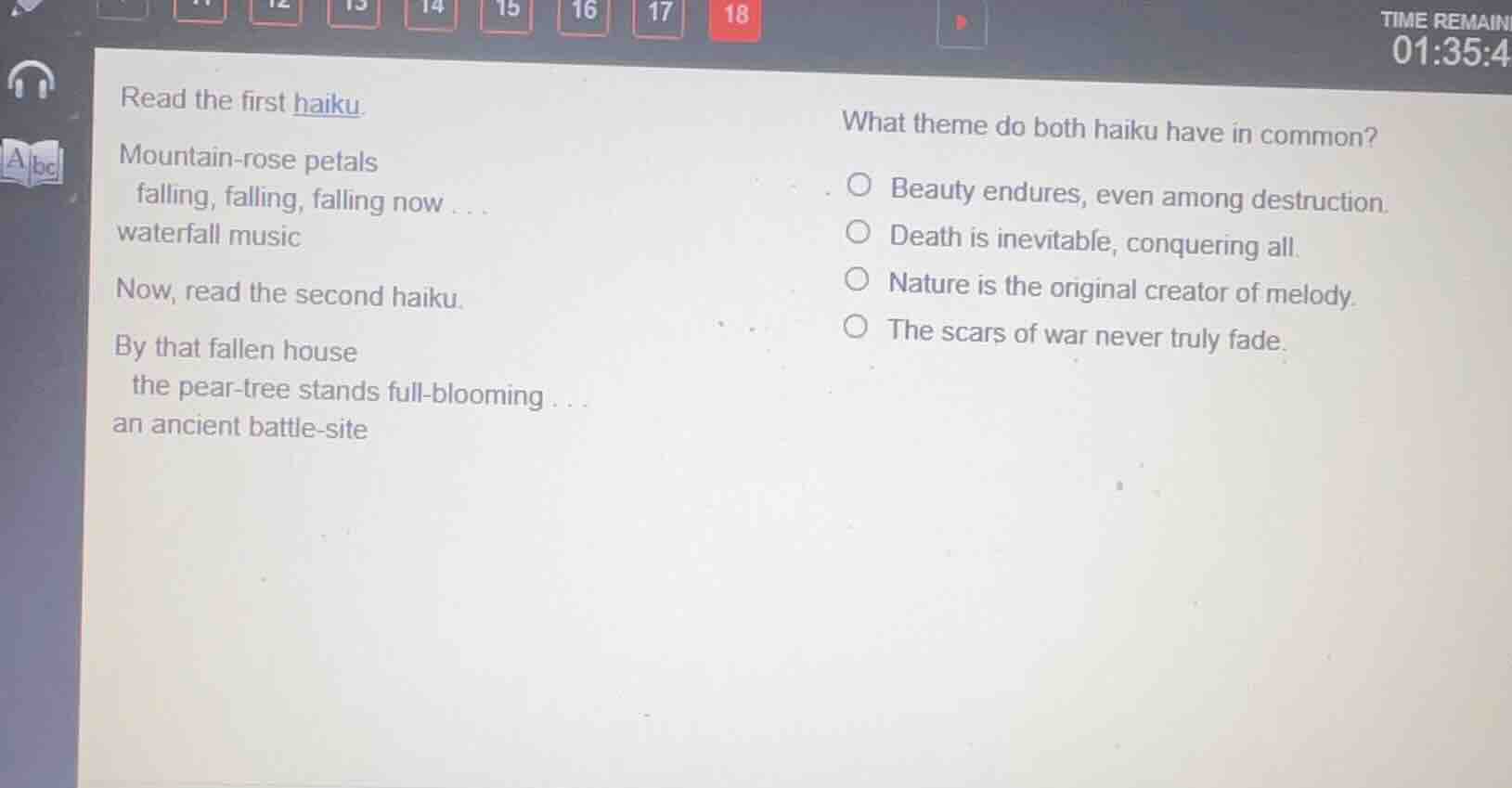
read the first haiku.
mountain-rose petals
falling, falling, falling now...
waterfall music
now, read the second haiku.
by that fallen house
the pear-tree stands full-blooming...
an ancient battle-site
what theme do both haiku have in common?
- beauty endures, even among destruction.
- death is inevitable, conquering all.
- nature is the original creator of melody.
- the scars of war never truly fade.
Analyze the first haiku
Using the Haiku Structure and Poetic Analysis knowledge points
The first poem describes mountain-rose petals falling into a waterfall, creating "waterfall music." This imagery pairs the delicate, transient beauty of falling petals with the enduring, powerful flow of the waterfall. It highlights how natural beauty persists and harmonizes even as individual elements fade or fall.
Analyze the second haiku
Using the Poetic Analysis knowledge point
The second poem depicts a "pear-tree stands full-blooming" next to a "fallen house" on "an ancient battle-site." This starkly contrasts human destruction (a collapsed home, a war zone) with the resilient, vibrant rebirth of nature (the blooming pear tree).
Synthesize the common theme
Using the Poetic Analysis knowledge point
Both poems center on natural beauty persisting amidst change or ruin. The first shows beauty in falling petals and rushing water, while the second directly contrasts a site of human conflict and decay with a thriving, blooming tree. Thus, both convey that beauty and life endure even in the face of destruction or decline.
Evaluate the options
Using the Poetic Analysis knowledge point
- Beauty endures, even among destruction: This perfectly matches both poems, especially the contrast of the blooming tree on a battle-site.
- Death is inevitable, conquering all: Incorrect; the poems emphasize survival and blooming rather than total defeat by death.
- Nature is the original creator of melody: Incorrect; this only relates to the "music" in the first poem, not the second.
- The scars of war never truly fade: Incorrect; this only relates to the second poem's battle-site and ignores the first poem entirely.

Snap & solve any problem in the app
Get step-by-step solutions on Sovi AI
Photo-based solutions with guided steps
Explore more problems and detailed explanations
- Beauty endures, even among destruction. (Correct answer)
- Death is inevitable, conquering all.
- Nature is the original creator of melody.
- The scars of war never truly fade.