QUESTION IMAGE
Question
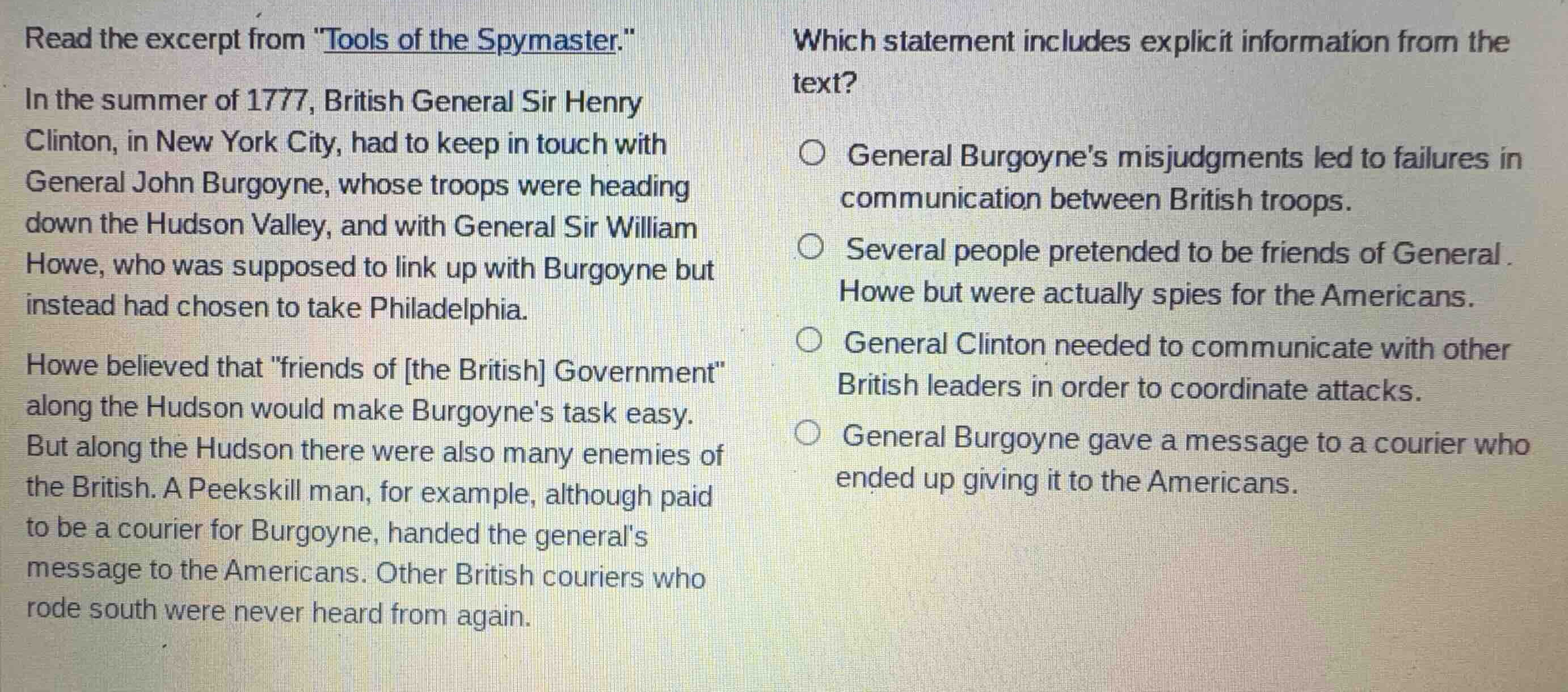
read the excerpt from \tools of the spymaster.\
in the summer of 1777, british general sir henry clinton, in new york city, had to keep in touch with general john burgoyne, whose troops were heading down the hudson valley, and with general sir william howe, who was supposed to link up with burgoyne but instead had chosen to take philadelphia.
howe believed that \friends of the british government\ along the hudson would make burgoynes task easy. but along the hudson there were also many enemies of the british. a peekskill man, for example, although paid to be a courier for burgoyne, handed the generals message to the americans. other british couriers who rode south were never heard from again.
which statement includes explicit information from the text?
- general burgoynes misjudgments led to failures in communication between british troops.
- several people pretended to be friends of general howe but were actually spies for the americans.
- general clinton needed to communicate with other british leaders in order to coordinate attacks.
- general burgoyne gave a message to a courier who ended up giving it to the americans.
Analyze the question requirements
The question asks to identify which statement includes explicit information directly stated in the provided text. Explicit information is directly and clearly written in the passage, requiring no inference or reading between the lines. We will use Textual Evidence to evaluate each option.
Evaluate the first option
The first option states: "General Burgoyne's misjudgments led to failures in communication between British troops."
- Looking at the text, it mentions that General Clinton "had to keep in touch with General John Burgoyne... and with General Sir William Howe."
- It also mentions a courier who handed a message to the Americans and other couriers who disappeared.
- However, the text does not explicitly state that Burgoyne made "misjudgments" that caused these communication failures. This is an inference rather than explicit information.
Evaluate the second option
The second option states: "Several people pretended to be friends of General Howe but were actually spies for the Americans."
- The text mentions that Howe believed "friends of [the British] Government" along the Hudson would help, but there were also "many enemies of the British."
- It mentions a specific Peekskill man who was paid to be a courier but handed the message to the Americans.
- It does not explicitly state that several people pretended to be friends of General Howe specifically to spy on him. This is inaccurate and not explicitly in the text.
Evaluate the third option
The third option states: "General Clinton needed to communicate with other British leaders in order to coordinate attacks."
- The text explicitly states: "In the summer of 1777, British General Sir Henry Clinton, in New York City, had to keep in touch with General John Burgoyne... and with General Sir William Howe..."
- While it mentions he had to keep in touch, the specific purpose of "coordinating attacks" is an implicit assumption or historical context, but the exact phrase "to coordinate attacks" is not explicitly written in this excerpt. Let's compare this with the fourth option to find the most direct explicit match.
Evaluate the fourth option
The fourth option states: "General Burgoyne gave a message to a courier who ended up giving it to the Americans."
- Let's look at the exact Textual Evidence in the second paragraph: "A Peekskill man, for example, although paid to be a courier for Burgoyne, handed the general's message to the Americans."
- This directly and explicitly matches the statement: General Burgoyne gave a message to a courier (the Peekskill man paid to be a courier for Burgoyne) who ended up giving it (handed the general's message) to the Americans.
- This is a direct, word-for-word explicit detail from the text.

Snap & solve any problem in the app
Get step-by-step solutions on Sovi AI
Photo-based solutions with guided steps
Explore more problems and detailed explanations
- (A) General Burgoyne's misjudgments led to failures in communication between British troops.
- (B) Several people pretended to be friends of General Howe but were actually spies for the Americans.
- (C) General Clinton needed to communicate with other British leaders in order to coordinate attacks.
- (D) General Burgoyne gave a message to a courier who ended up giving it to the Americans. (Correct answer)