QUESTION IMAGE
Question
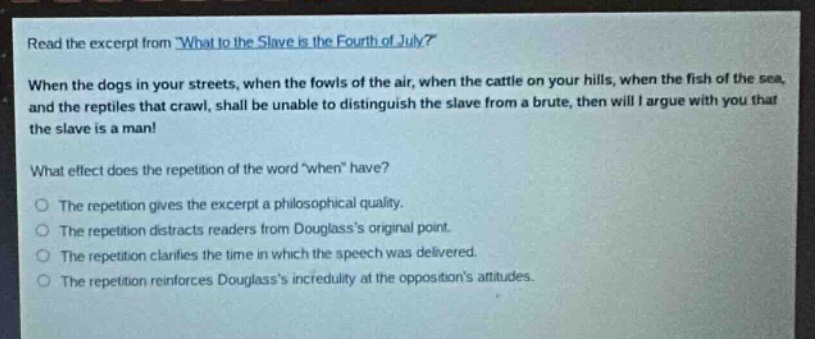
read the excerpt from \what to the slave is the fourth of july?\
when the dogs in your streets, when the fowls of the air, when the cattle on your hills, when the fish of the sea, and the reptiles that crawl, shall be unable to distinguish the slave from a brute, then will i argue with you that the slave is a man!
what effect does the repetition of the word \when\ have?
- the repetition gives the excerpt a philosophical quality.
- the repetition distracts readers from douglasss original point.
- the repetition clarifies the time in which the speech was delivered.
- the repetition reinforces douglasss incredulity at the oppositions attitudes.
🆕 New Concept Discovered: Rhetorical Devices and Effects
Analyzing how authors use repetition to build arguments and convey emotion.
Step 1: Analyze the excerpt and the repetition
In this passage from Frederick Douglass's speech, "What to the Slave is the Fourth of July?", he uses a series of clauses starting with the word "when":
- "When the dogs in your streets..."
- "when the fowls of the air..."
- "when the cattle on your hills..."
- "when the fish of the sea..."
He lists various animals (dogs, birds, cattle, fish, reptiles) and states that only when these non-human creatures are unable to tell the difference between an enslaved person and a beast ("a brute") will he stoop to argue that a slave is a human being.
Step 2: Determine the rhetorical effect
By repeating "when" alongside a growing list of common animals, Douglass emphasizes how obvious and undeniable the humanity of enslaved people is. He is pointing out the absurdity of having to prove something so fundamental.
- Option 1 (philosophical quality): While the speech is profound, the primary function of this specific repetition is persuasive and emotional rather than purely abstract or philosophical.
- Option 2 (distracts readers): The repetition does not distract; it focuses and strengthens his argument.
- Option 3 (clarifies the time): The word "when" is used here as a conditional conjunction (meaning "at the point at which"), not to state the historical time or date the speech was delivered.
- Option 4 (reinforces Douglass's incredulity): Incredulity means a state of disbelief or shock. Douglass is expressing his disbelief and outrage that anyone would require an argument to prove a slave is a human. The repeated "when" clauses build a mountain of absurd conditions, reinforcing his intense disbelief at his opponents' dehumanizing attitudes.

Snap & solve any problem in the app
Get step-by-step solutions on Sovi AI
Photo-based solutions with guided steps
Explore more problems and detailed explanations
The repetition reinforces Douglass's incredulity at the opposition's attitudes.