QUESTION IMAGE
Question
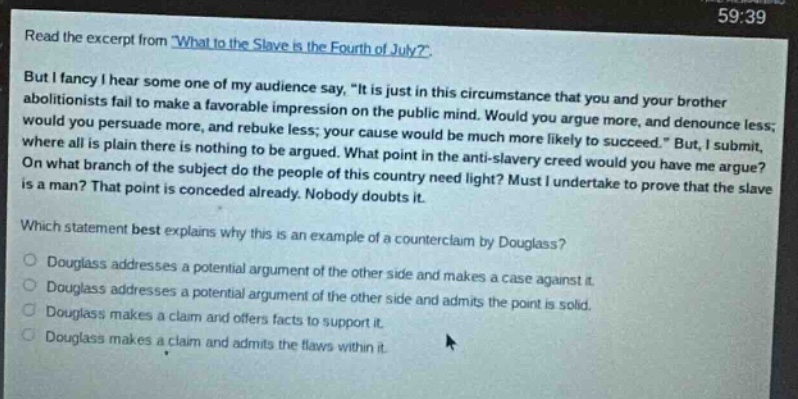
read the excerpt from \what to the slave is the fourth of july?\.
but i fancy i hear some one of my audience say, \it is just in this circumstance that you and your brother abolitionists fail to make a favorable impression on the public mind. would you argue more, and denounce less; would you persuade more, and rebuke less; your cause would be much more likely to succeed.\ but, i submit, where all is plain there is nothing to be argued. what point in the anti-slavery creed would you have me argue? on what branch of the subject do the people of this country need light? must i undertake to prove that the slave is a man? that point is conceded already. nobody doubts it.
which statement best explains why this is an example of a counterclaim by douglass?
douglass addresses a potential argument of the other side and makes a case against it.
douglass addresses a potential argument of the other side and admits the point is solid.
douglass makes a claim and offers facts to support it.
douglass makes a claim and admits the flaws within it.
🆕 New Concept Discovered: Identifying and Analyzing Counterclaims
An opposing argument addressed to strengthen a position.
Step 1: Define a counterclaim
A counterclaim is an argument or position that opposes, contradicts, or challenges a writer's main argument. In persuasive writing and speech, authors often introduce a potential objection from the opposing side (the counterclaim) so they can immediately disprove or weaken it (the rebuttal). This strategy makes the author's overall argument stronger by showing they have considered multiple perspectives.
Step 2: Analyze the excerpt
In the excerpt, Frederick Douglass begins by imagining an objection from his audience:
"But I fancy I hear some one of my audience say, 'It is just in this circumstance that you and your brother abolitionists fail to make a favorable impression on the public mind. Would you argue more, and denounce less... your cause would be much more likely to succeed.'"
This represents the opposing side's view: that abolitionists should argue logically rather than denounce slavery so harshly.
Douglass then immediately responds to and refutes this objection:
"But, I submit, where all is plain there is nothing to be argued. What point in the anti-slavery creed would you have me argue?... Must I undertake to prove that the slave is a man? That point is conceded already."
By showing that the humanity of enslaved people is already an obvious, agreed-upon fact, he argues that logical debate is unnecessary and that denunciation is the only appropriate response.
Step 3: Evaluate the options
- Option 1: "Douglass addresses a potential argument of the other side and makes a case against it."
- This perfectly matches the definition of a counterclaim and rebuttal. Douglass introduces the audience's objection (argue more, denounce less) and then builds a case against it (there is nothing to argue because the facts are already plain).
- Option 2: "Douglass addresses a potential argument of the other side and admits the point is solid."
- Incorrect. Douglass does not agree with the objection; he strongly refutes it.
- Option 3: "Douglass makes a claim and offers facts to support it."
- Incorrect. While he does make claims, this option describes a standard supporting argument rather than explaining why this specific passage is a counterclaim.
- Option 4: "Douglass makes a claim and admits the flaws within it."
- Incorrect. Douglass does not admit to flaws in his own argument.

Snap & solve any problem in the app
Get step-by-step solutions on Sovi AI
Photo-based solutions with guided steps
Explore more problems and detailed explanations
Douglass addresses a potential argument of the other side and makes a case against it.