QUESTION IMAGE
Question
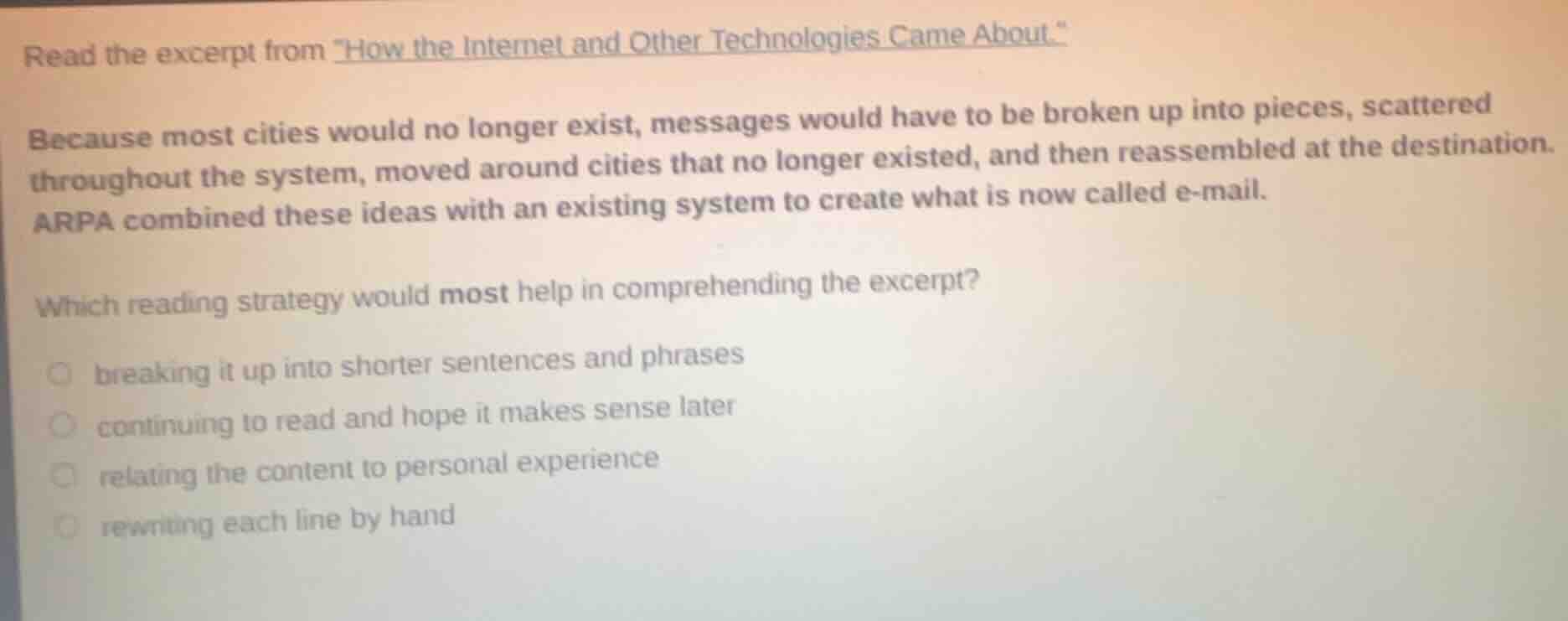
read the excerpt from \how the internet and other technologies came about.\
because most cities would no longer exist, messages would have to be broken up into pieces, scattered throughout the system, moved around cities that no longer existed, and then reassembled at the destination. arpa combined these ideas with an existing system to create what is now called e-mail.
which reading strategy would most help in comprehending the excerpt?
- breaking it up into shorter sentences and phrases
- continuing to read and hope it makes sense later
- relating the content to personal experience
- rewriting each line by hand
Analyze the structure of the excerpt
The excerpt consists of a single, highly complex sentence followed by a shorter concluding sentence:
"Because most cities would no longer exist, messages would have to be broken up into pieces, scattered throughout the system, moved around cities that no longer existed, and then reassembled at the destination. ARPA combined these ideas with an existing system to create what is now called e-mail."
The first sentence contains multiple clauses, passive verb constructions, and sequential actions ("broken up", "scattered", "moved around", "reassembled") packed together. This dense syntax makes it difficult to digest in one reading.
Evaluate the reading strategies
We evaluate the given multiple-choice options to determine which strategy best aids comprehension of this dense passage:
- breaking it up into shorter sentences and phrases: This is a core Reading Comprehension Strategies technique. By chunking a long, complex sentence into smaller, manageable parts (e.g., identifying the cause: "cities would no longer exist", and the sequential steps of message delivery), a reader can easily follow the technical process described.
- continuing to read and hope it makes sense later: This passive approach does not actively resolve the immediate confusion caused by the complex sentence structure.
- relating the content to personal experience: While personal connection can help with thematic texts, it does not directly help decode the complex, technical, and historical process of early network packet switching described here.
- rewriting each line by hand: This is highly inefficient and does not inherently aid in structural comprehension or decoding of complex syntax.
Select the best strategy
Breaking down the long, multi-clause sentence into smaller phrases is the most effective active reading strategy for comprehending dense, technical explanations.

Snap & solve any problem in the app
Get step-by-step solutions on Sovi AI
Photo-based solutions with guided steps
Explore more problems and detailed explanations
- (A) breaking it up into shorter sentences and phrases (Correct answer)
- (B) continuing to read and hope it makes sense later
- (C) relating the content to personal experience
- (D) rewriting each line by hand