QUESTION IMAGE
Question
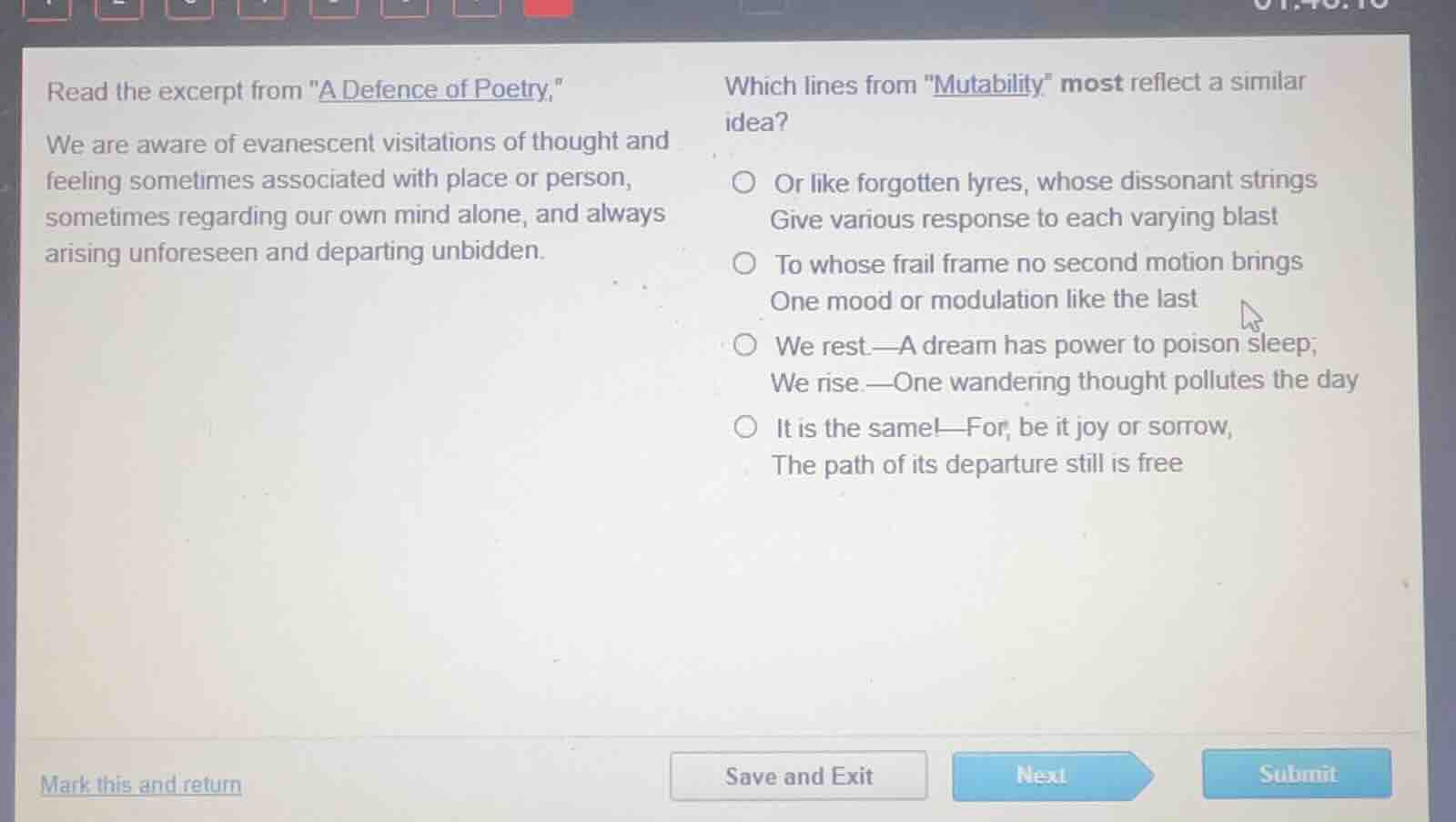
read the excerpt from \a defence of poetry,\
we are aware of evanescent visitations of thought and feeling sometimes associated with place or person, sometimes regarding our own mind alone, and always arising unforeseen and departing unbidden.
which lines from \mutability\ most reflect a similar idea?
or like forgotten lyres, whose dissonant strings
give various response to each varying blast
to whose frail frame no second motion brings
one mood or modulation like the last
we rest.-a dream has power to poison sleep;
we rise.-one wandering thought pollutes the day
it is the same!-for, be it joy or sorrow,
the path of its departure still is free
Analyze the prose excerpt
Using the Comparative Text Analysis knowledge point, we examine the excerpt from Percy Bysshe Shelley's prose work "A Defence of Poetry":
"We are aware of evanescent visitations of thought and feeling sometimes associated with place or person, sometimes regarding our own mind alone, and always arising unforeseen and departing unbidden."
The core idea here is that human thoughts and feelings are fleeting ("evanescent"), unpredictable, and outside of our conscious control—they arrive unexpectedly ("arising unforeseen") and leave without our permission ("departing unbidden").
Analyze the poetic options
Using the Poetry Interpretation and Romantic Poetry Themes knowledge points, we evaluate the stanzas from Shelley's poem "Mutability" to find a matching theme of fleeting, uncontrollable thoughts:
- Option 1: "Or like forgotten lyres, whose dissonant strings / Give various response to each varying blast"
- Analysis: This describes how humans respond to external influences, like a wind harp responding to changing winds.
- Option 2: "To whose frail frame no second motion brings / One mood or modulation like the last"
- Analysis: This emphasizes constant change and the uniqueness of each passing state, but doesn't focus on the sudden, unbidden arrival/departure of thoughts.
- Option 3: "We rest.—A dream has power to poison sleep; / We rise.—One wandering thought pollutes the day"
- Analysis: This directly illustrates how sudden, uncontrollable mental visitations (a dream while sleeping, a single wandering thought while awake) unexpectedly arrive and completely alter our state of mind, mirroring the "unforeseen" and "unbidden" visitations of thought in the prose.
- Option 4: "It is the same!—For, be it joy or sorrow, / The path of its departure still is free"
- Analysis: This focuses on the inevitability of departure and change itself, rather than the sudden, unbidden arrival of thoughts and feelings.
Determine the best match
Using the Comparative Text Analysis knowledge point, Option 3 is the strongest match. The prose describes "visitations of thought and feeling... arising unforeseen and departing unbidden." Similarly, the lines "A dream has power to poison sleep; / We rise.—One wandering thought pollutes the day" show how fleeting, unbidden thoughts and dreams unexpectedly disrupt our rest and our day.

Snap & solve any problem in the app
Get step-by-step solutions on Sovi AI
Photo-based solutions with guided steps
Explore more problems and detailed explanations
- (A) Or like forgotten lyres, whose dissonant strings / Give various response to each varying blast
- (B) To whose frail frame no second motion brings / One mood or modulation like the last
- (C) We rest.—A dream has power to poison sleep; / We rise.—One wandering thought pollutes the day (Correct answer)
- (D) It is the same!—For, be it joy or sorrow, / The path of its departure still is free