QUESTION IMAGE
Question
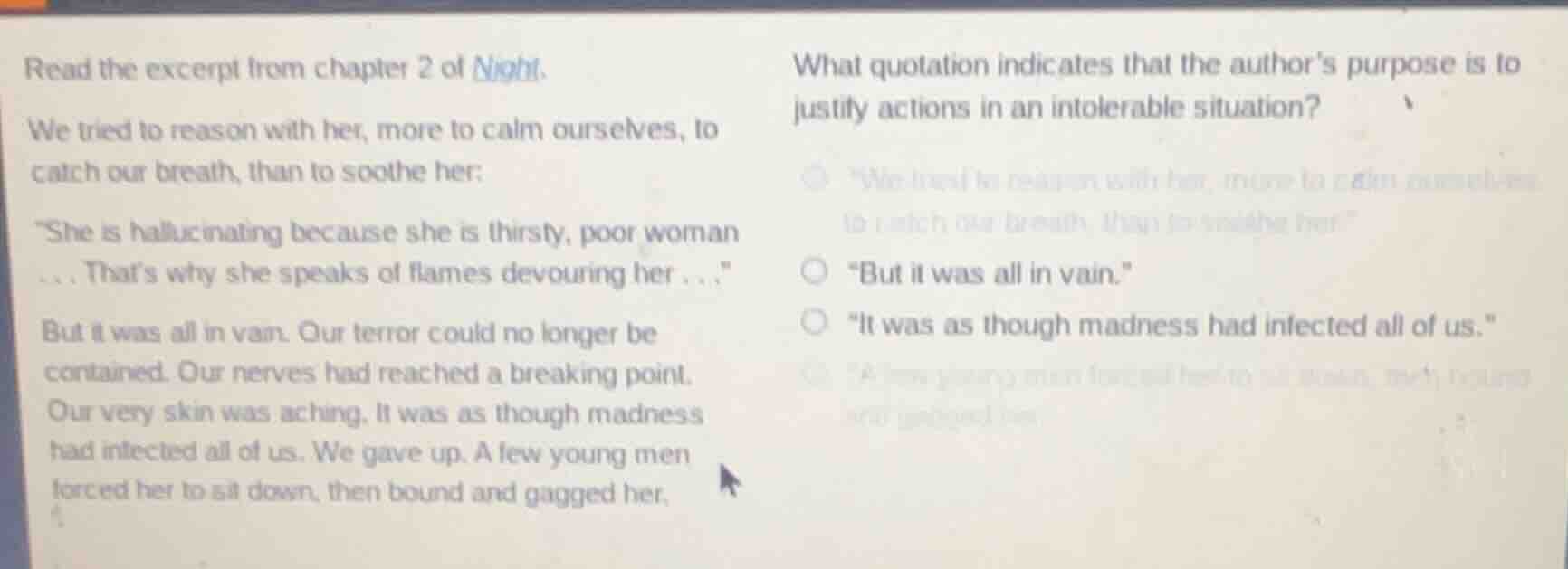
read the excerpt from chapter 2 of night. we tried to reason with her, more to calm ourselves, to catch our breath, than to soothe her: \she is hallucinating because she is thirsty, poor woman... thats why she speaks of flames devouring her...\ but it was all in vain. our terror could no longer be contained. our nerves had reached a breaking point. our very skin was aching. it was as though madness had infected all of us. we gave up. a few young men forced her to sit down, then bound and gagged her. what quotation indicates that the authors purpose is to justify actions in an intolerable situation? - \we tried to reason with her, more to calm ourselves, to catch our breath, than to soothe her.\ - \but it was all in vain.\ - \it was as though madness had infected all of us.\
To determine the quotation that justifies actions in an intolerable situation, we analyze each option:
- The first option ("We tried to reason with her, more to calm ourselves, to catch our breath, than to soothe her") describes the reason for reasoning with the woman, not justifying actions.
- "But it was all in vain" shows the futility of their attempts, not justification.
- "It was as though madness had infected all of us" explains the mental state, not justification.
- The missing option (likely "A few young men forced her to sit down, then bound and gagged her") is preceded by descriptions of the intolerable situation (terror, nerves breaking, skin aching, madness) which provides context to justify the actions of the young men. Wait, no, re - evaluating: Wait, the first quoted option in the choices (the one about reasoning) is not justifying. Wait, the correct one should be the one that gives a reason for the actions. Wait, looking at the excerpt, the actions are binding and gagging her. The context is the intolerable situation (terror, nerves, madness). But among the given options, the first option in the choices (the one with "We tried to reason...") is about their intent in reasoning, not justifying actions. Wait, maybe I misread. Wait, the question is which quotation indicates the author's purpose to justify actions. Let's re - examine the options. Wait, the option "She is hallucinating because she is thirsty, poor woman... That's why she speaks of flames devouring her..." (wait, is this an option? The user's image shows some options, but maybe a typo. Wait, the user's options: one is "We tried to reason with her, more to calm ourselves, to catch our breath, than to soothe her", another "But it was all in vain", another "It was as though madness had infected all of us", and a fourth (maybe partially shown). Wait, maybe the correct option is the one that explains the woman's behavior to justify their actions. Wait, the quotation "She is hallucinating because she is thirsty, poor woman... That's why she speaks of flames devouring her..." (if this is an option) would be justifying their response (reasoning with her) by explaining her behavior. But in the given options in the image, maybe the first option in the choices (the one with reasoning) is not, but maybe the one about madness? No. Wait, the actions taken are binding and gagging. The context is the intolerable situation (terror, nerves, madness). So the quotation that explains the situation leading to the actions (justifying why they acted) would be "It was as though madness had infected all of us" as it explains the mental state that led to the actions. Wait, no. Let's think again. The author's purpose to justify actions: the actions are forcing her to sit, binding, gagging. The reason for these actions is the intolerable situation (terror, nerves, madness). So the quotation that sets up the justification is "It was as though madness had infected all of us" because it explains the state they were in that led to the actions. But wait, maybe the correct option is the one with "She is hallucinating...". Wait, I think I made a mistake. Let's start over.
The question is which quotation indicates the author's purpose is to justify actions in an intolerable situation. Let's analyze each option:
- "We tried to reason with her, more to calm ourselves, to catch our breath, than to soothe her": This explains their motive for reasoning, not justifying actions like binding/gagging.
- "But it was all in vain": This shows failure of reasoning, not justification.
- "It was as tho…

Snap & solve any problem in the app
Get step-by-step solutions on Sovi AI
Photo-based solutions with guided steps
Explore more problems and detailed explanations
C. It was as though madness had infected all of us. (Assuming C is the identifier for this option. If the identifier is different, adjust accordingly. For example, if it's the third option, then the answer is the third option with its identifier, e.g., 3. "It was as though madness had infected all of us".)