QUESTION IMAGE
Question
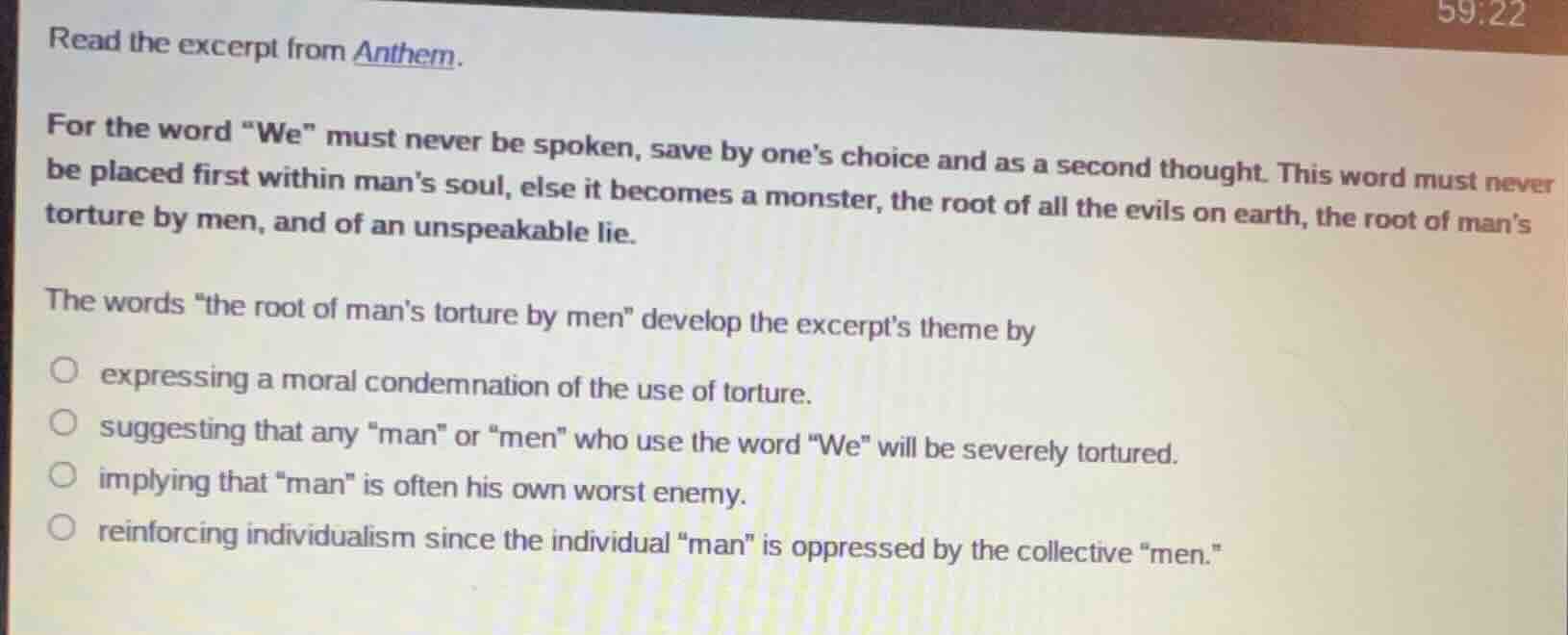
read the excerpt from anthem.
for the word \we\ must never be spoken, save by ones choice and as a second thought. this word must never be placed first within mans soul, else it becomes a monster, the root of all the evils on earth, the root of mans torture by men, and of an unspeakable lie.
the words \the root of mans torture by men\ develop the excerpts theme by
expressing a moral condemnation of the use of torture.
suggesting that any \man\ or \men\ who use the word \we\ will be severely tortured.
implying that \man\ is often his own worst enemy.
reinforcing individualism since the individual \man\ is oppressed by the collective \men.\
<pre_analysis>
{
"quality": "clear",
"question_count": 1,
"skills_matched": [
"direct_cot",
"multiple_choice_formatter",
"explain_then_answer",
"quick"
],
"needs_drawing": false,
"concepts_used": [],
"new_concepts": [],
"current_concepts": [
"Anthem Analysis",
"Individualism vs Collectivism",
"Literary Theme"
]
}
</pre_analysis>
<reasoning>
Analyze the excerpt's context and central theme
The excerpt from Ayn Rand's Anthem discusses the word "We," stating it must never be placed first in man's soul, otherwise it becomes "a monster, the root of all the evils on earth, the root of man's torture by men." This directly addresses the conflict between the collective ("We"/"men") and the individual ("man").
Evaluate the phrase "the root of man's torture by men"
The singular "man" represents the individual, while the plural "men" represents the collective group. The phrase implies that when the collective ("We") is prioritized over the individual, it leads to the oppression and torture of the individual ("man") by the collective group ("men").
Match with the correct multiple-choice option
- Option 1 is incorrect because the passage is not about physical torture as a practice, but rather a metaphorical/philosophical oppression.
- Option 2 is incorrect because it misinterprets the literal application of torture to those who speak the word.
- Option 3 is incorrect because it misses the distinction between the singular individual and the collective group.
- Option 4 is correct because it directly connects the singular "man" being oppressed by the collective "men" to the reinforcement of individualism over collectivism.
</reasoning>
<answer>
<mcq-option>expressing a moral condemnation of the use of torture.</mcq-option>
<mcq-option>suggesting that any "man" or "men" who use the word "We" will be severely tortured.</mcq-option>
<mcq-option>implying that "man" is often his own worst enemy.</mcq-option>
<mcq-correct>reinforcing individualism since the individual "man" is oppressed by the collective "men."</mcq-correct>
</answer>
<post_analysis>
{
"subject": "Arts",
"question_type": "Multiple Choice",
"knowledge_point": [
"Arts",
"Literary Analysis",
"Individualism vs Collectivism"
]
}
</post_analysis>
Snap & solve any problem in the app
Get step-by-step solutions on Sovi AI
Photo-based solutions with guided steps
Explore more problems and detailed explanations
<pre_analysis>
{
"quality": "clear",
"question_count": 1,
"skills_matched": [
"direct_cot",
"multiple_choice_formatter",
"explain_then_answer",
"quick"
],
"needs_drawing": false,
"concepts_used": [],
"new_concepts": [],
"current_concepts": [
"Anthem Analysis",
"Individualism vs Collectivism",
"Literary Theme"
]
}
</pre_analysis>
<reasoning>
Analyze the excerpt's context and central theme
The excerpt from Ayn Rand's Anthem discusses the word "We," stating it must never be placed first in man's soul, otherwise it becomes "a monster, the root of all the evils on earth, the root of man's torture by men." This directly addresses the conflict between the collective ("We"/"men") and the individual ("man").
Evaluate the phrase "the root of man's torture by men"
The singular "man" represents the individual, while the plural "men" represents the collective group. The phrase implies that when the collective ("We") is prioritized over the individual, it leads to the oppression and torture of the individual ("man") by the collective group ("men").
Match with the correct multiple-choice option
- Option 1 is incorrect because the passage is not about physical torture as a practice, but rather a metaphorical/philosophical oppression.
- Option 2 is incorrect because it misinterprets the literal application of torture to those who speak the word.
- Option 3 is incorrect because it misses the distinction between the singular individual and the collective group.
- Option 4 is correct because it directly connects the singular "man" being oppressed by the collective "men" to the reinforcement of individualism over collectivism.
</reasoning>
<answer>
<mcq-option>expressing a moral condemnation of the use of torture.</mcq-option>
<mcq-option>suggesting that any "man" or "men" who use the word "We" will be severely tortured.</mcq-option>
<mcq-option>implying that "man" is often his own worst enemy.</mcq-option>
<mcq-correct>reinforcing individualism since the individual "man" is oppressed by the collective "men."</mcq-correct>
</answer>
<post_analysis>
{
"subject": "Arts",
"question_type": "Multiple Choice",
"knowledge_point": [
"Arts",
"Literary Analysis",
"Individualism vs Collectivism"
]
}
</post_analysis>