QUESTION IMAGE
Question
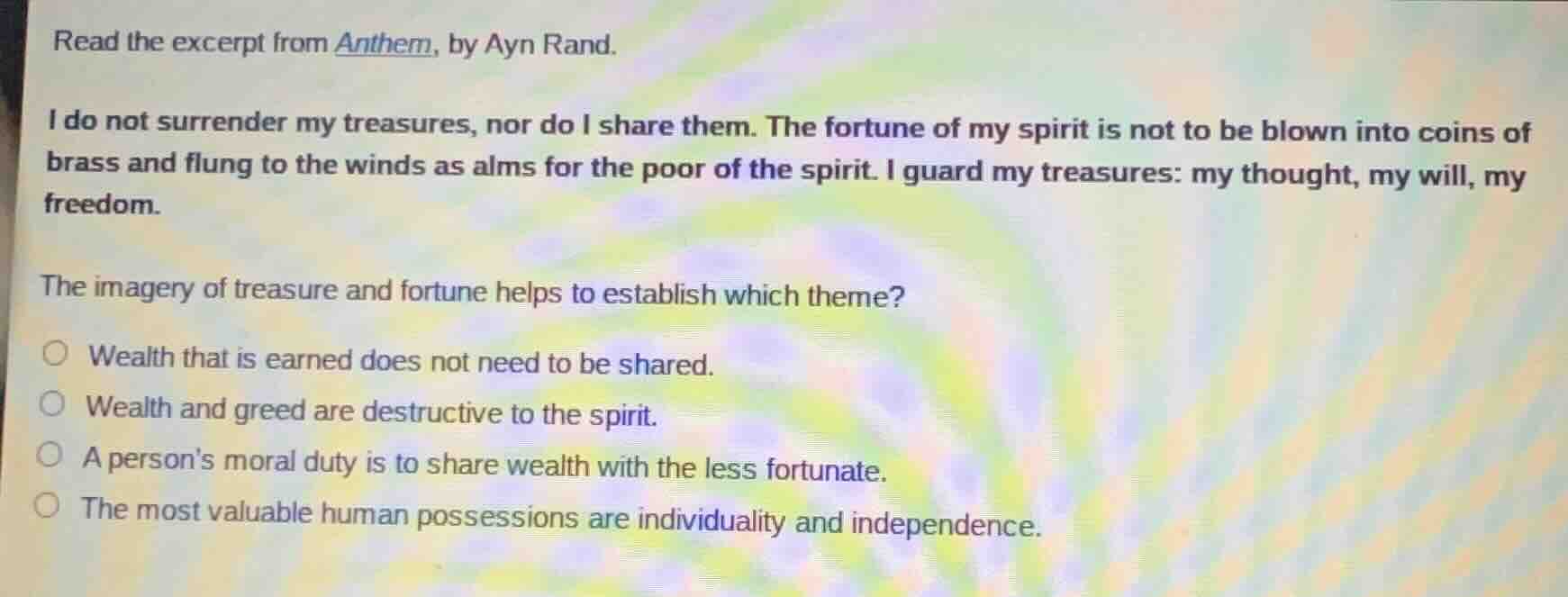
read the excerpt from anthem, by ayn rand.
i do not surrender my treasures, nor do i share them. the fortune of my spirit is not to be blown into coins of brass and flung to the winds as alms for the poor of the spirit. i guard my treasures: my thought, my will, my freedom.
the imagery of treasure and fortune helps to establish which theme?
wealth that is earned does not need to be shared.
wealth and greed are destructive to the spirit.
a persons moral duty is to share wealth with the less fortunate.
the most valuable human possessions are individuality and independence.
Analyze the metaphorical imagery of "treasures" and "fortune"
The narrator defines "my treasures" explicitly at the end of the passage: "my thought, my will, my freedom." These are internal, spiritual qualities of the individual rather than material wealth.
Connect the imagery to the central theme
By describing personal thoughts, will, and freedom as "treasures" and "fortune" that must not be surrendered or shared as "alms for the poor of the spirit," the text establishes that individuality and independence are the most valuable human possessions.
Evaluate the answer choices
- Option 1 and Option 3 misinterpret the spiritual metaphor as literal financial wealth.
- Option 2 contradicts the passage, which values this "fortune of my spirit."
- Option 4 correctly identifies that the "treasures" represent the supreme value of individuality and independence.

Snap & solve any problem in the app
Get step-by-step solutions on Sovi AI
Photo-based solutions with guided steps
Explore more problems and detailed explanations
- Wealth that is earned does not need to be shared.
- Wealth and greed are destructive to the spirit.
- A person's moral duty is to share wealth with the less fortunate.
- The most valuable human possessions are individuality and independence. (Correct answer)