QUESTION IMAGE
Question
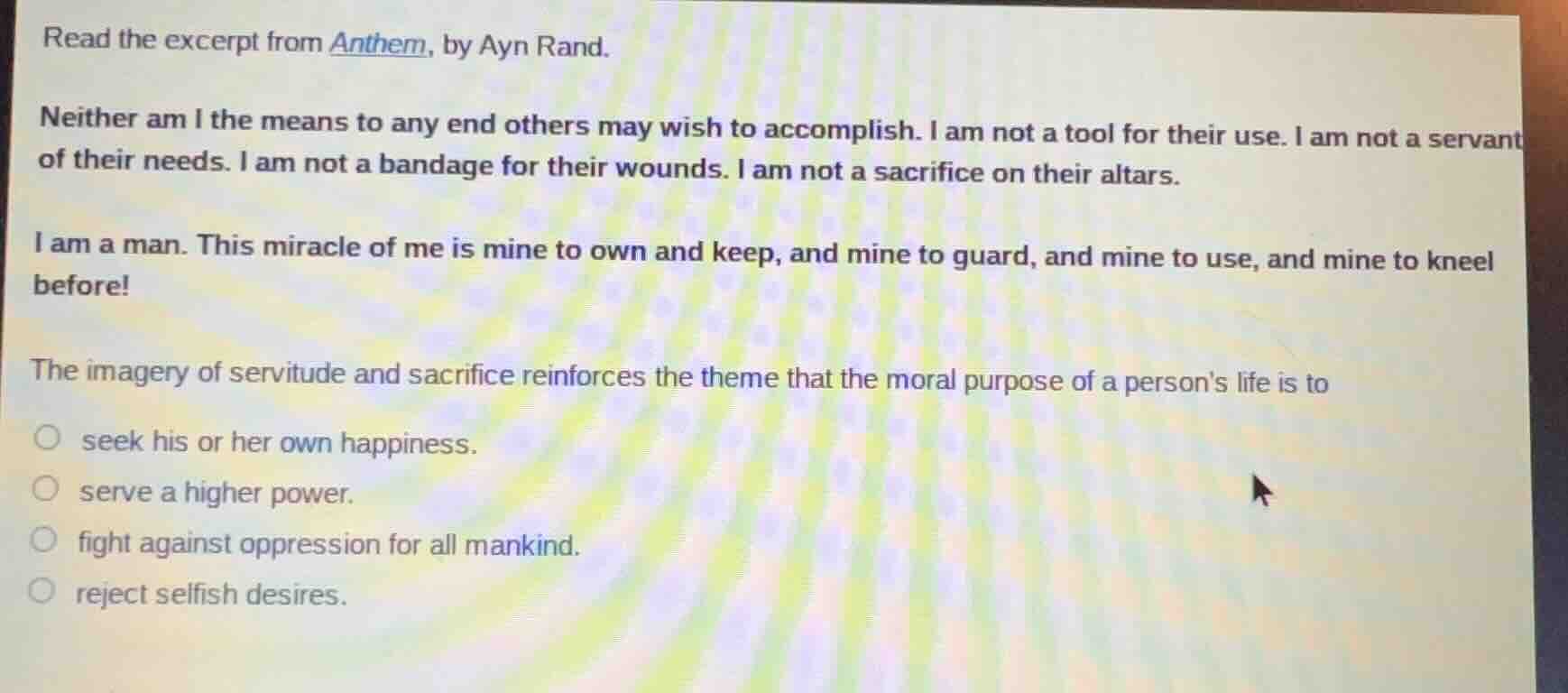
read the excerpt from anthem, by ayn rand.
neither am i the means to any end others may wish to accomplish. i am not a tool for their use. i am not a servant of their needs. i am not a bandage for their wounds. i am not a sacrifice on their altars.
i am a man. this miracle of me is mine to own and keep, and mine to guard, and mine to use, and mine to kneel before!
the imagery of servitude and sacrifice reinforces the theme that the moral purpose of a persons life is to
seek his or her own happiness.
serve a higher power.
fight against oppression for all mankind.
reject selfish desires.
<pre_analysis>
{
"quality": "clear",
"question_count": 1,
"skills_matched": [
"direct_cot",
"multiple_choice_formatter",
"explain_then_answer",
"quick"
],
"needs_drawing": false,
"concepts_used": [
"Anthem Analysis",
"Ayn Rand Philosophy",
"Individualism vs Collectivism",
"Anthem Imagery Analysis"
],
"new_concepts": [],
"current_concepts": [
"Anthem Analysis",
"Ayn Rand Philosophy",
"Individualism vs Collectivism",
"Anthem Imagery Analysis"
]
}
</pre_analysis>
<reasoning>
Analyze the excerpt's imagery and themes
The narrator rejects being a "tool," "servant," "bandage," or "sacrifice" for others, asserting that "This miracle of me is mine to own and keep." This rejection of servitude and sacrifice directly opposes collectivist self-sacrifice and promotes the individual's right to exist for their own sake.
Connect to Ayn Rand's philosophy
In Ayn Rand's philosophy of Objectivism, the moral purpose of a person's life is the pursuit of their own personal happiness. The rejection of serving others' ends directly supports the idea that one must seek his or her own happiness.
Evaluate the answer choices
- "seek his or her own happiness" matches Rand's core theme of rational self-interest and individualism.
- "serve a higher power" contradicts the text's rejection of kneeling to external forces.
- "fight against oppression for all mankind" is too broad; the focus is on individual sovereignty.
- "reject selfish desires" is the exact opposite of Rand's philosophy.
</reasoning>
<answer>
<mcq-correct>seek his or her own happiness.</mcq-correct>
<mcq-option>serve a higher power.</mcq-option>
<mcq-option>fight against oppression for all mankind.</mcq-option>
<mcq-option>reject selfish desires.</mcq-option>
</answer>
<post_analysis>
{
"subject": "Arts",
"question_type": "Multiple Choice",
"knowledge_point": [
"Arts",
"Literary Analysis",
"Anthem Analysis"
]
}
</post_analysis>
Snap & solve any problem in the app
Get step-by-step solutions on Sovi AI
Photo-based solutions with guided steps
Explore more problems and detailed explanations
<pre_analysis>
{
"quality": "clear",
"question_count": 1,
"skills_matched": [
"direct_cot",
"multiple_choice_formatter",
"explain_then_answer",
"quick"
],
"needs_drawing": false,
"concepts_used": [
"Anthem Analysis",
"Ayn Rand Philosophy",
"Individualism vs Collectivism",
"Anthem Imagery Analysis"
],
"new_concepts": [],
"current_concepts": [
"Anthem Analysis",
"Ayn Rand Philosophy",
"Individualism vs Collectivism",
"Anthem Imagery Analysis"
]
}
</pre_analysis>
<reasoning>
Analyze the excerpt's imagery and themes
The narrator rejects being a "tool," "servant," "bandage," or "sacrifice" for others, asserting that "This miracle of me is mine to own and keep." This rejection of servitude and sacrifice directly opposes collectivist self-sacrifice and promotes the individual's right to exist for their own sake.
Connect to Ayn Rand's philosophy
In Ayn Rand's philosophy of Objectivism, the moral purpose of a person's life is the pursuit of their own personal happiness. The rejection of serving others' ends directly supports the idea that one must seek his or her own happiness.
Evaluate the answer choices
- "seek his or her own happiness" matches Rand's core theme of rational self-interest and individualism.
- "serve a higher power" contradicts the text's rejection of kneeling to external forces.
- "fight against oppression for all mankind" is too broad; the focus is on individual sovereignty.
- "reject selfish desires" is the exact opposite of Rand's philosophy.
</reasoning>
<answer>
<mcq-correct>seek his or her own happiness.</mcq-correct>
<mcq-option>serve a higher power.</mcq-option>
<mcq-option>fight against oppression for all mankind.</mcq-option>
<mcq-option>reject selfish desires.</mcq-option>
</answer>
<post_analysis>
{
"subject": "Arts",
"question_type": "Multiple Choice",
"knowledge_point": [
"Arts",
"Literary Analysis",
"Anthem Analysis"
]
}
</post_analysis>