QUESTION IMAGE
Question
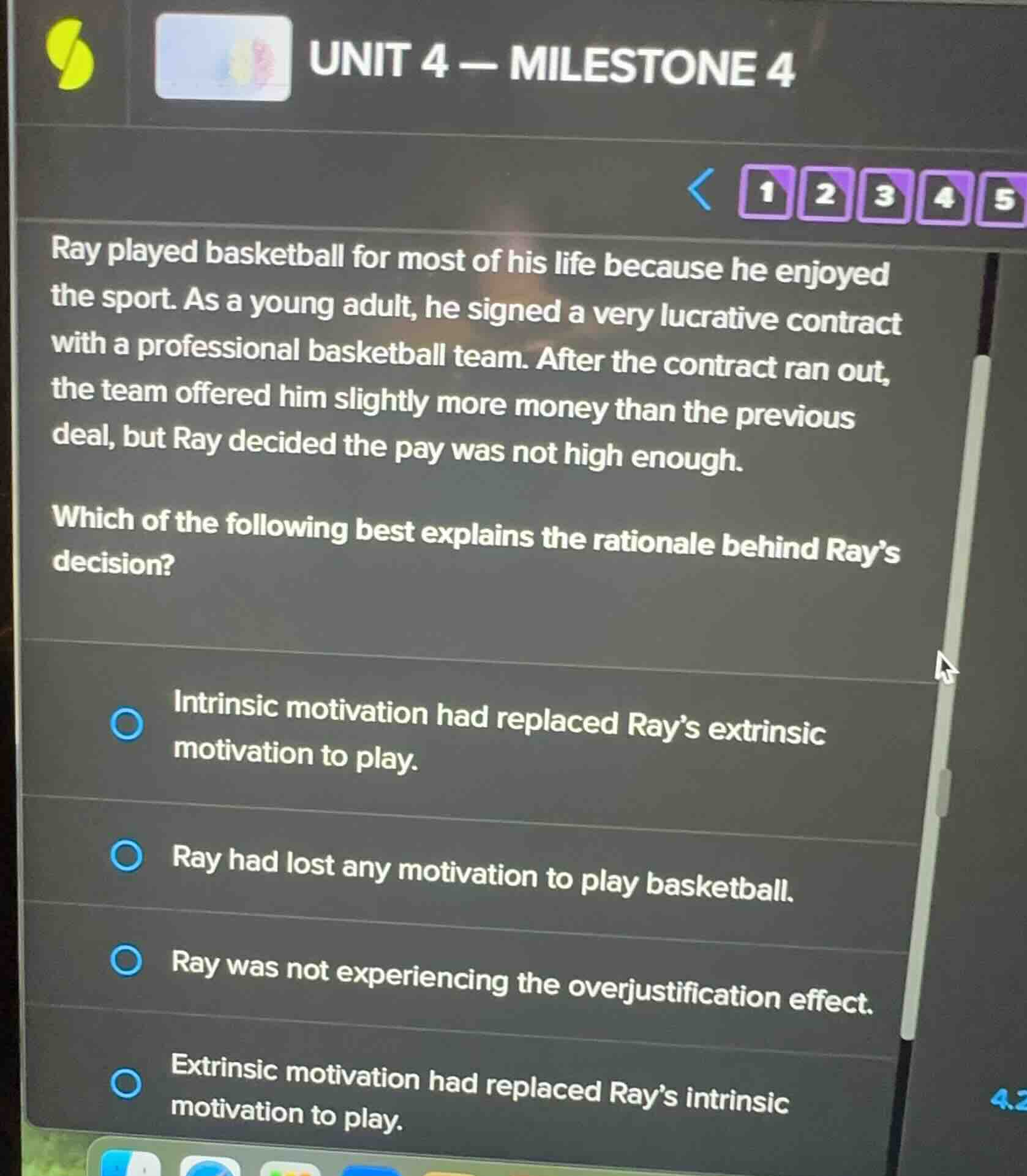
ray played basketball for most of his life because he enjoyed the sport. as a young adult, he signed a very lucrative contract with a professional basketball team. after the contract ran out, the team offered him slightly more money than the previous deal, but ray decided the pay was not high enough.
which of the following best explains the rationale behind rays decision?
- intrinsic motivation had replaced rays extrinsic motivation to play.
- ray had lost any motivation to play basketball.
- ray was not experiencing the overjustification effect.
- extrinsic motivation had replaced rays intrinsic motivation to play.
Analyze Ray's initial motivation
Ray played basketball for most of his life because he enjoyed the sport. This represents intrinsic motivation, which is driving behavior through internal rewards and personal satisfaction.
Analyze the introduction of external rewards
As a young adult, Ray signed a highly lucrative professional contract. This introduced a strong external reward, which is associated with extrinsic motivation.
Evaluate the shift in motivation
When external rewards (money) are introduced for an activity that was previously intrinsically enjoyable, the person's motivation can shift. This psychological phenomenon is known as the overjustification effect, where extrinsic motivation replaces intrinsic motivation.
Connect to Ray's final decision
Once the contract ended, Ray refused to play because the offered pay was "not high enough," even though it was more than his previous deal. Because his intrinsic enjoyment had been replaced by extrinsic motivation, he would no longer play simply for the love of the game; he now required a high external reward to perform.
Match with the correct option
The option "Extrinsic motivation had replaced Ray's intrinsic motivation to play" directly describes this shift, which explains why he refused to play when the financial incentive did not meet his expectations.

Snap & solve any problem in the app
Get step-by-step solutions on Sovi AI
Photo-based solutions with guided steps
Explore more problems and detailed explanations
- Intrinsic motivation had replaced Ray’s extrinsic motivation to play.
- Ray had lost any motivation to play basketball.
- Ray was not experiencing the overjustification effect.
- Extrinsic motivation had replaced Ray’s intrinsic motivation to play. (Correct answer)