QUESTION IMAGE
Question
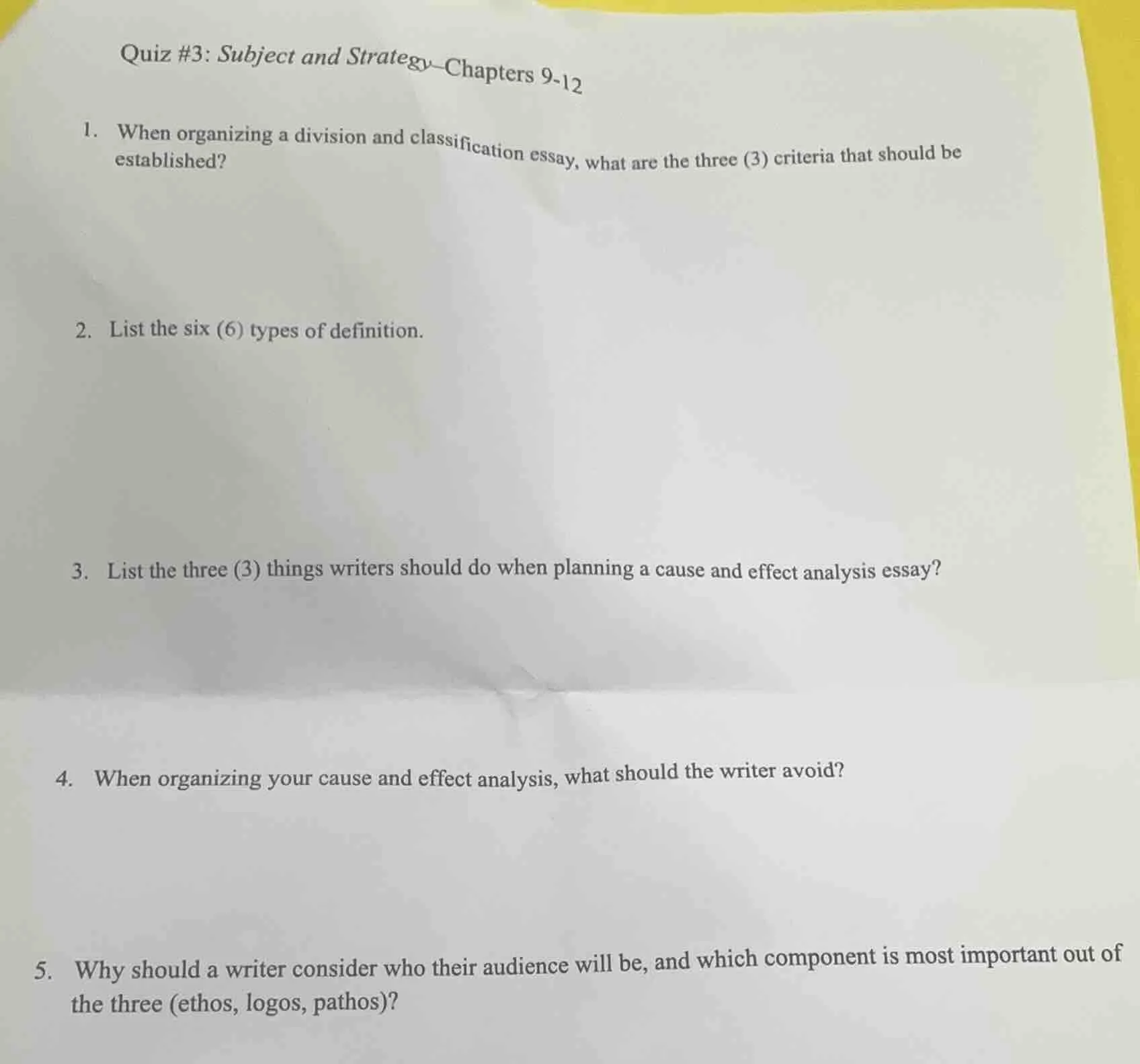
quiz #3: subject and strategy—chapters 9-12
- when organizing a division and classification essay, what are the three (3) criteria that should be established?
- list the six (6) types of definition.
- list the three (3) things writers should do when planning a cause and effect analysis essay?
- when organizing your cause and effect analysis, what should the writer avoid?
- why should a writer consider who their audience will be, and which component is most important out of the three (ethos, logos, pathos)?
Question 1
For a division and classification essay, the three criteria are: 1. Consistency: The criteria for dividing or classifying must be applied uniformly throughout the essay. 2. Completeness: All parts of the subject being divided or classified should be included (no major elements left out). 3. Exclusivity: The categories or divisions should be distinct and not overlap with each other.
The six types of definitions are: 1. Formal (or Dictionary) Definition: Uses the typical “term = genus + differentia” structure (e.g., “A triangle is a three - sided polygon”). 2. Informal Definition: A more casual, personal explanation (e.g., “For me, a ‘vacation’ is a time to completely unwind”). 3. Extended Definition: A detailed exploration, often including examples, descriptions, and analysis (e.g., explaining “democracy” by discussing its history, principles, and real - world applications). 4. Etymological Definition: Focuses on the origin of the word (e.g., “‘Philosophy’ comes from the Greek words ‘philo’ (love) and ‘sophia’ (wisdom), so it means the love of wisdom”). 5. Operational Definition: Defines a term based on how it is used or measured (e.g., “In this experiment, ‘intelligence’ is defined as the score on the Wechsler Adult Intelligence Scale”). 6. Definition by Example: Defines a term by providing specific instances (e.g., “Fruits include apples, oranges, and bananas”).
When planning a cause - and - effect analysis essay: 1. Identify the Focus: Decide whether to focus on causes, effects, or both. For example, if writing about air pollution, you might choose to focus on its causes (like industrial emissions, vehicle exhaust) or its effects (like respiratory diseases, environmental degradation). 2. Gather and Analyze Data: Collect relevant information, facts, and examples. This could involve researching scientific studies on the topic or looking at real - world cases. Then, analyze this data to determine the most significant causes or effects. 3. Determine Relationships: Figure out the logical connections between causes and effects. Are they direct or indirect? Are there multiple causes leading to one effect, or one cause leading to multiple effects? For example, in the case of obesity, there are multiple causes (diet, lack of exercise, genetics) and multiple effects (health problems, social stigma).

Snap & solve any problem in the app
Get step-by-step solutions on Sovi AI
Photo-based solutions with guided steps
Explore more problems and detailed explanations
The three criteria are Consistency, Completeness, and Exclusivity.