QUESTION IMAGE
Question
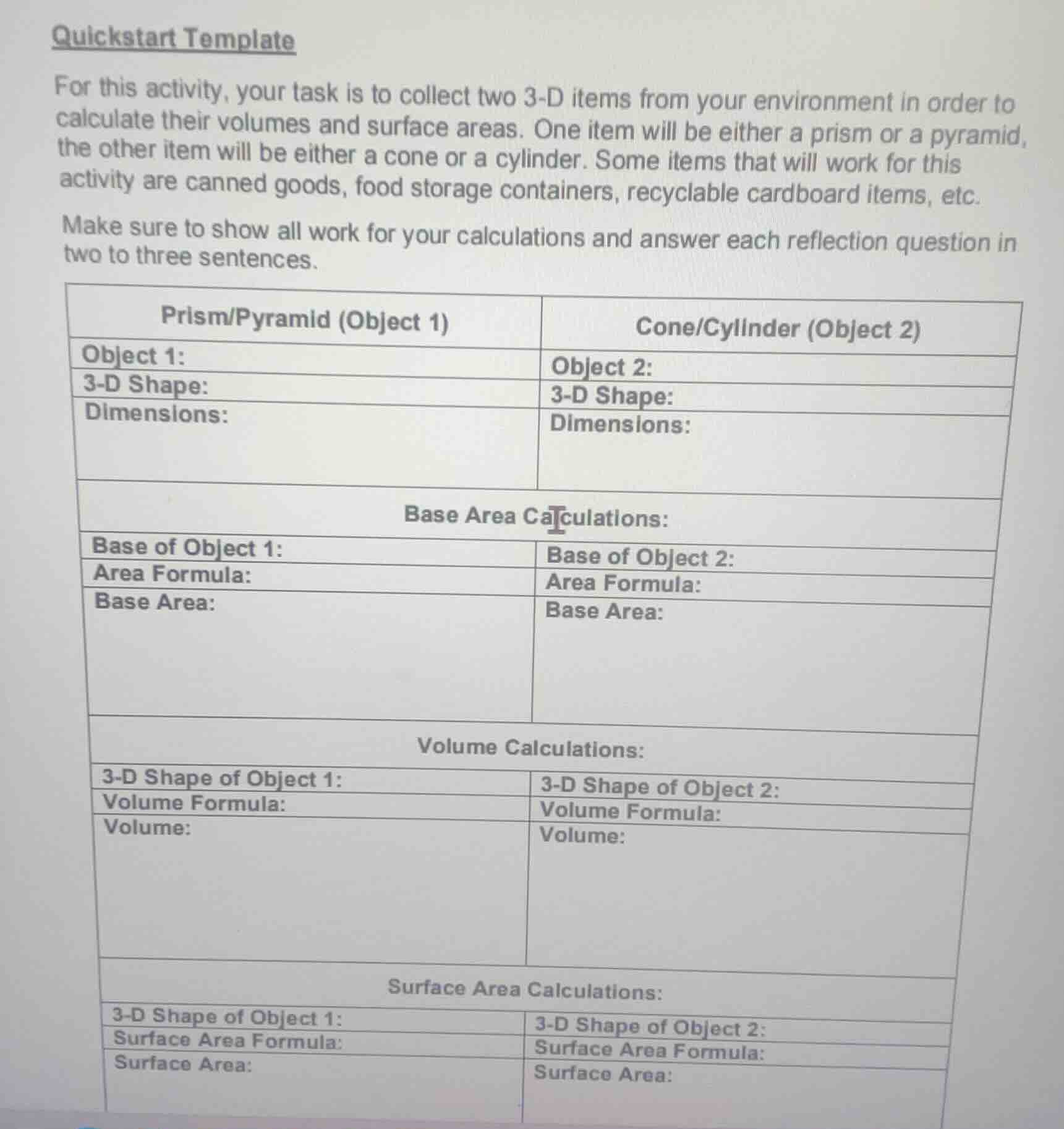
quickstart template
for this activity, your task is to collect two 3-d items from your environment in order to calculate their volumes and surface areas. one item will be either a prism or a pyramid, the other item will be either a cone or a cylinder. some items that will work for this activity are canned goods, food storage containers, recyclable cardboard items, etc.
make sure to show all work for your calculations and answer each reflection question in two to three sentences.
prism/pyramid (object 1)
object 1:
3-d shape:
dimensions:
cone/cylinder (object 2)
object 2:
3-d shape:
dimensions:
base area calculations:
base of object 1:
area formula:
base area:
base of object 2:
area formula:
base area:
volume calculations:
3-d shape of object 1:
volume formula:
volume:
3-d shape of object 2:
volume formula:
volume:
surface area calculations:
3-d shape of object 1:
surface area formula:
surface area:
3-d shape of object 2:
surface area formula:
surface area:
Identify objects and dimensions
To complete this hands-on activity template, we will select two common household items as representative 3-D objects:
- Object 1 (Prism/Pyramid): A rectangular cardboard tissue box (Rectangular Prism).
- Dimensions: Length \(l = 20\text{ cm}\), Width \(w = 10\text{ cm}\), Height \(h = 8\text{ cm}\).
- Object 2 (Cone/Cylinder): A standard metal soup can (Cylinder).
- Dimensions: Diameter \(d = 7.4\text{ cm}\) (Radius \(r = 3.7\text{ cm}\)), Height \(h = 11\text{ cm}\).
Calculate base areas
Using the Volume of Prisms and Volume of Cylinders concepts, we first find the area of the base for each object:
- Object 1 (Rectangular Prism):
- Base shape: Rectangle
- Area Formula: \(A = l \times w\)
- Calculation: \(A = 20\text{ cm} \times 10\text{ cm} = 200\text{ cm}^2\)
- Object 2 (Cylinder):
- Base shape: Circle
- Area Formula: \(A = \pi r^2\)
- Calculation: \(A = \pi \times (3.7\text{ cm})^2 \approx 43.01\text{ cm}^2\)
Calculate volumes
Next, we calculate the volume of each 3-D shape:
- Object 1 (Rectangular Prism):
- Volume Formula: \(V = \text{Base Area} \times h = l \times w \times h\)
- Calculation: \(V = 200\text{ cm}^2 \times 8\text{ cm} = 1600\text{ cm}^3\)
- Object 2 (Cylinder):
- Volume Formula: \(V = \text{Base Area} \times h = \pi r^2 h\)
- Calculation: \(V \approx 43.01\text{ cm}^2 \times 11\text{ cm} \approx 473.11\text{ cm}^3\)
Calculate surface areas
Finally, we calculate the total surface area for each object:
- Object 1 (Rectangular Prism):
- Surface Area Formula: \(SA = 2(lw + lh + wh)\)
- Calculation:
- Object 2 (Cylinder):
- Surface Area Formula: \(SA = 2\pi r^2 + 2\pi r h\)
- Calculation:

Snap & solve any problem in the app
Get step-by-step solutions on Sovi AI
Photo-based solutions with guided steps
Explore more problems and detailed explanations
Here is a completed template using two common household items:
Prism/Pyramid (Object 1)
- Object 1: Cardboard Tissue Box
- 3-D Shape: Rectangular Prism
- Dimensions: Length = \(20\text{ cm}\), Width = \(10\text{ cm}\), Height = \(8\text{ cm}\)
Cone/Cylinder (Object 2)
- Object 2: Soup Can
- 3-D Shape: Cylinder
- Dimensions: Radius = \(3.7\text{ cm}\), Height = \(11\text{ cm}\)
---
Base Area Calculations
- Base of Object 1: Rectangle
- Area Formula: \(A = \text{length} \times \text{width}\)
- Base Area: \(200\text{ cm}^2\)
- Base of Object 2: Circle
- Area Formula: \(A = \pi r^2\)
- Base Area: \(43.01\text{ cm}^2\)
---
Volume Calculations
- 3-D Shape of Object 1: Rectangular Prism
- Volume Formula: \(V = \text{length} \times \text{width} \times \text{height}\)
- Volume: \(1600\text{ cm}^3\)
- 3-D Shape of Object 2: Cylinder
- Volume Formula: \(V = \pi r^2 h\)
- Volume: \(473.11\text{ cm}^3\)
---
Surface Area Calculations
- 3-D Shape of Object 1: Rectangular Prism
- Surface Area Formula: \(SA = 2(lw + lh + wh)\)
- Surface Area: \(880\text{ cm}^2\)
- 3-D Shape of Object 2: Cylinder
- Surface Area Formula: \(SA = 2\pi r^2 + 2\pi r h\)
- Surface Area: \(341.75\text{ cm}^2\)