QUESTION IMAGE
Question
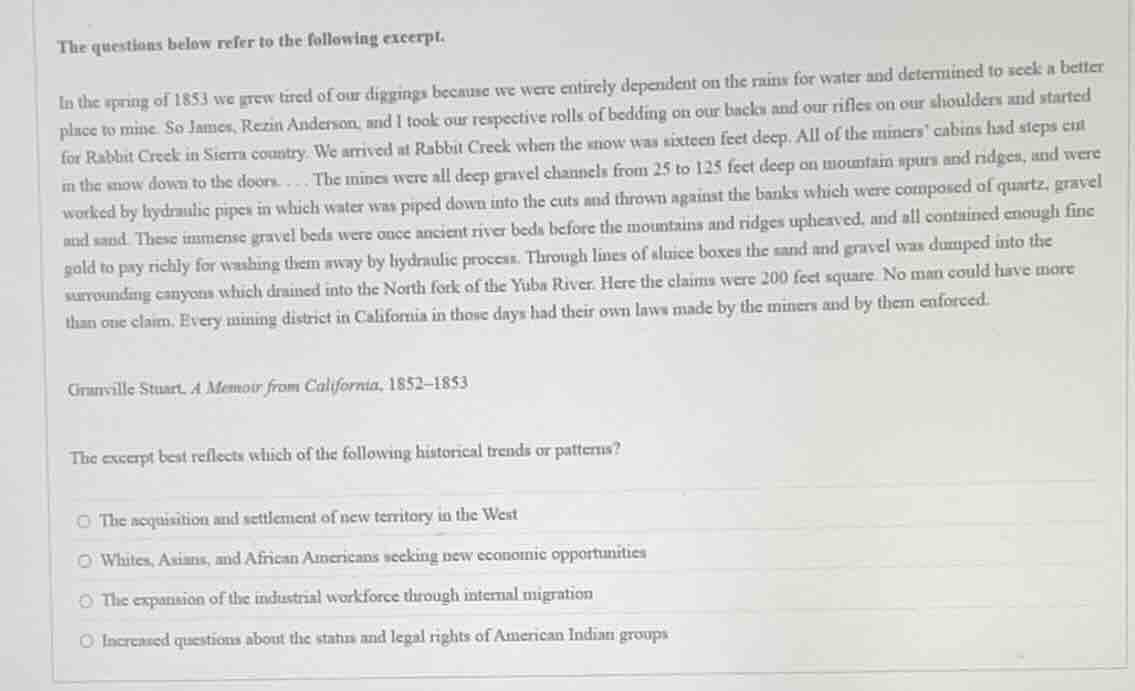
the questions below refer to the following excerpt.
in the spring of 1853 we grew tired of our diggings because we were entirely dependent on the rains for water and determined to seek a better place to mine. so james, rezin anderson, and i took our respective rolls of bedding on our backs and our rifles on our shoulders and started for rabbit creek in sierra country. we arrived at rabbit creek when the snow was sixteen feet deep. all of the miners cabins had steps cut in the snow down to the doors.... the mines were all deep gravel channels from 25 to 125 feet deep on mountain spurs and ridges, and were worked by hydraulic pipes in which water was piped down into the cuts and thrown against the banks which were composed of quartz, gravel and sand. these immense gravel beds were once ancient river beds before the mountains and ridges upheaved, and all contained enough fine gold to pay richly for washing them away by hydraulic process. through lines of sluice boxes the sand and gravel was dumped into the surrounding canyons which drained into the north fork of the yuba river. here the claims were 200 feet square. no man could have more than one claim. every mining district in california in those days had their own laws made by the miners and by them enforced.
granville stuart, a memoir from california, 1852-1853
the excerpt best reflects which of the following historical trends or patterns?
- the acquisition and settlement of new territory in the west
- whites, asians, and african americans seeking new economic opportunities
- the expansion of the industrial workforce through internal migration
- increased questions about the status and legal rights of american indian groups
Analyze the historical context of the excerpt
Using the Manifest Destiny knowledge point, we identify that this 1853 memoir by Granville Stuart describes gold mining in California (Sierra country, Rabbit Creek, Yuba River). This period directly follows the acquisition of California via the Treaty of Guadalupe Hidalgo (1848) and the subsequent California Gold Rush, which drew thousands of migrants seeking wealth.
Evaluate the options against the text
- Option 1 ("The acquisition and settlement of new territory in the West"): This aligns perfectly with the historical context of the early 1850s, where the U.S. settled newly acquired western lands following the Mexican-American War.
- Option 2 ("Whites, Asians, and African Americans seeking new economic opportunities"): While diverse groups did migrate, the excerpt itself focuses on a specific group of miners ("James, Rezin Anderson, and I") and does not describe or reflect multi-ethnic cooperation or demographic trends.
- Option 3 ("The expansion of the industrial workforce through internal migration"): Gold mining in 1853, especially individual claims and hydraulic mining described here, is categorized under resource extraction and western settlement rather than the expansion of the urban industrial factory workforce.
- Option 4 ("Increased questions about the status and legal rights of American Indian groups"): The excerpt discusses miners making and enforcing their own local laws, but it does not address the legal status or rights of Native Americans.
Formulate the final conclusion
The passage describes the physical movement, settlement, and resource extraction by American migrants in California during the gold rush. This is a direct reflection of the broader mid-19th-century trend of acquiring and settling new western territories.

Snap & solve any problem in the app
Get step-by-step solutions on Sovi AI
Photo-based solutions with guided steps
Explore more problems and detailed explanations
- The acquisition and settlement of new territory in the West (Correct answer)
- Whites, Asians, and African Americans seeking new economic opportunities
- The expansion of the industrial workforce through internal migration
- Increased questions about the status and legal rights of American Indian groups