QUESTION IMAGE
Question
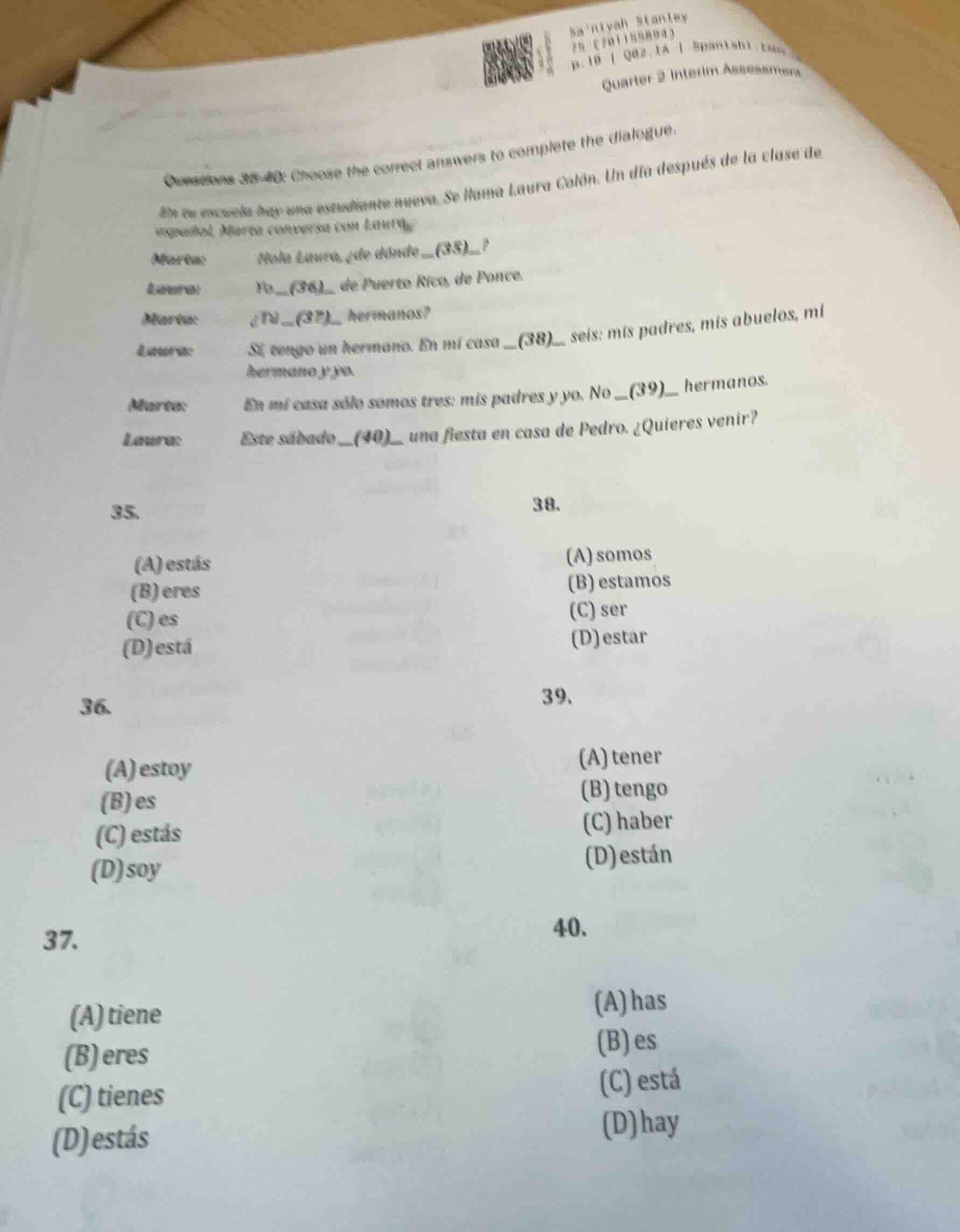
questions 35 - 40: choose the correct answers to complete the dialogue. en su escuela hay una estudiante nueva. se llama laura colón. un día después de la clase de español, marta conversa con laura. marta: hola laura, ¿de dónde (35) ? laura: yo (36) de puerto rico, de ponce. marta: ¿tú (37) hermanos? laura: sí, tengo un hermano. en mi casa (38) seis: mis padres, mis abuelos, mi hermano y yo. marta: en mi casa solo somos tres: mis padres y yo. no (39) hermanos. laura: este sábado (40) una fiesta en casa de pedro. ¿quieres venir? 35. (a) estás (b) eres (c) es (d) está 36. (a) estoy (b) es (c) estás (d) soy 37. (a) tiene (b) eres (c) tienes (d) estás 38. (a) somos (b) estamos (c) ser (d) estar 39. (a) tener (b) tengo (c) haber (d) están 40. (a) has (b) es (c) está (d) hay
- 35: The question asks about Laura's origin, using the tú form of "ser" (for origin/identity). "Eres" is the correct tú conjugation of "ser".
- 36: Laura states her origin, using the yo form of "ser". "Soy" is the correct yo conjugation of "ser".
- 37: Marta asks if Laura has siblings, using the tú form of "tener". "Tienes" is the correct tú conjugation of "tener".
- 38: Laura describes the number of people in her house, using the nosotros form of "ser" (for describing a group's quantity/identity). "Somos" is the correct nosotros conjugation of "ser".
- 39: Marta says she has no siblings, using the yo form of "tener" in negative. "Tengo" is the correct yo conjugation of "tener".
- 40: Laura mentions a party exists, using "hay" (the impersonal verb for "there is/are").

Snap & solve any problem in the app
Get step-by-step solutions on Sovi AI
Photo-based solutions with guided steps
Explore more problems and detailed explanations
- (B) eres
- (D) soy
- (C) tienes
- (A) somos
- (B) tengo
- (D) hay