QUESTION IMAGE
Question
question 3
you may need accent marks. please copy and paste what you need from here: á é í ó ú ñ é ¡
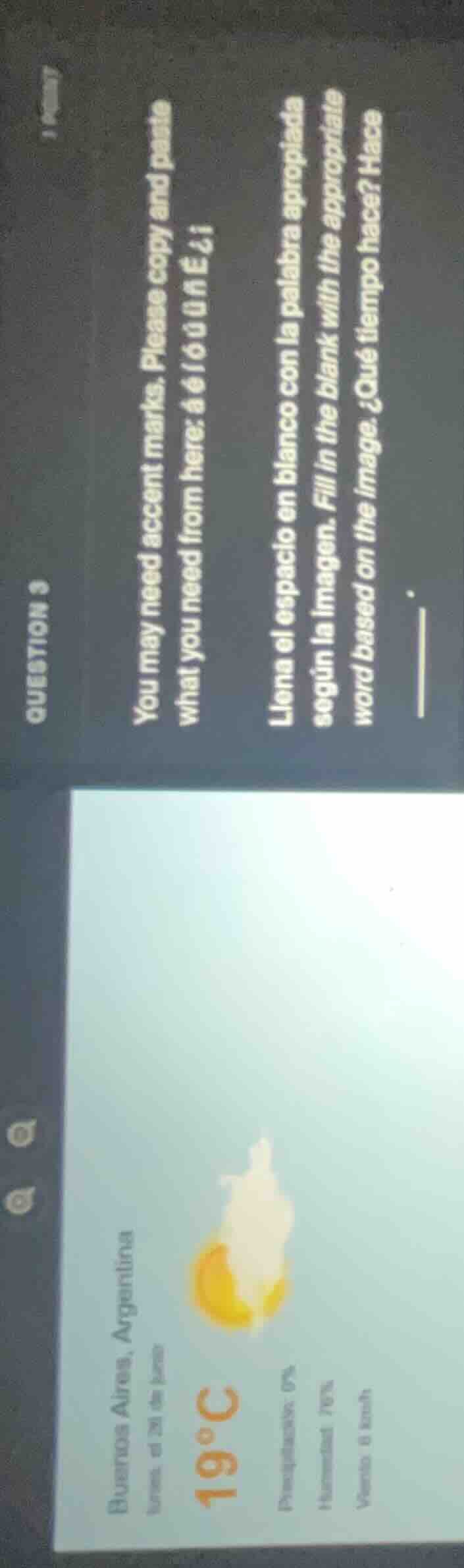
llena el espacio en blanco con la palabra apropiada según la imagen. fill in the blank with the appropriate word based on the image. ¿qué tiempo hace? hace ______.
(image shows buenos aires, argentina, 19°c, and a sunny icon)
The image shows a sunny weather symbol (sun with some clouds? Or mostly sunny) and the temperature is 19°C in Buenos Aires, Argentina. The question is "¿Qué tiempo hace?" (What's the weather like?). For sunny weather, the appropriate word in Spanish is "soleado" (sunny). Wait, but let's check the image again. The symbol looks like the sun is out, maybe "hace sol" but the blank is to fill the word. Wait, maybe the image has a sun, so the weather is sunny. The correct word for sunny weather in the context of "¿Qué tiempo hace?" would be "soleado" or maybe "hace sol" but the blank is to fill the word. Wait, the image shows the sun, so the weather is sunny. The appropriate word here, considering the weather symbol (sun), the answer should be related to sunny. Wait, maybe the image has a sun, so the weather is "soleado" or "hace sol" but the blank is to fill the word. Wait, the question is to fill in the blank with the appropriate word based on the image. The image shows the sun (19°C, Buenos Aires), so the weather is sunny. The Spanish word for sunny weather in this context, when answering "¿Qué tiempo hace?", the response is "hace sol" but the blank is maybe for the adjective. Wait, no, the question is "¿Qué tiempo hace? Hace ____". So the blank should be filled with the weather condition. The image shows a sun, so the weather is "soleado" (sunny) or "hace sol" but the blank is a single word? Wait, maybe the image has a sun, so the correct word is "sol" (sun) but with the verb "hacer", it's "hace sol" (it's sunny). But the blank is after "Hace", so "Hace sol". Wait, but the user's image shows a sun, 19°C, Buenos Aires. So the appropriate word to fill in the blank (after "Hace") is "sol", making "Hace sol" (It's sunny). Alternatively, if it's an adjective, "soleado", but "hace sol" is the common phrase. Let's check the image again. The image has a sun (yellow circle with a white cloud-like shape, maybe a partly sunny? But the temperature is 19°C, Buenos Aires. The common phrase for sunny weather is "hace sol". So the blank should be filled with "sol" (but with accent? Wait, "sol" doesn't have an accent. Wait, maybe the image's text has "¿Qué tiempo hace? Hace ____" and the appropriate word is "sol" or "soleado". Wait, the user's instruction says "copy and paste what you need from here: á é í ó ú ñ É ñ ¡" so maybe the word has an accent? No, "sol" doesn't have an accent. Wait, maybe "soleado" but that's an adjective. Wait, the correct phrase is "hace sol" (it's sunny). So the blank is filled with "sol". But let's confirm. In Spanish, "¿Qué tiempo hace?" is answered with "Hace sol" (sunny), "Hace frío" (cold), "Hace calor" (hot), etc. The image shows a sun, so "Hace sol". So the appropriate word to fill in the blank (after "Hace") is "sol".

Snap & solve any problem in the app
Get step-by-step solutions on Sovi AI
Photo-based solutions with guided steps
Explore more problems and detailed explanations
sol