QUESTION IMAGE
Question
question 2
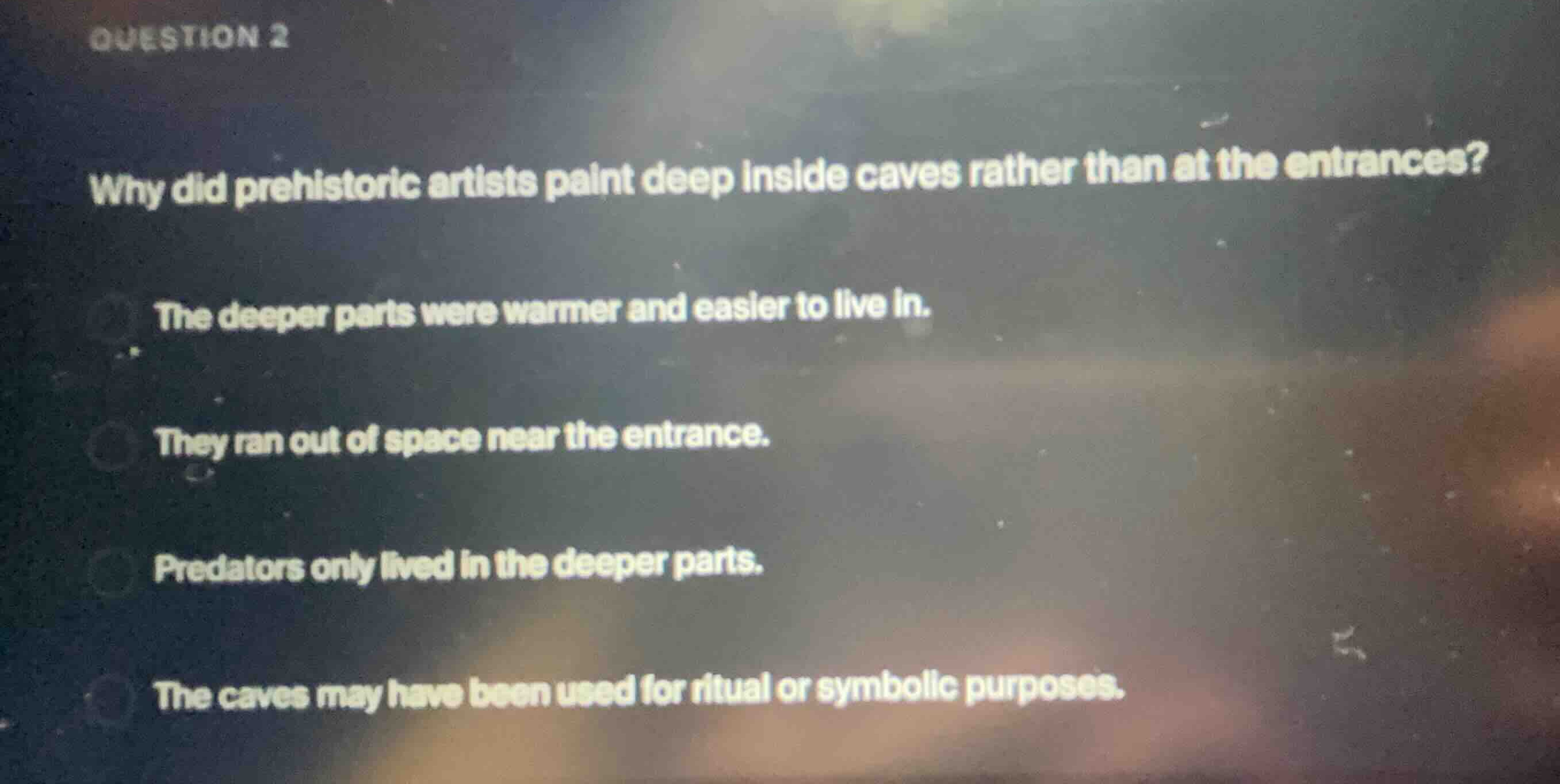
why did prehistoric artists paint deep inside caves rather than at the entrances?
the deeper parts were warmer and easier to live in.
they ran out of space near the entrance.
predators only lived in the deeper parts.
the caves may have been used for ritual or symbolic purposes.
<pre_analysis>
{
"quality": "clear",
"question_count": 1,
"skills_matched": [
"direct_cot",
"multiple_choice_formatter",
"explain_then_answer",
"quick"
],
"needs_drawing": false,
"concepts_used": [],
"new_concepts": [
"Prehistoric Art",
"Cave Painting Functions",
"Ritual Art"
],
"current_concepts": [
"Prehistoric Art",
"Cave Painting Functions",
"Ritual Art"
]
}
</pre_analysis>
<reasoning>
Analyze the environmental and practical context of cave art
Deep cave chambers are dark, cold, difficult to access, and not suitable for daily habitation, which disproves the idea that they were painted there for warmth or convenience.
Evaluate the symbolic and ritualistic theories
The placement of paintings in remote, hard-to-reach galleries suggests these spaces held sacred, ceremonial, or spiritual significance rather than serving as mere decoration or random storage.
Assess the given multiple-choice options
The statement "The caves may have been used for ritual or symbolic purposes" aligns with the consensus among archaeologists and art historians regarding Paleolithic cave art.
</reasoning>
<answer>
<mcq-option>(A) The deeper parts were warmer and easier to live in.</mcq-option>
<mcq-option>(B) They ran out of space near the entrance.</mcq-option>
<mcq-option>(C) Predators only lived in the deeper parts.</mcq-option>
<mcq-correct>(D) The caves may have been used for ritual or symbolic purposes.</mcq-correct>
</answer>
<post_analysis>
{
"subject": "Arts",
"question_type": "Multiple Choice",
"knowledge_point": [
"Arts",
"Art History",
"Prehistoric Art"
]
}
</post_analysis>
Snap & solve any problem in the app
Get step-by-step solutions on Sovi AI
Photo-based solutions with guided steps
Explore more problems and detailed explanations
<pre_analysis>
{
"quality": "clear",
"question_count": 1,
"skills_matched": [
"direct_cot",
"multiple_choice_formatter",
"explain_then_answer",
"quick"
],
"needs_drawing": false,
"concepts_used": [],
"new_concepts": [
"Prehistoric Art",
"Cave Painting Functions",
"Ritual Art"
],
"current_concepts": [
"Prehistoric Art",
"Cave Painting Functions",
"Ritual Art"
]
}
</pre_analysis>
<reasoning>
Analyze the environmental and practical context of cave art
Deep cave chambers are dark, cold, difficult to access, and not suitable for daily habitation, which disproves the idea that they were painted there for warmth or convenience.
Evaluate the symbolic and ritualistic theories
The placement of paintings in remote, hard-to-reach galleries suggests these spaces held sacred, ceremonial, or spiritual significance rather than serving as mere decoration or random storage.
Assess the given multiple-choice options
The statement "The caves may have been used for ritual or symbolic purposes" aligns with the consensus among archaeologists and art historians regarding Paleolithic cave art.
</reasoning>
<answer>
<mcq-option>(A) The deeper parts were warmer and easier to live in.</mcq-option>
<mcq-option>(B) They ran out of space near the entrance.</mcq-option>
<mcq-option>(C) Predators only lived in the deeper parts.</mcq-option>
<mcq-correct>(D) The caves may have been used for ritual or symbolic purposes.</mcq-correct>
</answer>
<post_analysis>
{
"subject": "Arts",
"question_type": "Multiple Choice",
"knowledge_point": [
"Arts",
"Art History",
"Prehistoric Art"
]
}
</post_analysis>