QUESTION IMAGE
Question
question
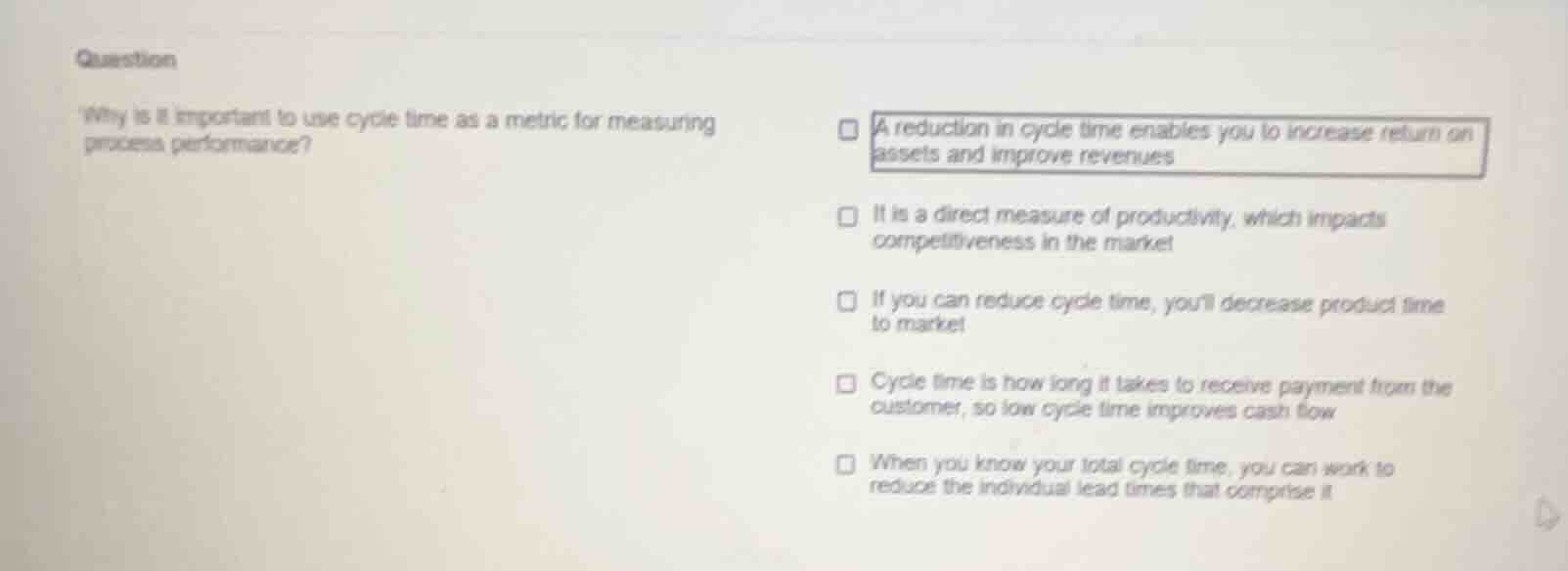
why is it important to use cycle time as a metric for measuring process performance?
- a reduction in cycle time enables you to increase return on assets and improve revenues
- it is a direct measure of productivity, which impacts competitiveness in the market
- if you can reduce cycle time, youll decrease product time to market
- cycle time is how long it takes to receive payment from the customer, so low cycle time improves cash flow
- when you know your total cycle time, you can work to reduce the individual lead times that comprise it
Understand the core question
The question asks why it is important to use cycle time as a metric for measuring process performance. We need to evaluate the given options to find the most accurate business and operational justification for tracking cycle time.
Analyze the first option
The first option states: "A reduction in cycle time enables you to increase return on assets and improve revenues."
- Reducing cycle time means processes run faster, which decreases work-in-progress (WIP) inventory. Less capital tied up in inventory directly increases the return on assets (ROA).
- Faster delivery and higher throughput also allow a company to fulfill more orders, directly improving revenues.
- This is a fundamental concept in Performance Measurement Approaches and Six Sigma Metrics.
Analyze the second option
The second option states: "It is a direct measure of productivity, which impacts competitiveness in the market."
- Productivity is typically defined as output per unit of input (e.g., labor hours). Cycle time measures duration, not resource efficiency directly, making this less precise than the financial and asset-utilization link.
Analyze the third and fourth options
The third option states: "If you can reduce cycle time, you'll decrease product time to market."
- While true for product development, cycle time applies to all operational processes, not just product launch phases.
The fourth option states: "Cycle time is how long it takes to receive payment from the customer, so low cycle time improves cash flow."
- This specifically describes "Days Sales Outstanding" (DSO) or the cash conversion cycle, which is only one specific financial cycle, not the general definition of process cycle time.
Analyze the fifth option
The fifth option states: "When you know your total cycle time, you can work to reduce the individual lead times that comprise it."
- This reverses the relationship; total lead time is comprised of individual process cycle times and queue times, not the other way around. Therefore, the first option is the most comprehensive and accurate.

Snap & solve any problem in the app
Get step-by-step solutions on Sovi AI
Photo-based solutions with guided steps
Explore more problems and detailed explanations
- (A) A reduction in cycle time enables you to increase return on assets and improve revenues (Correct answer)
- (B) It is a direct measure of productivity, which impacts competitiveness in the market
- (C) If you can reduce cycle time, you'll decrease product time to market
- (D) Cycle time is how long it takes to receive payment from the customer, so low cycle time improves cash flow
- (E) When you know your total cycle time, you can work to reduce the individual lead times that comprise it