QUESTION IMAGE
Question
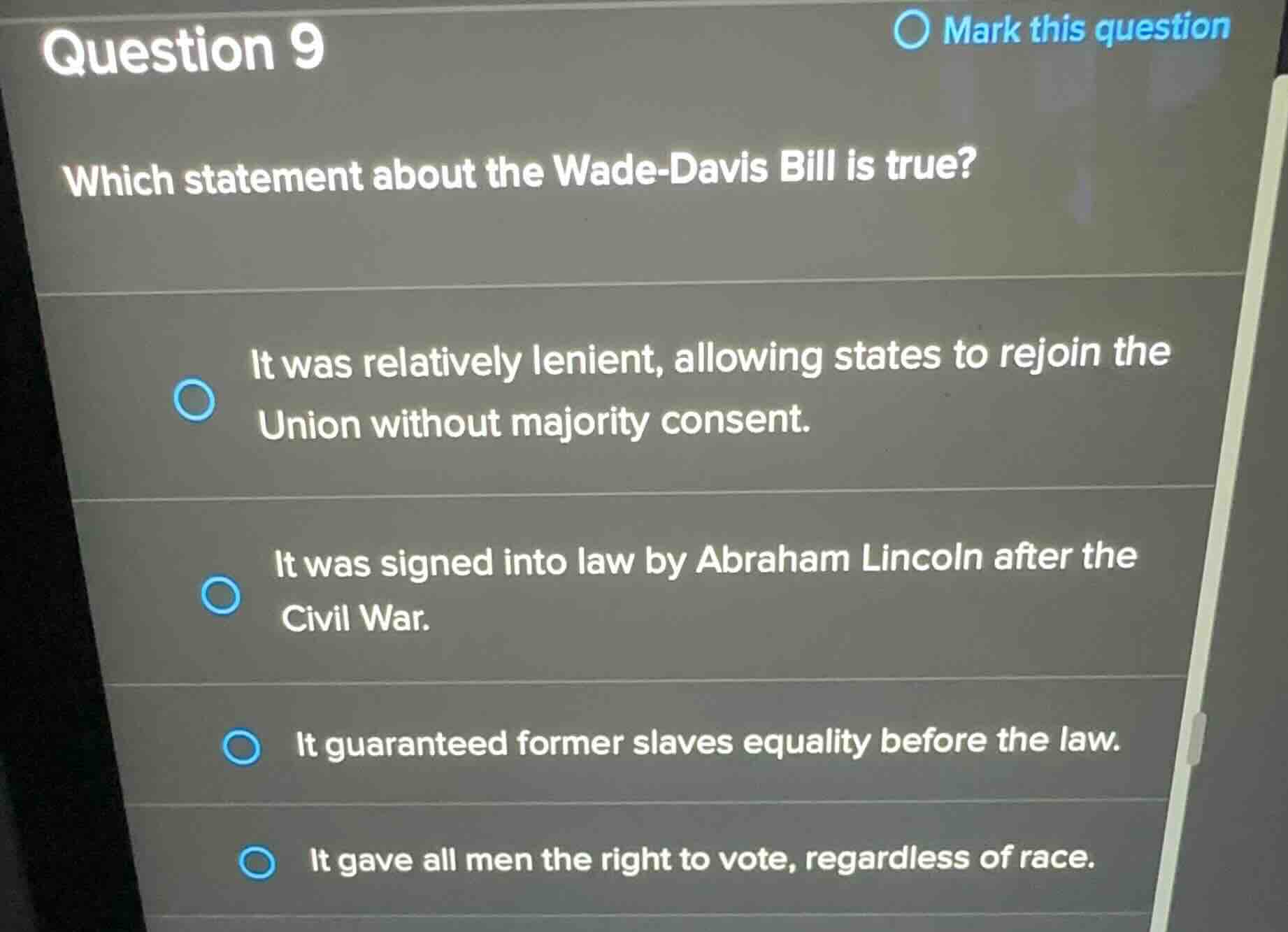
question 9
which statement about the wade-davis bill is true?
- it was relatively lenient, allowing states to rejoin the union without majority consent.
- it was signed into law by abraham lincoln after the civil war.
- it guaranteed former slaves equality before the law.
- it gave all men the right to vote, regardless of race.
Analyze the Wade-Davis Bill context
The Wade-Davis Bill was proposed in 1864 by Radical Republicans Benjamin Wade and Henry Winter Davis as a stricter alternative to Abraham Lincoln's lenient Ten Percent Plan during the Southern Reconstruction Context.
Evaluate the provisions of the bill
The bill required that 50 percent of a seceded state's white male voters take an "Ironclad Oath" of allegiance swearing they had never supported the Confederacy before the state could readmit to the Union. It also required states to abolish slavery, repudiate Confederate war debts, and guarantee former slaves equality before the law (civil rights), though it did not grant them the right to vote.
Assess the options
- Option 1: "It was relatively lenient..." is incorrect. It was far stricter than Lincoln's plan, requiring a majority (50%) rather than 10%.
- Option 2: "It was signed into law by Abraham Lincoln..." is incorrect. Lincoln used a pocket veto to block the bill in July 1864; it never became law.
- Option 3: "It guaranteed former slaves equality before the law." is correct. The bill contained provisions requiring the new state constitutions to ban slavery and guarantee equality before the law for freedmen.
- Option 4: "It gave all men the right to vote, regardless of race." is incorrect. The bill did not establish black suffrage (the right to vote).

Snap & solve any problem in the app
Get step-by-step solutions on Sovi AI
Photo-based solutions with guided steps
Explore more problems and detailed explanations
- (A) It was relatively lenient, allowing states to rejoin the Union without majority consent.
- (B) It was signed into law by Abraham Lincoln after the Civil War.
- (C) It guaranteed former slaves equality before the law. (Correct answer)
- (D) It gave all men the right to vote, regardless of race.