QUESTION IMAGE
Question
question
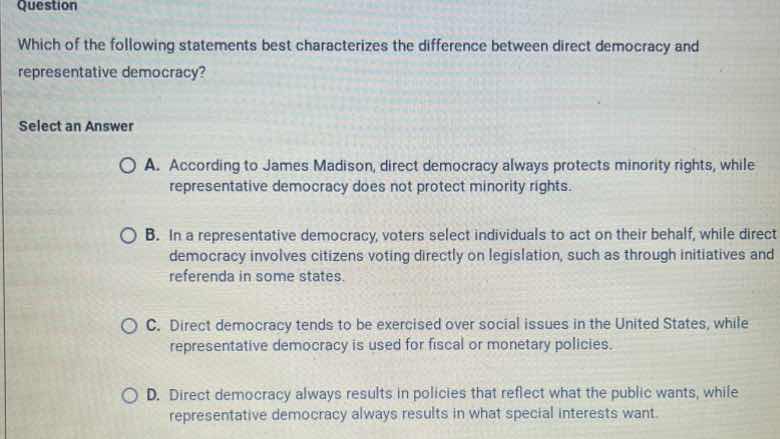
which of the following statements best characterizes the difference between direct democracy and representative democracy?
select an answer
a. according to james madison, direct democracy always protects minority rights, while representative democracy does not protect minority rights.
b. in a representative democracy, voters select individuals to act on their behalf, while direct democracy involves citizens voting directly on legislation, such as through initiatives and referenda in some states.
c. direct democracy tends to be exercised over social issues in the united states, while representative democracy is used for fiscal or monetary policies.
d. direct democracy always results in policies that reflect what the public wants, while representative democracy always results in what special interests want.
Define direct and representative democracy
Direct democracy involves citizens voting directly on laws and policies, whereas representative democracy involves citizens electing officials to make decisions on their behalf.
Evaluate the given options
- Option A is incorrect because James Madison argued in Federalist No. 10 that direct democracies are prone to the tyranny of the majority and fail to protect minority rights.
- Option B correctly defines representative democracy (voters select individuals to act on their behalf) and direct democracy (citizens voting directly on legislation, such as initiatives and referenda).
- Option C is incorrect because direct democracy mechanisms (like state referenda) can cover fiscal issues (e.g., tax limits), and representative bodies handle both social and fiscal policies.
- Option D is incorrect because it uses absolute terms ("always") that do not accurately characterize the complex outcomes of either system.

Snap & solve any problem in the app
Get step-by-step solutions on Sovi AI
Photo-based solutions with guided steps
Explore more problems and detailed explanations
- (A) According to James Madison, direct democracy always protects minority rights, while representative democracy does not protect minority rights.
- (B) In a representative democracy, voters select individuals to act on their behalf, while direct democracy involves citizens voting directly on legislation, such as through initiatives and referenda in some states. (Correct answer)
- (C) Direct democracy tends to be exercised over social issues in the United States, while representative democracy is used for fiscal or monetary policies.
- (D) Direct democracy always results in policies that reflect what the public wants, while representative democracy always results in what special interests want.