QUESTION IMAGE
Question
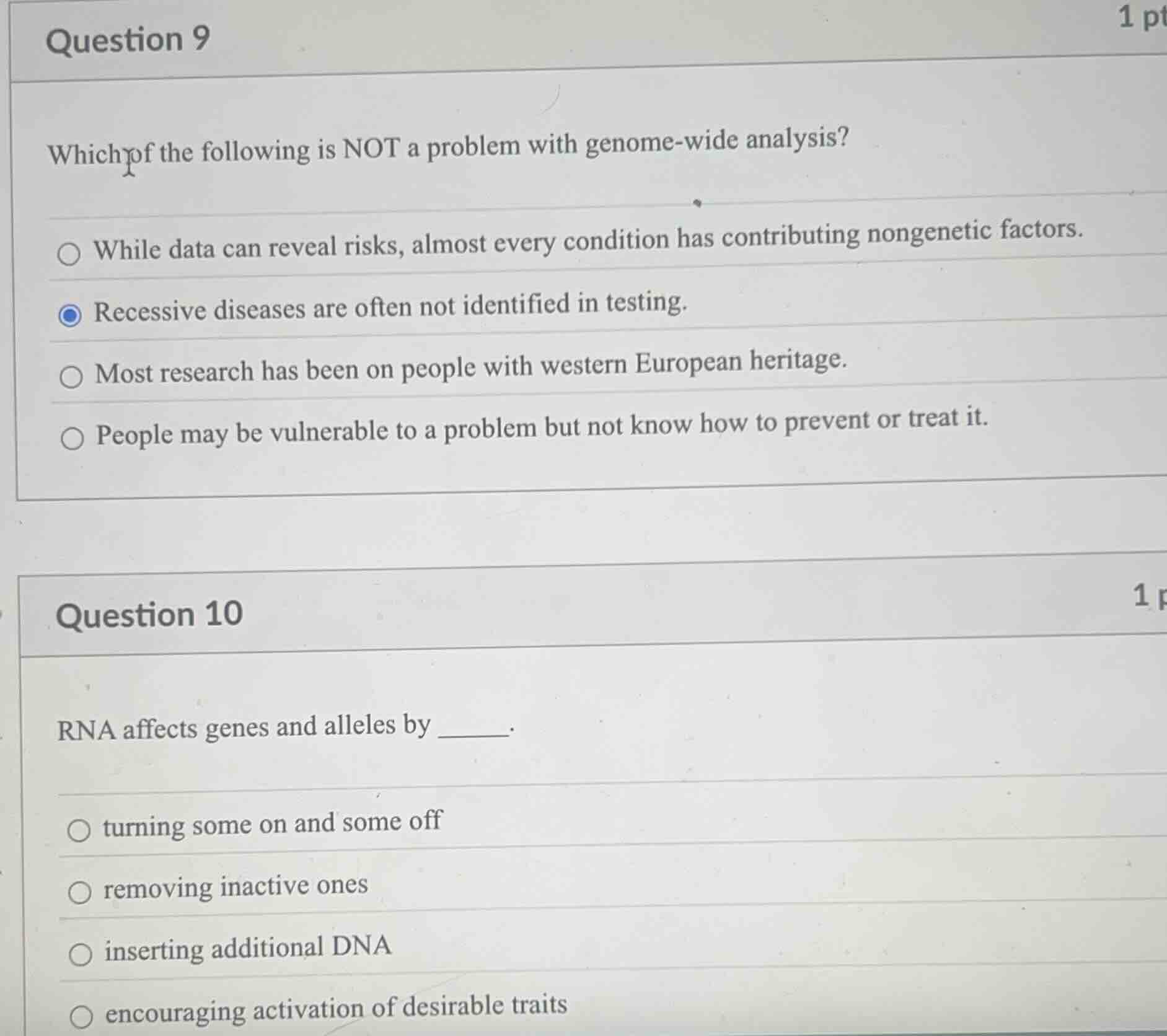
question 9
which of the following is not a problem with genome-wide analysis?
- while data can reveal risks, almost every condition has contributing nongenetic factors.
- recessive diseases are often not identified in testing.
- most research has been on people with western european heritage.
- people may be vulnerable to a problem but not know how to prevent or treat it.
question 10
rna affects genes and alleles by ______.
- turning some on and some off
- removing inactive ones
- inserting additional dna
- encouraging activation of desirable traits
Analyze Question 9 regarding genome-wide analysis
Genome-wide association studies (GWAS) look at genetic variants across the entire genome to find associations with diseases. Let's evaluate each option to find which is NOT a problem:
- Option 1: "While data can reveal risks, almost every condition has contributing nongenetic factors." This is a true limitation/problem of genome-wide analysis because environmental factors complicate risk prediction.
- Option 2: "Recessive diseases are often not identified in testing." This is NOT a characteristic problem of genome-wide analysis. Genome-wide sequencing and microarray technologies are highly capable of detecting homozygous or compound heterozygous variants responsible for recessive diseases.
- Option 3: "Most research has been on people with western European heritage." This is a well-known bias and major problem in current genomic databases, limiting clinical applicability to diverse populations.
- Option 4: "People may be vulnerable to a problem but not know how to prevent or treat it." This is an ethical and clinical challenge (actionability) of revealing genetic predispositions for untreatable conditions.
Therefore, the statement that is NOT a problem with genome-wide analysis is that recessive diseases are often not identified in testing.
Analyze Question 10 regarding how RNA affects genes and alleles
RNA molecules, particularly non-coding RNAs (such as microRNAs, siRNAs, and long non-coding RNAs), play a major role in regulating gene expression post-transcriptionally or epigenetically:
- Option 1: "turning some on and some off." This describes gene regulation (activation and silencing), which is a primary mechanism by which RNA molecules modulate gene expression.
- Option 2: "removing inactive ones." RNA does not physically excise or remove DNA sequences from the genome.
- Option 3: "inserting additional DNA." RNA does not insert DNA into the host genome during normal cellular regulation.
- Option 4: "encouraging activation of desirable traits." Biological systems do not selectively regulate genes based on human-defined "desirable" traits.
Thus, RNA affects genes and alleles by turning some on and some off.

Snap & solve any problem in the app
Get step-by-step solutions on Sovi AI
Photo-based solutions with guided steps
Explore more problems and detailed explanations
Question 9
- (A) While data can reveal risks, almost every condition has contributing nongenetic factors.
- (B) Recessive diseases are often not identified in testing. (Correct answer)
- (C) Most research has been on people with western European heritage.
- (D) People may be vulnerable to a problem but not know how to prevent or treat it.
Question 10
- (A) turning some on and some off (Correct answer)
- (B) removing inactive ones
- (C) inserting additional DNA
- (D) encouraging activation of desirable traits