QUESTION IMAGE
Question
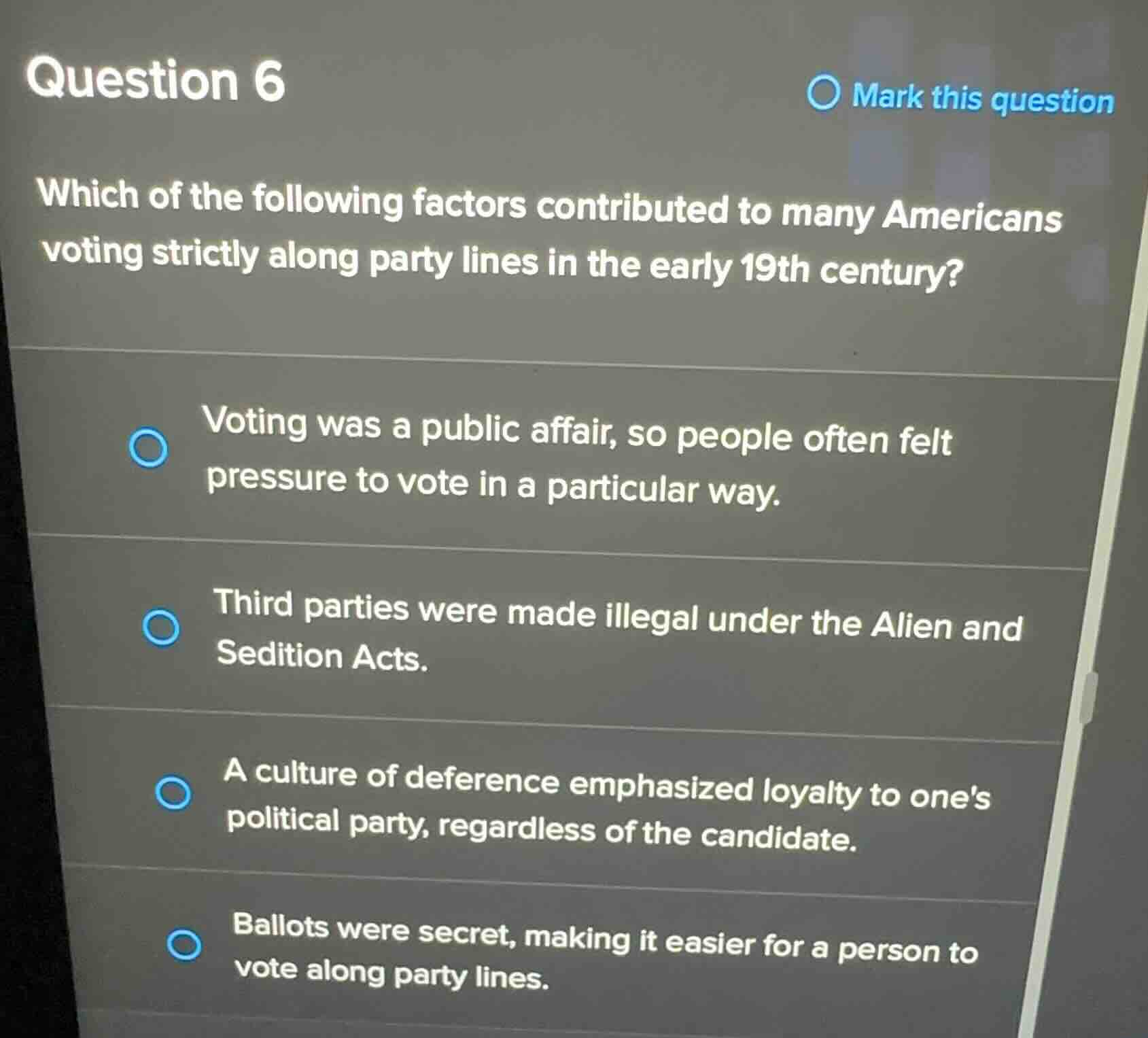
question 6
which of the following factors contributed to many americans voting strictly along party lines in the early 19th century?
- voting was a public affair, so people often felt pressure to vote in a particular way.
- third parties were made illegal under the alien and sedition acts.
- a culture of deference emphasized loyalty to ones political party, regardless of the candidate.
- ballots were secret, making it easier for a person to vote along party lines.
Analyze early 19th-century voting practices
In the early 19th century, voting in the United States was not a private or secret process. Instead, it was a highly public affair. Depending on the state, voting was conducted either out loud (viva voce) or using pre-printed, colored paper ballots provided directly by the political parties (party tickets). Because there was no government-printed secret ballot (the Australian ballot was not introduced in the US until the late 19th century), everyone at the polling place could see or hear exactly how an individual voted. This public nature of voting created immense social, political, and economic pressure from neighbors, employers, and party organizers to vote strictly along party lines.
Evaluate the incorrect options
- "Third parties were made illegal under the Alien and Sedition Acts." This is historically incorrect. The Alien and Sedition Acts of 1798 restricted speech critical of the government and targeted foreign nationals, but they did not outlaw third parties.
- "A culture of deference emphasized loyalty to one's political party, regardless of the candidate." The early 19th century, particularly during the rise of Jacksonian Democracy, saw a decline in the traditional "culture of deference" (where ordinary citizens deferred to the social elite) and an increase in active, mass-party mobilization.
- "Ballots were secret, making it easier for a person to vote along party lines." This is historically inaccurate. Secret ballots were not adopted in the United States until the late 1880s and 1890s.

Snap & solve any problem in the app
Get step-by-step solutions on Sovi AI
Photo-based solutions with guided steps
Explore more problems and detailed explanations
- Voting was a public affair, so people often felt pressure to vote in a particular way. (Correct answer)
- Third parties were made illegal under the Alien and Sedition Acts.
- A culture of deference emphasized loyalty to one's political party, regardless of the candidate.
- Ballots were secret, making it easier for a person to vote along party lines.