QUESTION IMAGE
Question
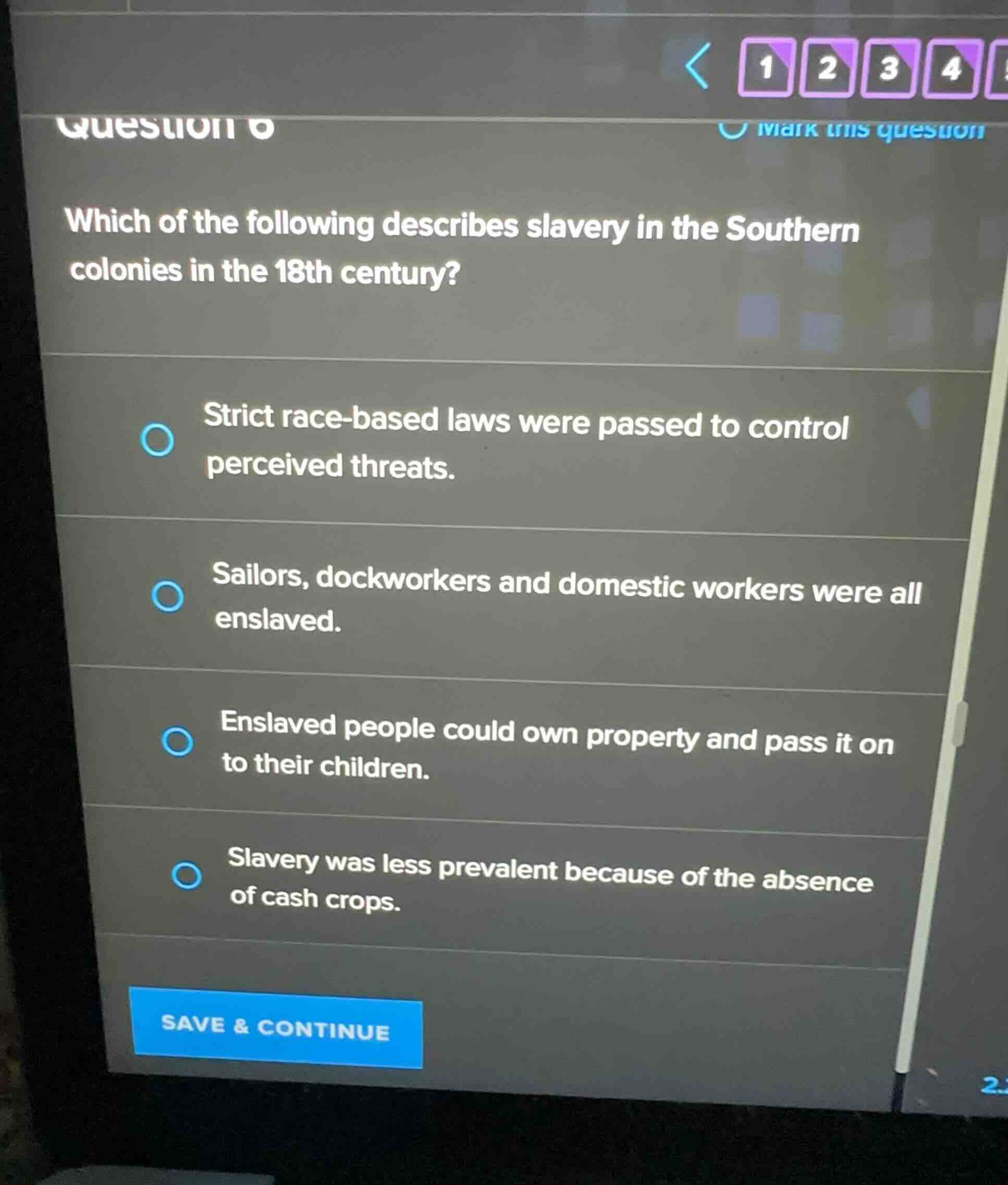
question 6
which of the following describes slavery in the southern colonies in the 18th century?
- strict race-based laws were passed to control perceived threats.
- sailors, dockworkers and domestic workers were all enslaved.
- enslaved people could own property and pass it on to their children.
- slavery was less prevalent because of the absence of cash crops.
Analyze the historical context of Southern slavery
Using the Colonial Slavery Systems knowledge point
In the 18th century, the Southern colonies (such as Virginia, Maryland, the Carolinas, and Georgia) developed plantation-based economies heavily reliant on cash crops like tobacco, rice, and indigo. As the enslaved population grew rapidly, white colonists established increasingly strict, race-based legal codes (slave codes) to control the enslaved population, restrict their movement, and prevent potential rebellions or perceived threats.
Evaluate the given options
- Option 1: "Strict race-based laws were passed to control perceived threats." This is historically accurate. As the enslaved population grew, colonial legislatures passed strict slave codes to legally codify racial slavery and prevent uprisings.
- Option 2: "Sailors, dockworkers and domestic workers were all enslaved." While some enslaved people worked in these roles, this description is much more characteristic of the diverse labor roles of enslaved people in the Northern or Middle colonies, rather than the defining feature of Southern plantation slavery.
- Option 3: "Enslaved people could own property and pass it on to their children." This is incorrect. Under Southern slave codes, enslaved people were legally classified as chattel property and had no legal rights to own or inherit property.
- Option 4: "Slavery was less prevalent because of the absence of cash crops." This is incorrect. The Southern economy was entirely defined by cash crops (tobacco, rice, indigo), making slavery highly prevalent and central to the region's economy.

Snap & solve any problem in the app
Get step-by-step solutions on Sovi AI
Photo-based solutions with guided steps
Explore more problems and detailed explanations
- Strict race-based laws were passed to control perceived threats. (Correct answer)
- Sailors, dockworkers and domestic workers were all enslaved.
- Enslaved people could own property and pass it on to their children.
- Slavery was less prevalent because of the absence of cash crops.