Sovi.AI - AI Math Tutor

Scan to solve math questions

QUESTION IMAGE

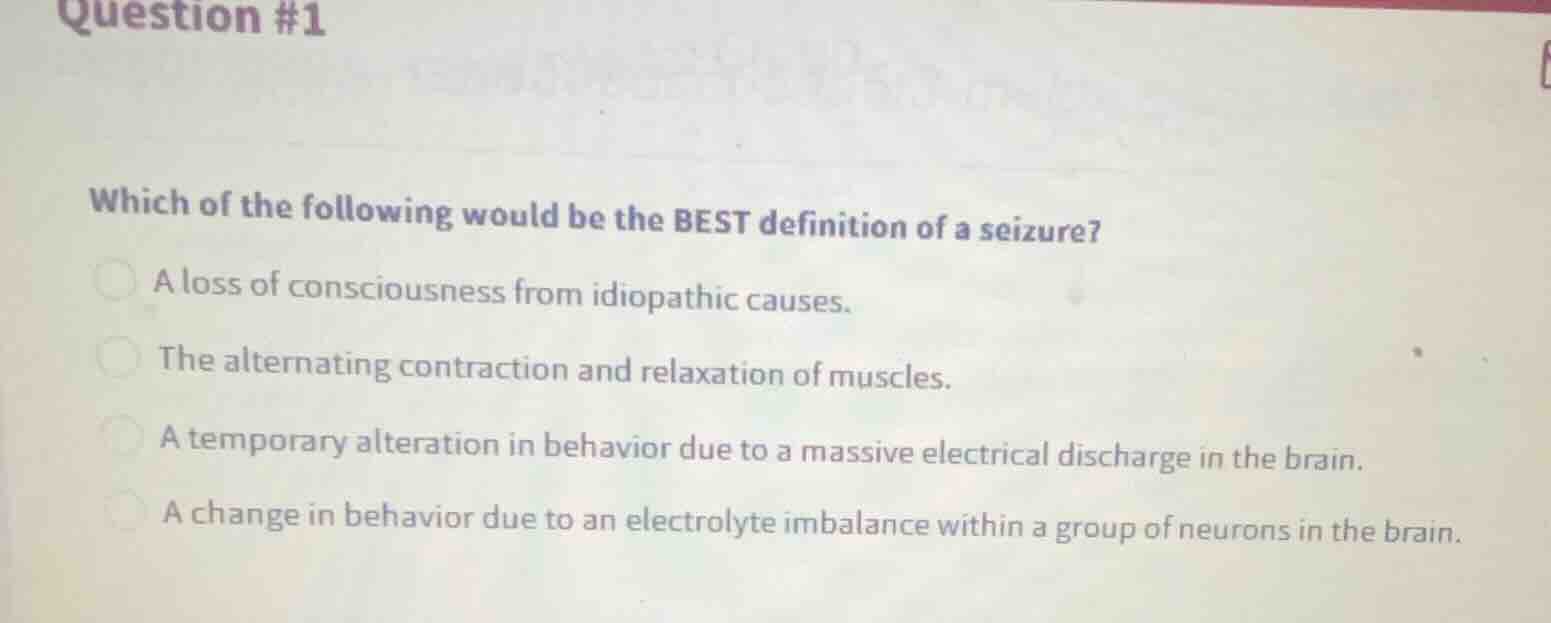
question #1 which of the following would be the best definition of a se…

Question

question #1

which of the following would be the best definition of a seizure?

a loss of consciousness from idiopathic causes.
the alternating contraction and relaxation of muscles.
a temporary alteration in behavior due to a massive electrical discharge in the brain.
a change in behavior due to an electrolyte imbalance within a group of neurons in the brain.

Explanation:

Response

<pre_analysis>
{
"quality": "clear",
"question_count": 1,
"skills_matched": [
"direct_cot",
"multiple_choice_formatter",
"explain_then_answer",
"tutor",
"mastery_adaptive_brevity"
],
"needs_drawing": false,
"concepts_used": [
"Seizure Risk Factors"
],
"new_concepts": [
"Seizure Definition",
"Pathophysiology of Seizures"
],
"current_concepts": [
"Seizure Risk Factors",
"Seizure Definition",
"Pathophysiology of Seizures"
]
}
</pre_analysis>

<reasoning>

Analyze the clinical definition of a seizure

Using the Seizure Risk Factors knowledge point, we evaluate the physiological mechanism of a seizure. A seizure is characterized by sudden, temporary, and uncontrolled electrical discharges in the brain's neurons, which disrupt normal cerebral function and lead to observable changes in behavior, sensation, or motor activity.

Evaluate the given options

  • Option 1 ("A loss of consciousness from idiopathic causes"): This describes syncope or general unconsciousness rather than the specific neurological mechanism of a seizure, as many seizures occur without a complete loss of consciousness (e.g., focal seizures).
  • Option 2 ("The alternating contraction and relaxation of muscles"): This specifically describes clonic muscle activity or convulsions. While convulsions can be a sign of a generalized tonic-clonic seizure, not all seizures involve motor activity (e.g., absence seizures).
  • Option 3 ("A temporary alteration in behavior due to a massive electrical discharge in the brain"): This accurately captures both the clinical presentation (temporary alteration in behavior, sensation, or consciousness) and the underlying pathophysiology (massive, synchronized electrical discharges in cerebral neurons).
  • Option 4 ("A change in behavior due to an electrolyte imbalance within a group of neurons in the brain"): While electrolyte imbalances (like hyponatremia) can trigger seizures, they are not the defining mechanism of all seizures.

</reasoning>

<answer>
<mcq-option>A loss of consciousness from idiopathic causes.</mcq-option>
<mcq-option>The alternating contraction and relaxation of muscles.</mcq-option>
<mcq-correct>A temporary alteration in behavior due to a massive electrical discharge in the brain.</mcq-correct>
<mcq-option>A change in behavior due to an electrolyte imbalance within a group of neurons in the brain.</mcq-option>
</answer>

<post_analysis>
{
"subject": "Natural Science",
"question_type": "Multiple Choice",
"knowledge_point": [
"Natural Science",
"Medicine",
"Neurological Emergencies"
]
}
</post_analysis>

Answer:

<pre_analysis>
{
"quality": "clear",
"question_count": 1,
"skills_matched": [
"direct_cot",
"multiple_choice_formatter",
"explain_then_answer",
"tutor",
"mastery_adaptive_brevity"
],
"needs_drawing": false,
"concepts_used": [
"Seizure Risk Factors"
],
"new_concepts": [
"Seizure Definition",
"Pathophysiology of Seizures"
],
"current_concepts": [
"Seizure Risk Factors",
"Seizure Definition",
"Pathophysiology of Seizures"
]
}
</pre_analysis>

<reasoning>

Analyze the clinical definition of a seizure

Using the Seizure Risk Factors knowledge point, we evaluate the physiological mechanism of a seizure. A seizure is characterized by sudden, temporary, and uncontrolled electrical discharges in the brain's neurons, which disrupt normal cerebral function and lead to observable changes in behavior, sensation, or motor activity.

Evaluate the given options

  • Option 1 ("A loss of consciousness from idiopathic causes"): This describes syncope or general unconsciousness rather than the specific neurological mechanism of a seizure, as many seizures occur without a complete loss of consciousness (e.g., focal seizures).
  • Option 2 ("The alternating contraction and relaxation of muscles"): This specifically describes clonic muscle activity or convulsions. While convulsions can be a sign of a generalized tonic-clonic seizure, not all seizures involve motor activity (e.g., absence seizures).
  • Option 3 ("A temporary alteration in behavior due to a massive electrical discharge in the brain"): This accurately captures both the clinical presentation (temporary alteration in behavior, sensation, or consciousness) and the underlying pathophysiology (massive, synchronized electrical discharges in cerebral neurons).
  • Option 4 ("A change in behavior due to an electrolyte imbalance within a group of neurons in the brain"): While electrolyte imbalances (like hyponatremia) can trigger seizures, they are not the defining mechanism of all seizures.

</reasoning>

<answer>
<mcq-option>A loss of consciousness from idiopathic causes.</mcq-option>
<mcq-option>The alternating contraction and relaxation of muscles.</mcq-option>
<mcq-correct>A temporary alteration in behavior due to a massive electrical discharge in the brain.</mcq-correct>
<mcq-option>A change in behavior due to an electrolyte imbalance within a group of neurons in the brain.</mcq-option>
</answer>

<post_analysis>
{
"subject": "Natural Science",
"question_type": "Multiple Choice",
"knowledge_point": [
"Natural Science",
"Medicine",
"Neurological Emergencies"
]
}
</post_analysis>