QUESTION IMAGE
Question
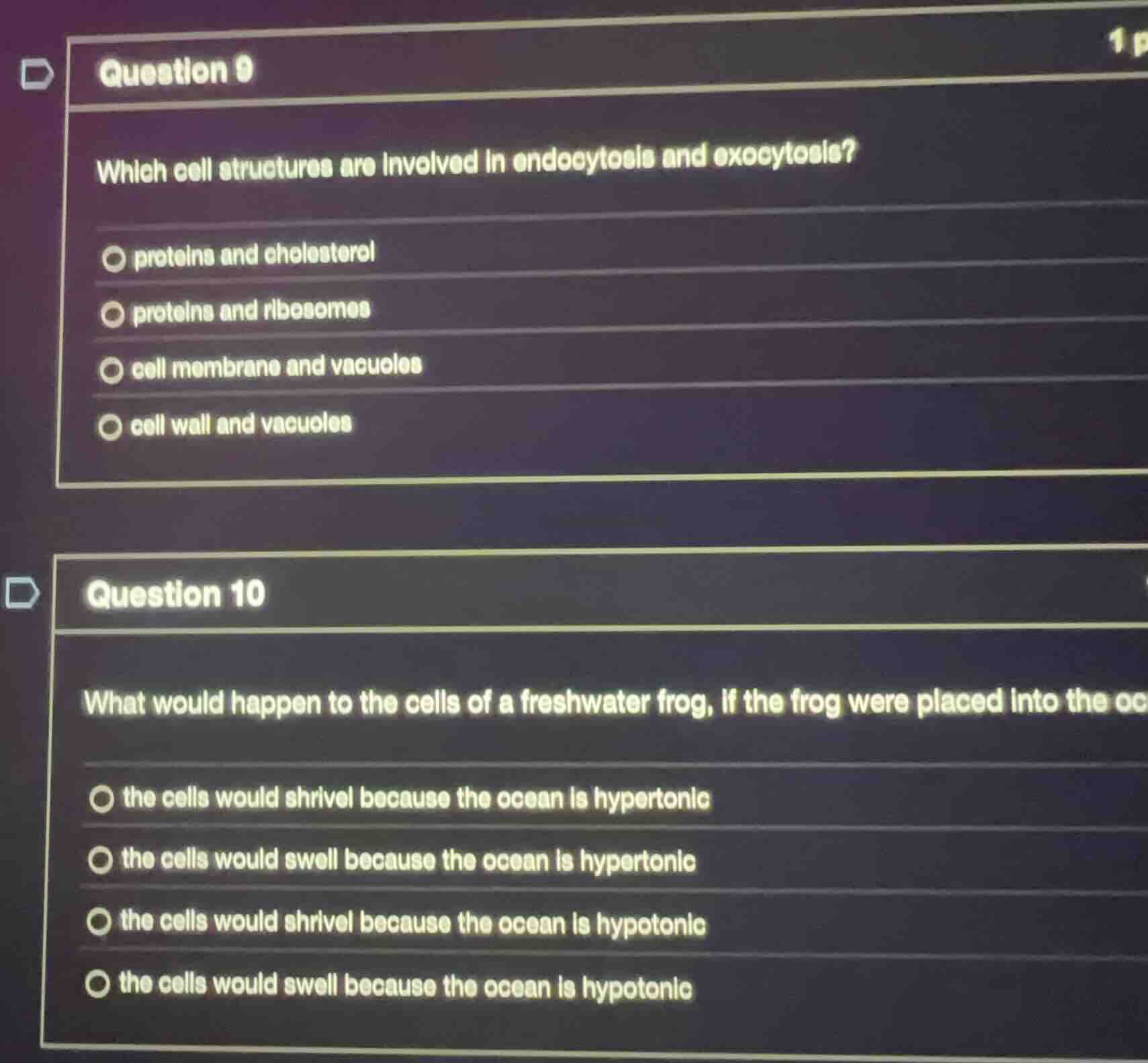
question 9
which cell structures are involved in endocytosis and exocytosis?
proteins and cholesterol
proteins and ribosomes
cell membrane and vacuoles
cell wall and vacuoles
question 10
what would happen to the cells of a freshwater frog, if the frog were placed into the ocean?
the cells would shrivel because the ocean is hypertonic
the cells would swell because the ocean is hypertonic
the cells would shrivel because the ocean is hypotonic
the cells would swell because the ocean is hypotonic
Analyze Question 9
Using the Endocytosis and Exocytosis knowledge points
- Endocytosis and exocytosis are active transport processes that move large particles or bulk quantities of substances across the cell membrane.
- Both processes rely on the fluid nature of the cell membrane to fold inward or fuse with internal membrane-bound sacs called vacuoles (or vesicles) to transport materials.
- Therefore, the cell membrane and vacuoles are the primary structures involved.
Analyze Question 10
Using the Tonicity knowledge point
- A freshwater frog has cells adapted to a low-solute (hypotonic) environment, meaning its internal cellular environment has a lower solute concentration than seawater.
- The ocean is highly saline, making it a hypertonic environment relative to the frog's cells.
- Due to osmosis, water will flow out of the frog's cells down its concentration gradient (from low solute concentration to high solute concentration), causing the cells to shrivel.

Snap & solve any problem in the app
Get step-by-step solutions on Sovi AI
Photo-based solutions with guided steps
Explore more problems and detailed explanations
Question 9
- proteins and cholesterol
- proteins and ribosomes
- cell membrane and vacuoles (Correct answer)
- cell wall and vacuoles
Question 10
- the cells would shrivel because the ocean is hypertonic (Correct answer)
- the cells would swell because the ocean is hypertonic
- the cells would shrivel because the ocean is hypotonic
- the cells would swell because the ocean is hypotonic