QUESTION IMAGE
Question
question 3
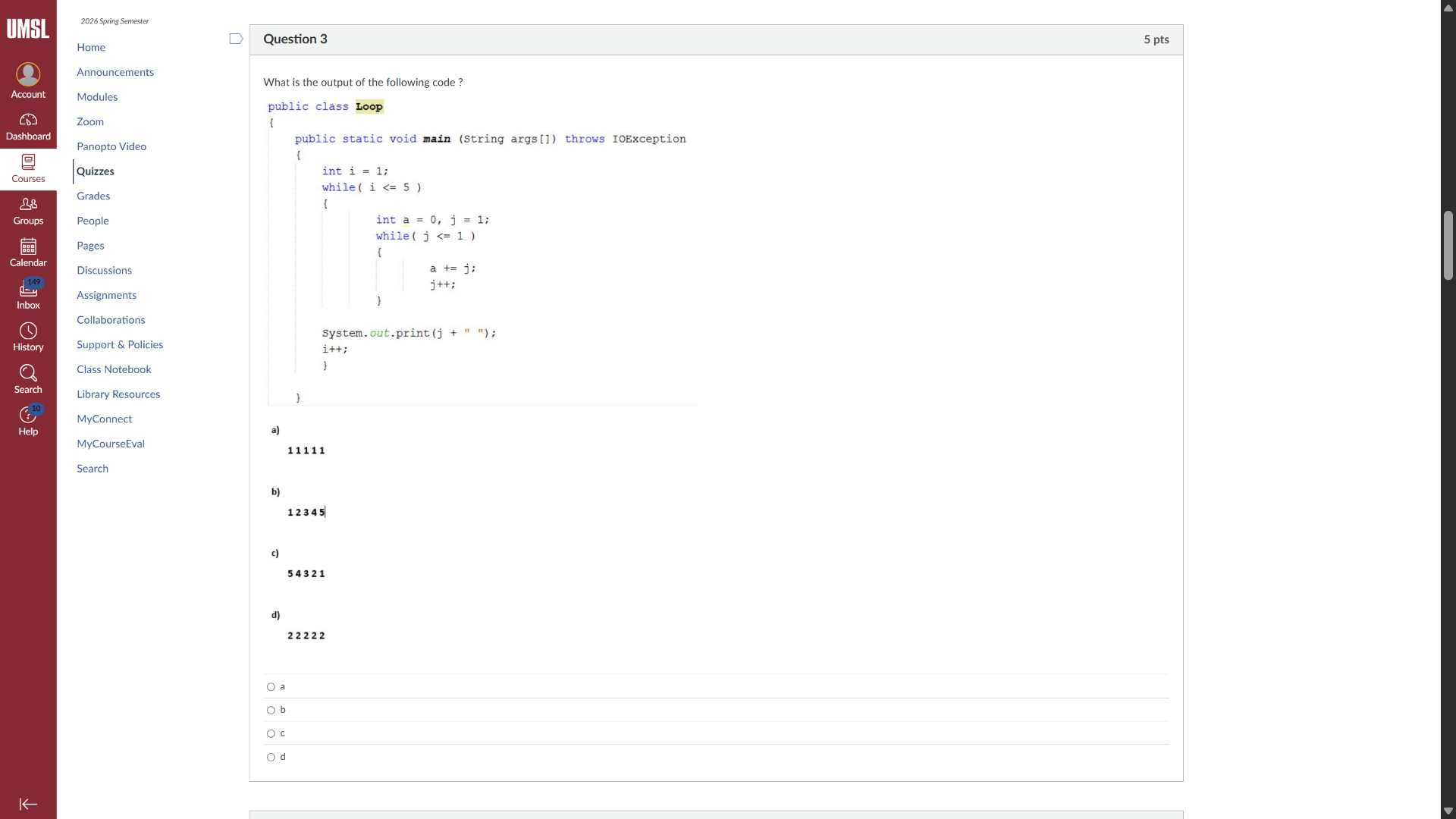
what is the output of the following code ?
java
public class loop
{
public static void main (string args) throws ioexception
{
int i = 1;
while( i <= 5 )
{
int a = 0, j = 1;
while( j <= 1 )
{
a += j;
j++;
}
system.out.print(j + \ \);
i++;
}
}
}
a)
1 1 1 1 1
b)
1 2 3 4 5
c)
5 4 3 2 1
d)
2 2 2 2 2
🆕 New Concept Discovered: Nested Loop Execution
Tracing variables step-by-step through inner and outer loops.
Step 1: Analyze the outer loop structure
The outer loop is controlled by the variable i, which starts at 1. The loop continues as long as i <= 5.
Inside this loop, several actions happen sequentially:
- Local variables
aandjare re-initialized:int a = 0, j = 1;. - An inner
whileloop runs. - The value of
jis printed followed by a space:System.out.print(j + " ");. iis incremented:i++;.
Step 2: Trace the inner loop execution
Let's look at what happens to j inside the inner loop during any single iteration of the outer loop:
- Before the inner loop starts,
jis initialized to1. - The inner loop condition is
while (j <= 1). - Since
jis1, the condition1 <= 1is true, so the loop body executes: a += j;(adds1toa)j++;(incrementsjto2)- The condition is checked again:
while (j <= 1). Sincejis now2, the condition2 <= 1is false, and the inner loop terminates.
At this point, the value of j is 2.
Step 3: Trace the print statement and outer loop iterations
After the inner loop terminates, the program executes:
System.out.print(j + " ");Since j is 2, this prints 2 .
Then, i is incremented (i++), and the outer loop moves to the next iteration.
Because a and j are declared and re-initialized to 0 and 1 respectively at the start of every outer loop iteration, this exact process repeats for every value of i from 1 to 5:
- Iteration 1 (
i = 1): Inner loop runs,jbecomes2, prints2. - Iteration 2 (
i = 2): Inner loop runs,jbecomes2, prints2. - Iteration 3 (
i = 3): Inner loop runs,jbecomes2, prints2. - Iteration 4 (
i = 4): Inner loop runs,jbecomes2, prints2. - Iteration 5 (
i = 5): Inner loop runs,jbecomes2, prints2.
After i becomes 6, the outer loop condition i <= 5 becomes false, and the program terminates. The total printed output is 2 2 2 2 2 .

Snap & solve any problem in the app
Get step-by-step solutions on Sovi AI
Photo-based solutions with guided steps
Explore more problems and detailed explanations
d (which corresponds to 22222)