QUESTION IMAGE
Question
question 1
3 tries left
listen to the excerpt:
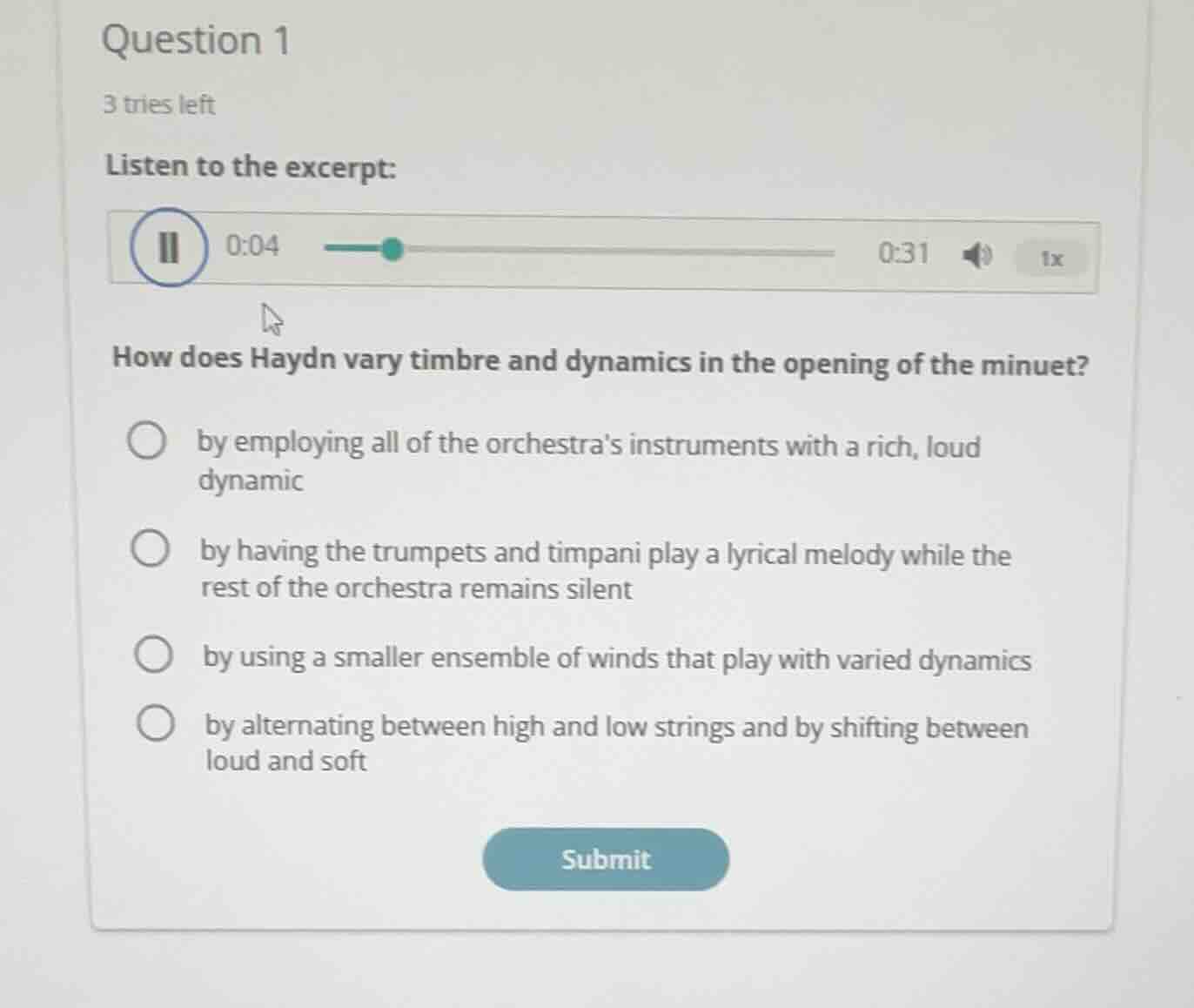
how does haydn vary timbre and dynamics in the opening of the minuet?
by employing all of the orchestras instruments with a rich, loud dynamic
by having the trumpets and timpani play a lyrical melody while the rest of the orchestra remains silent
by using a smaller ensemble of winds that play with varied dynamics
by alternating between high and low strings and by shifting between loud and soft
Identify the musical context
Using the Minuet and Trio Form and Haydn Symphony Structure knowledge points
The question asks how Franz Joseph Haydn varies timbre and dynamics in the opening of the minuet of a symphony (typically the third movement of his late symphonies, such as Symphony No. 102).
Analyze the stylistic features of Haydn's minuets
In the opening of his symphonic minuets, Haydn frequently employs sudden contrasts to surprise the listener. He achieves this by alternating the instrumentation (timbre) between the high strings (violins) and low strings (cellos/basses) and simultaneously shifting the volume (dynamics) between loud (forte) and soft (piano).
Evaluate the given multiple-choice options
- Option 1: "by employing all of the orchestra's instruments with a rich, loud dynamic" — This describes a uniform texture rather than variation.
- Option 2: "by having the trumpets and timpani play a lyrical melody..." — Trumpets and timpani in the Classical era were not used to play lyrical melodies alone while the orchestra remained silent.
- Option 3: "by using a smaller ensemble of winds..." — The opening of the minuet typically features the string section prominently rather than just a small wind ensemble.
- Option 4: "by alternating between high and low strings and by shifting between loud and soft" — This accurately describes Haydn's signature technique of varying timbre and dynamics through register and volume contrasts.

Snap & solve any problem in the app
Get step-by-step solutions on Sovi AI
Photo-based solutions with guided steps
Explore more problems and detailed explanations
- (A) by employing all of the orchestra's instruments with a rich, loud dynamic
- (B) by having the trumpets and timpani play a lyrical melody while the rest of the orchestra remains silent
- (C) by using a smaller ensemble of winds that play with varied dynamics
- (D) by alternating between high and low strings and by shifting between loud and soft (Correct answer)