QUESTION IMAGE
Question
question 5 of 5
select the correct answer from each drop - down menu.
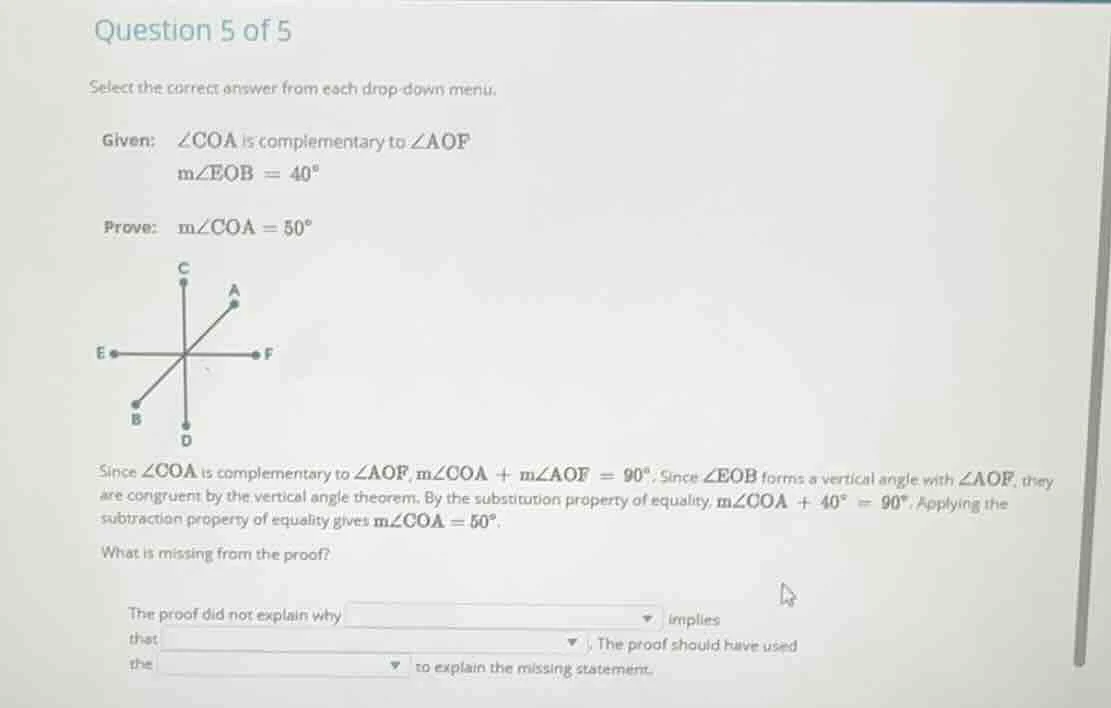
given: ∠coa is complementary to ∠aof
m∠eqb = 40°
prove: m∠coa = 50°
since ∠coa is complementary to ∠aof, m∠coa + m∠aof = 90°. since ∠eob forms a vertical angle with ∠aof, they are congruent by the vertical angle theorem. by the substitution property of equality, m∠coa + 40° = 90°. applying the subtraction property of equality gives m∠coa = 50°.
what is missing from the proof?
the proof did not explain why
implies
that
. the proof should have used
the
to explain the missing statement.
- First, we need to identify the gap in the proof: it states ∠EOB and ∠AOF are vertical angles but does not explicitly state their measures are equal, which is required for substitution.
- The first blank refers to the pair of angles: ∠EOB ≅ ∠AOF (vertical angles).
- The second blank is the consequence of that congruence: $m\angle EOB = m\angle AOF$.
- The third blank is the property that justifies congruent angles having equal measures: definition of congruent angles.

Snap & solve any problem in the app
Get step-by-step solutions on Sovi AI
Photo-based solutions with guided steps
Explore more problems and detailed explanations
The proof did not explain why ∠EOB ≅ ∠AOF implies that $m\angle EOB = m\angle AOF$. The proof should have used the definition of congruent angles to explain the missing statement.