QUESTION IMAGE
Question
question 4
5 pts
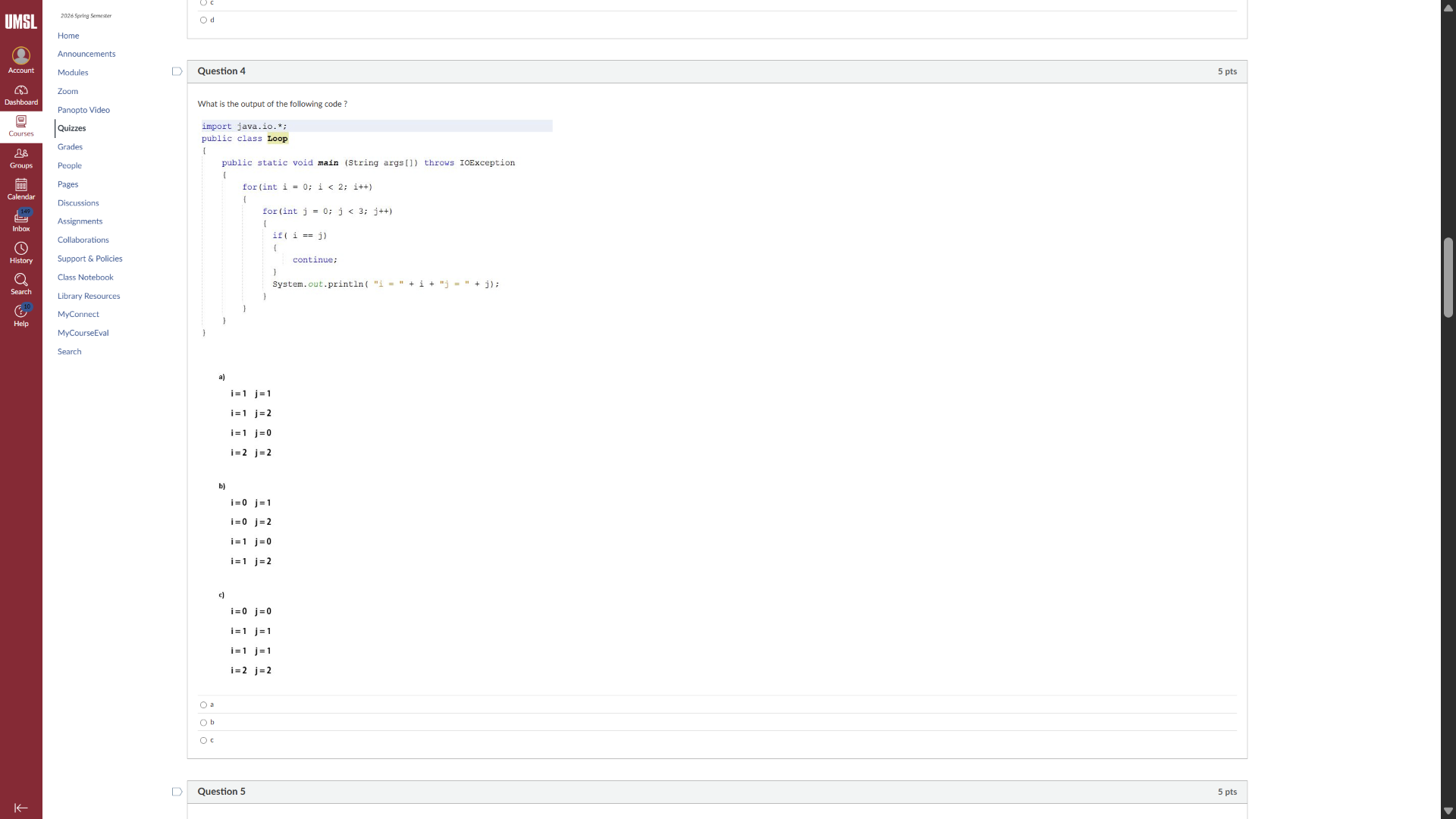
what is the output of the following code?
java
import java.io.*;
public class loop
{
public static void main (string args) throws ioexception
{
for(int i = 0; i < 2; i++)
{
for(int j = 0; j < 3; j++)
{
if(i == j)
{
continue;
}
system.out.println(\i = \ + i + \ j = \ + j);
}
}
}
}
a)
i=1 j=1
i=1 j=2
i=1 j=0
i=2 j=2
b)
i=0 j=1
i=0 j=2
i=1 j=0
i=1 j=2
c)
i=0 j=0
i=1 j=1
i=1 j=1
i=2 j=2
o a
o b
o c
🆕 New Concept Discovered: Nested Loops with Control Statements
How loops inside loops behave when using control statements like continue.
Step 1: Understand the Loop Structures
The code contains a nested loop structure:
- Outer loop:
for(int i = 0; i < 2; i++)runs for \( i = 0 \) and \( i = 1 \). - Inner loop:
for(int j = 0; j < 3; j++)runs for \( j = 0 \), \( j = 1 \), and \( j = 2 \) during each iteration of the outer loop.
Inside the inner loop, there is a conditional check:
if (i == j) {
    continue;
}
The continue statement immediately skips the rest of the current iteration of the inner loop and moves to the next update expression (j++).
---
Step 2: Trace the Execution for \( i = 0 \)
When the outer loop starts, \( i = 0 \). We enter the inner loop:
- \( j = 0 \):
- Check condition: \( i == j \) \(
ightarrow\) \( 0 == 0 \) is true.
- Action: The
continuestatement executes. The print statement is skipped. - \( j = 1 \):
- Check condition: \( i == j \) \(
ightarrow\) \( 0 == 1 \) is false.
- Action: The print statement executes:
i = 0 j = 1
- \( j = 2 \):
- Check condition: \( i == j \) \(
ightarrow\) \( 0 == 2 \) is false.
- Action: The print statement executes:
i = 0 j = 2
---
Step 3: Trace the Execution for \( i = 1 \)
The outer loop increments to \( i = 1 \). We enter the inner loop again:
- \( j = 0 \):
- Check condition: \( i == j \) \(
ightarrow\) \( 1 == 0 \) is false.
- Action: The print statement executes:
i = 1 j = 0
- \( j = 1 \):
- Check condition: \( i == j \) \(
ightarrow\) \( 1 == 1 \) is true.
- Action: The
continuestatement executes. The print statement is skipped. - \( j = 2 \):
- Check condition: \( i == j \) \(
ightarrow\) \( 1 == 2 \) is false.
- Action: The print statement executes:
i = 1 j = 2
---
Step 4: Compare with Given Options
Let's compile the printed lines in order:
i = 0 j = 1
i = 0 j = 2
i = 1 j = 0
i = 1 j = 2
This matches option b exactly.

Snap & solve any problem in the app
Get step-by-step solutions on Sovi AI
Photo-based solutions with guided steps
Explore more problems and detailed explanations
b