QUESTION IMAGE
Question
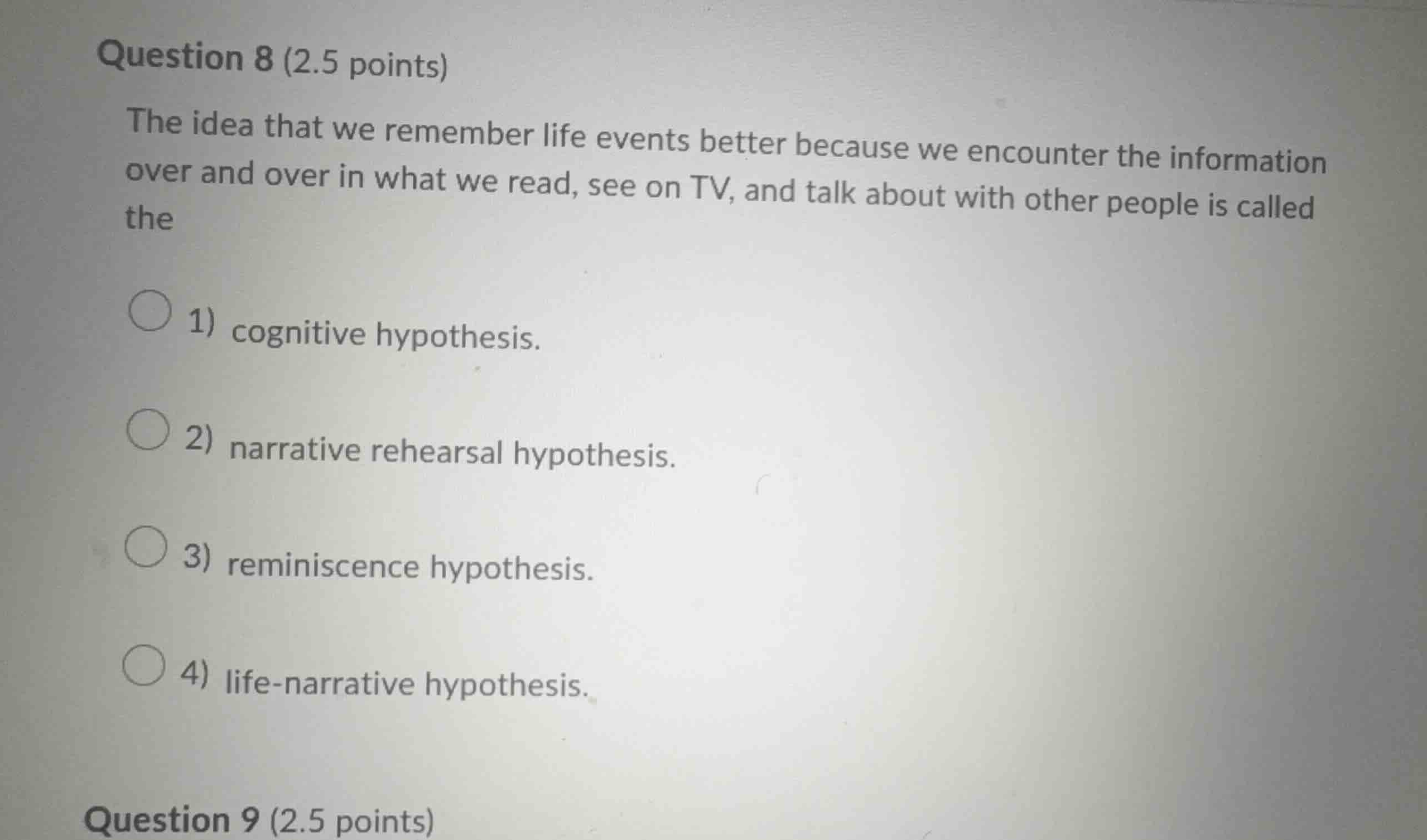
question 8 (2.5 points)
the idea that we remember life events better because we encounter the information over and over in what we read, see on tv, and talk about with other people is called the
- cognitive hypothesis.
- narrative rehearsal hypothesis.
- reminiscence hypothesis.
- life-narrative hypothesis.
question 9 (2.5 points)
🆕 New Concept Discovered: Narrative Rehearsal Hypothesis
Memory reinforcement through repeated exposure and storytelling.
Step 1: Analyze the question prompt
The prompt describes a phenomenon where we remember significant life events (often public or autobiographical events, such as flashbulb memories) better because we repeatedly encounter information about them. This exposure happens through media (reading, TV) and social interactions (talking with others).
Step 2: Evaluate the options
- 1) Cognitive hypothesis: This hypothesis suggests that periods of rapid change followed by stability cause stronger memory encoding (often used to explain the reminiscence bump). It does not focus on media and social rehearsal.
- 2) Narrative rehearsal hypothesis: Proposed by cognitive psychologist Ulric Neisser, this hypothesis states that we remember certain events very well not because of a special encoding mechanism at the time of the event, but because we constantly rehearse them after they happen (by talking about them, seeing them on TV, and reading about them). This matches the prompt perfectly.
- 3) Reminiscence hypothesis: This generally refers to the tendency for older adults to have increased recollection for events that occurred during their adolescence and early adulthood (the reminiscence bump).
- 4) Life-narrative hypothesis: This is closely related to the self-image hypothesis, suggesting that memory is enhanced for events that occur while a person's life identity is being formed.
Step 3: Select the correct match
The definition provided in the question directly describes the narrative rehearsal hypothesis.

Snap & solve any problem in the app
Get step-by-step solutions on Sovi AI
Photo-based solutions with guided steps
Explore more problems and detailed explanations
- narrative rehearsal hypothesis.