QUESTION IMAGE
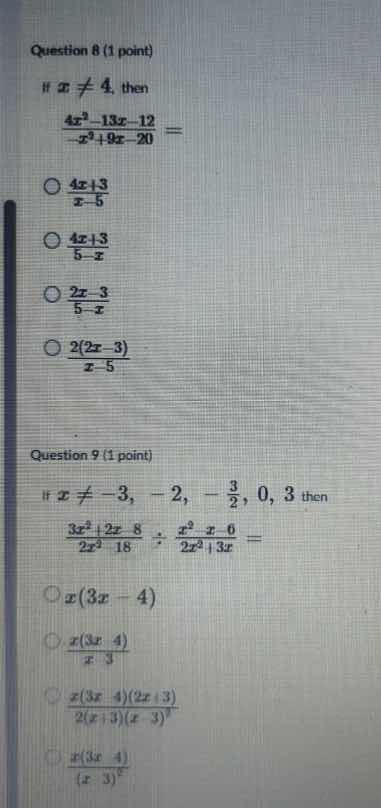
Question
question 8 (1 point)
if \\(x \
eq 4\\), then
\\\frac{4x^2 - 13x - 12}{-x^2 + 9x - 20} =\\
\\(\bigcirc \frac{4x + 3}{x - 5}\\)
\\(\bigcirc \frac{4x + 3}{5 - x}\\)
\\(\bigcirc \frac{2x - 3}{5 - x}\\)
\\(\bigcirc \frac{2(2x - 3)}{x - 5}\\)
question 9 (1 point)
if \\(x \
eq -3, -2, -\frac{3}{2}, 0, 3\\) then
\\\frac{3x^2 + 2x - 8}{2x^2 - 18} \div \frac{x^2 - x - 6}{2x^2 + 3x} =\\
\\(\bigcirc x(3x - 4)\\)
\\(\bigcirc \frac{x(3x - 4)}{x - 3}\\)
\\(\bigcirc \frac{x(3x - 4)(2x + 3)}{2(x + 3)(x - 3)^2}\\)
\\(\bigcirc \frac{x(3x - 4)}{(x - 3)^2}\\)
Factor the numerator and denominator of Question 8
We factor the quadratic expressions in the numerator and denominator.
For the numerator:
For the denominator:
Simplify the expression for Question 8
We substitute the factored forms back into the rational expression.
Given \(x
eq 4\), we can cancel the common factor \((x - 4)\):
This matches the second option.
Factor all components of Question 9
We factor each polynomial in the division problem.
First term numerator:
First term denominator:
Second term numerator:
Second term denominator:
Simplify the division in Question 9
We rewrite the division as multiplication by the reciprocal.
Given the domain restrictions, we cancel the common factor \((x + 2)\):
This matches the third option.

Snap & solve any problem in the app
Get step-by-step solutions on Sovi AI
Photo-based solutions with guided steps
Explore more problems and detailed explanations
Question 8
- (A) \(\frac{4x+3}{x-5}\)
- (B) \(\frac{4x+3}{5-x}\) (Correct answer)
- (C) \(\frac{2x-3}{5-x}\)
- (D) \(\frac{2(2x-3)}{x-5}\)
Question 9
- (A) \(x(3x-4)\)
- (B) \(\frac{x(3x-4)}{x-3}\)
- (C) \(\frac{x(3x-4)(2x+3)}{2(x+3)(x-3)^2}\) (Correct answer)
- (D) \(\frac{x(3x-4)}{(x-3)^2}\)