QUESTION IMAGE
Question
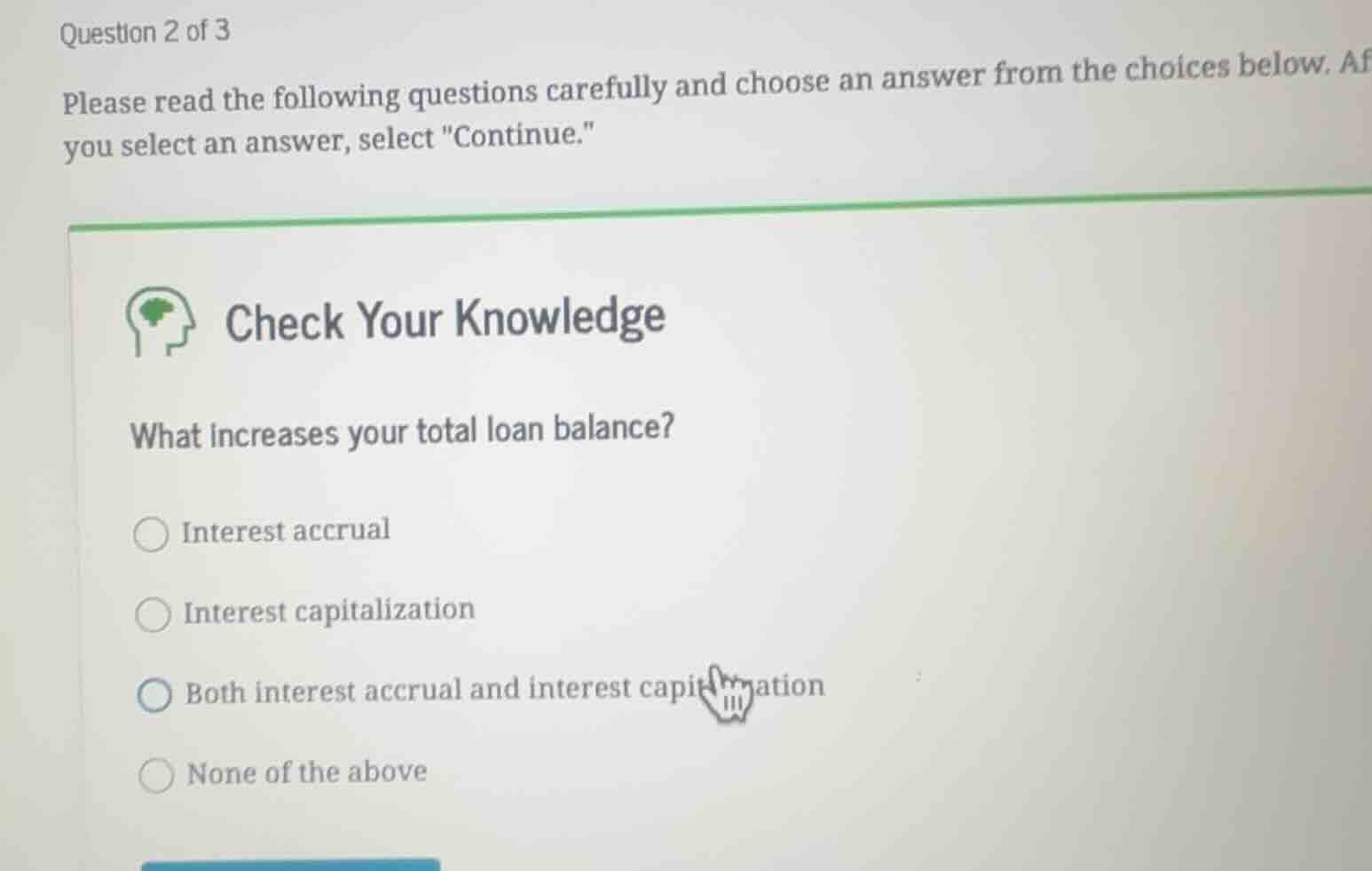
question 2 of 3
please read the following questions carefully and choose an answer from the choices below. after you select an answer, select \continue.\
check your knowledge
what increases your total loan balance?
- interest accrual
- interest capitalization
- both interest accrual and interest capitalization
- none of the above
<pre_analysis>
{
"quality": "clear",
"question_count": 1,
"skills_matched": [
"direct_cot",
"multiple_choice_formatter",
"explain_then_answer",
"tutor"
],
"needs_drawing": false,
"concepts_used": [
"Federal Student Loans",
"Student Loan Repayment"
],
"new_concepts": [
"Interest Accrual",
"Interest Capitalization"
],
"current_concepts": [
"Federal Student Loans",
"Student Loan Repayment",
"Interest Accrual",
"Interest Capitalization"
]
}
</pre_analysis>
<reasoning>
Define interest accrual
Interest accrual is the accumulation of unpaid interest over time. This accrued interest is added to the overall amount you owe, increasing your total outstanding balance.
Define interest capitalization
Interest capitalization occurs when unpaid accrued interest is added directly to the principal balance of your loan. Future interest then calculates based on this new, higher principal amount, which increases the total loan balance.
Compare the options
Since both interest accrual (the ongoing accumulation of interest) and interest capitalization (adding that interest to the principal) increase the total amount you owe on your loan, both processes increase your total loan balance.
Select the correct choice
Because both individual processes increase the total balance, the option "Both interest accrual and interest capitalization" is the correct choice.
</reasoning>
<answer>
<mcq-option>Interest accrual</mcq-option>
<mcq-option>Interest capitalization</mcq-option>
<mcq-correct>Both interest accrual and interest capitalization</mcq-correct>
<mcq-option>None of the above</mcq-option>
</answer>
<post_analysis>
{
"subject": "Business",
"question_type": "Multiple Choice",
"knowledge_point": [
"Business",
"Finance",
"Student Loans"
]
}
</post_analysis>
Snap & solve any problem in the app
Get step-by-step solutions on Sovi AI
Photo-based solutions with guided steps
Explore more problems and detailed explanations
<pre_analysis>
{
"quality": "clear",
"question_count": 1,
"skills_matched": [
"direct_cot",
"multiple_choice_formatter",
"explain_then_answer",
"tutor"
],
"needs_drawing": false,
"concepts_used": [
"Federal Student Loans",
"Student Loan Repayment"
],
"new_concepts": [
"Interest Accrual",
"Interest Capitalization"
],
"current_concepts": [
"Federal Student Loans",
"Student Loan Repayment",
"Interest Accrual",
"Interest Capitalization"
]
}
</pre_analysis>
<reasoning>
Define interest accrual
Interest accrual is the accumulation of unpaid interest over time. This accrued interest is added to the overall amount you owe, increasing your total outstanding balance.
Define interest capitalization
Interest capitalization occurs when unpaid accrued interest is added directly to the principal balance of your loan. Future interest then calculates based on this new, higher principal amount, which increases the total loan balance.
Compare the options
Since both interest accrual (the ongoing accumulation of interest) and interest capitalization (adding that interest to the principal) increase the total amount you owe on your loan, both processes increase your total loan balance.
Select the correct choice
Because both individual processes increase the total balance, the option "Both interest accrual and interest capitalization" is the correct choice.
</reasoning>
<answer>
<mcq-option>Interest accrual</mcq-option>
<mcq-option>Interest capitalization</mcq-option>
<mcq-correct>Both interest accrual and interest capitalization</mcq-correct>
<mcq-option>None of the above</mcq-option>
</answer>
<post_analysis>
{
"subject": "Business",
"question_type": "Multiple Choice",
"knowledge_point": [
"Business",
"Finance",
"Student Loans"
]
}
</post_analysis>